
 +86-574-5680 8878


TL;DR
- We choose an above-ground pool robot when the cleaning surface stays near 50 m² (540 ft²), the water depth is within 10 ft (3 m), and floor cleaning is the main job.
- We choose an inground pool robot when you need 120–200 m² (1,300–2,150 ft²) coverage, wall or waterline cleaning, longer runtime, and stronger debris handling.
- Our AquaJack 600 is listed for above-ground floor cleaning, while the AquaJack 700 and AquaJack 800 examples show how inground specifications scale to 120 minutes or 240 minutes of runtime.
- We use NSF/ANSI/CAN 50, ENERGY STAR pump data, and DOE pool-pump-motor rules as guardrails, but we still verify GS, CB, CE, cETLus, FCC, and UN 38.3 evidence for the exact SKU.
- Poolstar does not publish a first-party percentage cost premium between these robot classes, so this article compares engineering and operating differences rather than inventing price data.
We choose an above-ground pool robot when we need compact floor cleaning for a smaller, usually shallower pool; we choose an inground pool robot when the machine must cover more area, climb walls, hold a larger filter, and run longer per charge. In our robots for every pool type range, the split is not about “cheap” versus “premium” labels. We match cleaning area, water depth, debris load, runtime, filter capacity, and compliance documents to the pool. Our AquaJack 600 above-ground robot is listed at 50 m² (540 ft²), 60 minutes of runtime, 60 L/min suction, and a 2 L filter. Larger inground examples rise to 120 m² (1,300 ft²) or 200 m², 120–240 minutes of runtime, and 100–296 L/min suction. We treat that specification gap as the real selection matrix.
I have spent more than a decade in pool-industry marketing, channel development, and product launches, including OEM and ODM pool-equipment programs across Europe, the Americas, and Asia-Pacific. I start with pool geometry, then check written specifications and the above-ground robot showcase.
What is the practical difference between above-ground and inground pool robots?
An above-ground pool robot is usually a floor cleaner for a smaller, lighter structure; an inground pool robot is usually a higher-capacity cleaner designed for larger basins, wall contact, and longer duty cycles. We care about this distinction because the pool shell changes what the cleaner must do. We see many above-ground pools as seasonal residential assets with smaller footprints and limited wall-climbing needs. We see many inground pools with steps, slopes, tile lines, deeper water, and more debris-trapping surfaces.
Direct answer: Because above-ground pools often prioritize compact floor coverage, a 16 in diameter robot with a 60-minute cycle can be sufficient. So buyers should not automatically pay for wall-climbing hardware they may never use.
For export buyers, the better question is “Which robot fails later in my customer’s pool?” An undersized model will reposition, clog, and recharge more often; an oversized model may be harder to lift and store.
How does cleaning area change the motor, battery, and filter sizing?
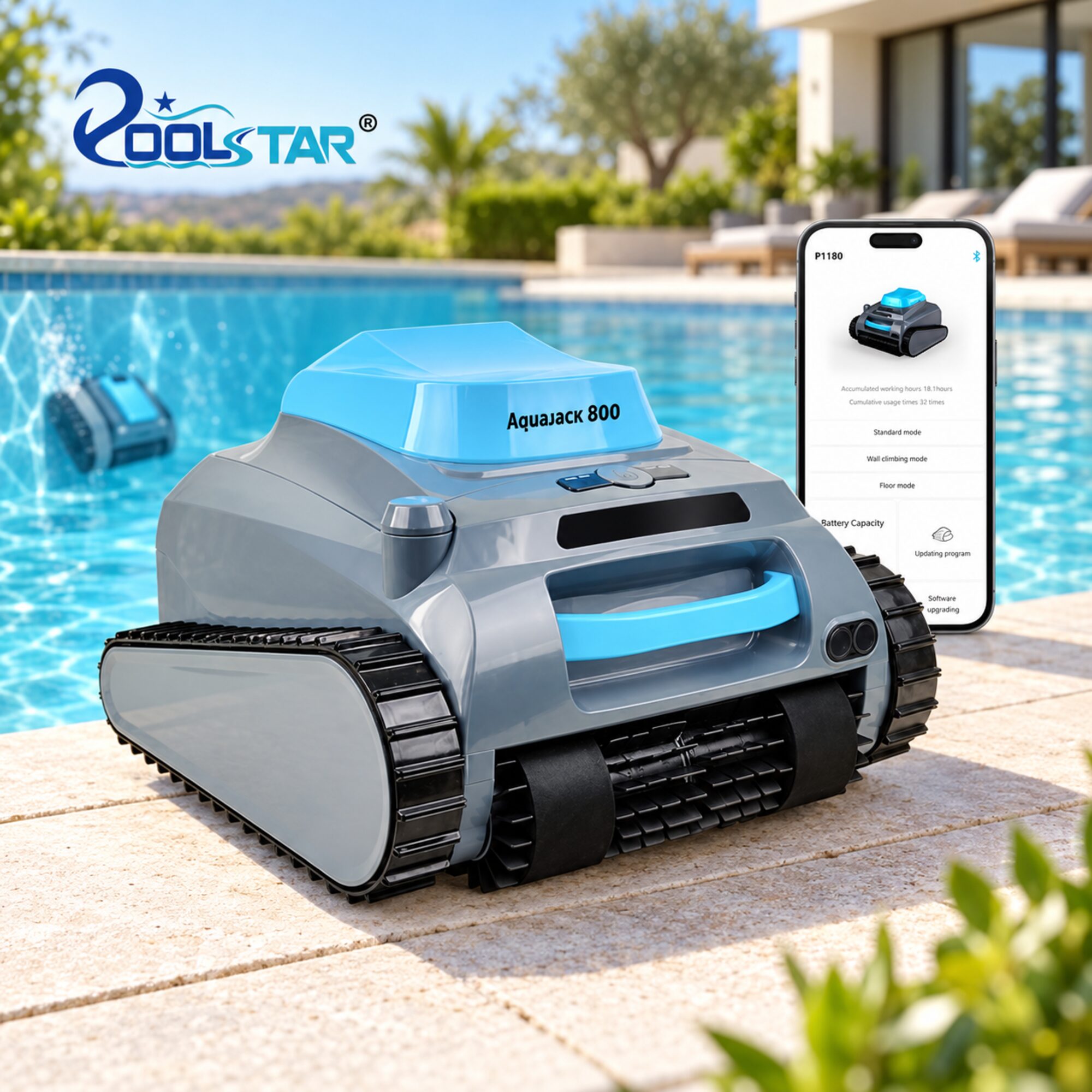
We use cleaning area to size runtime, suction, and filter volume. Poolstar’s AquaJack 600 is listed for a cleaning surface up to 50 m² (540 ft²), with a 27 W brushless motor, 7.4 V / 4000 mAh battery, 60 L/min suction, and a 2 L filter. The AquaJack 700 moves to 120 m² (1,300 ft²), a 51 W motor, 7.4 V / 13000 mAh battery, 100 L/min (26.4 gal/min) suction, and a 3 L filter. The AquaJack 800 covers up to 200 m², with 5200 GPH water flow, 296 L/min (78.2 gal/min) suction, a 4 L filter basket, and 70 μm + 150 μm dual filtration.
Direct answer: Because a 200 m² pool can hold more than three times the floor area of a 50 m² pool, an inground robot needs more battery energy, stronger water flow, and a larger debris chamber. Therefore the AquaJack 800 is closer to a multisurface work tool than a compact floor vacuum.
I advise distributors to treat cleaning area as a ceiling. If the pool has steps, heavy leaf fall, or a busy commercial schedule, the safer choice is the next class up.
Direct answer: A larger filter delays clogging. A 4 L basket gives an operator more time between cleanouts than a 2 L chamber, especially when the pool receives leaves, sand, or fine sediment after storms.
Which pool surfaces and debris loads should change your choice?
We treat floor-only above-ground cleaning as different from floor, wall, and waterline cleaning. The AquaJack 600 is presented as an above-ground floor cleaner. The AquaJack 800 is presented for floor, wall, and waterline cleaning, with three modes and Bluetooth app control. That surface difference changes brush design, traction, steering logic, and how the robot behaves near the waterline.
Direct answer: Because inground pools often include vertical surfaces and a waterline where oils and dust collect, wall-capable robots need stronger traction and controlled steering. So a floor-only unit is usually the better value only when the pool truly does not need wall cleaning.
Debris type matters as much as volume. Fine dust favors finer filtration, leaves favor a larger basket, and sand favors strong suction. The AquaJack 800’s 70 μm + 150 μm dual filtration separates fine and large particles instead of forcing one mesh to do every job.
When I review a new SKU, I ask engineering for debris test conditions. “Handles tough debris” is not a specification; “4 L filter, 296 L/min suction, and dual filtration” is.
Runtime and charging: what should a buyer compare beyond minutes?
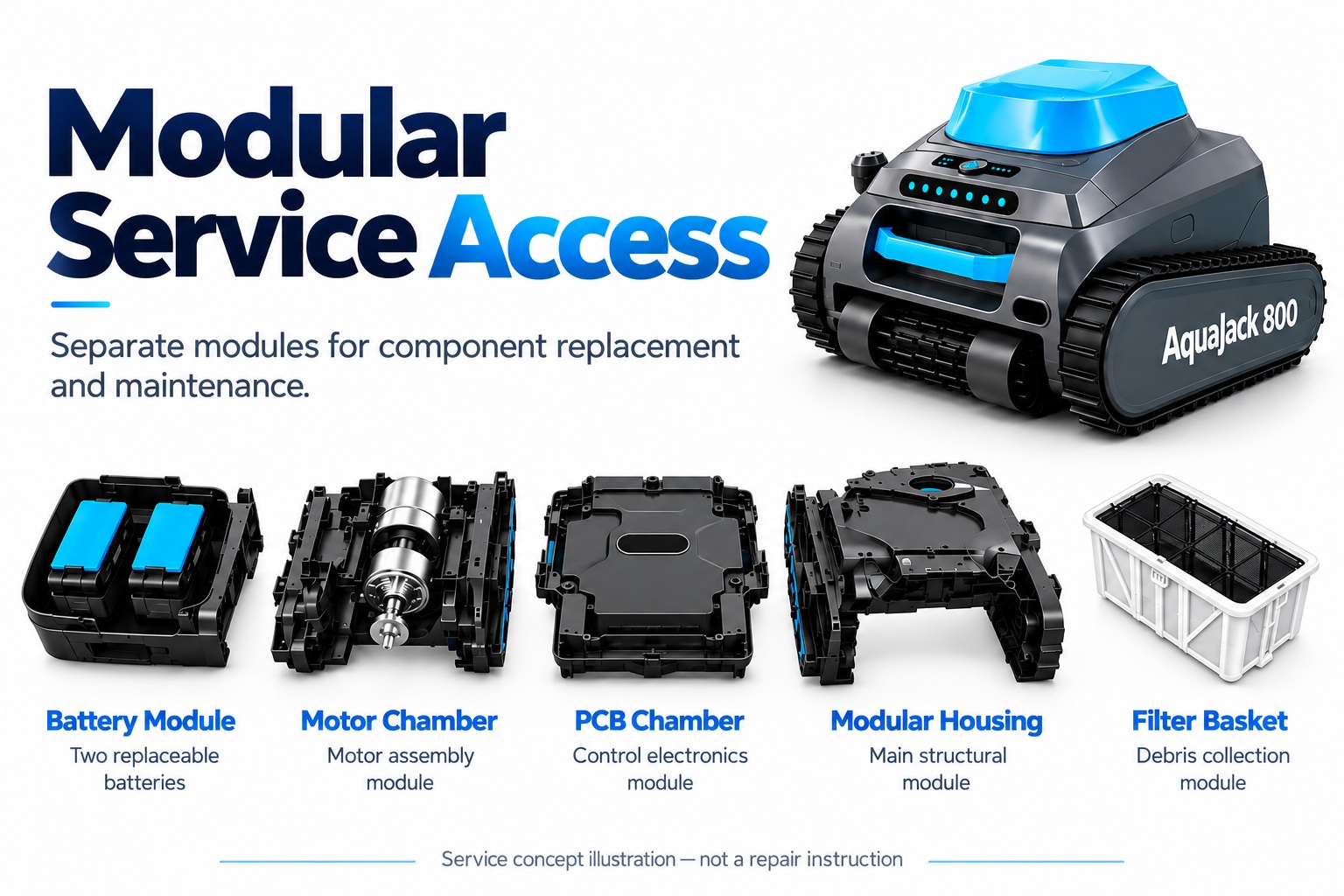
We read runtime together with battery voltage, capacity, charging time, and whether the robot returns near the pool edge. The AquaJack 600 lists up to 60 minutes of runtime and 3–4 hours of charging. The AquaJack 700 lists up to 120 minutes and 6 hours of charging. The AquaJack 800 lists 120 minutes with one battery or 240 minutes with two batteries, with 2 hours of charging and modular battery access.
Direct answer: Because battery capacity determines how long the cleaner can maintain useful suction, runtime is not just a convenience number. Therefore two 120-minute modules can be more useful than one fixed battery when a pool must be cleaned in separate zones.
Low-power return matters because a cleaner that stops far from the edge is harder to retrieve. Poolstar lists automatic steering and low-power return for the AquaJack 700, while the AquaJack 800 adds modular battery access.
Direct answer: For commercial operators, 120 minutes of usable runtime is a scheduling tool. It can let staff clean before opening, split a large basin into zones, or return the robot to a service point without entering the water.
Runtime varies with pool resistance, debris load, temperature, and filter condition, so the specification is a tested ceiling.
Compliance and safety signals: which certifications matter for export buyers?
We match certification evidence to the destination market and the exact product SKU. Poolstar lists GS, CB, CE (LVD+EMC), NRCan, DOE, CEC, FCC, and UN 38.3 for the AquaJack 600, and GS, CB, CE (LVD+EMC), RoHS, cETLus, FCC, UN 38.3, and transport documentation for the AquaJack 700. We use these documents for market access, electrical safety, electromagnetic compatibility, battery transport, and retailer onboarding.
Direct answer: Because export compliance is market-specific, we do not treat “CE” as a universal answer. So a buyer should request the certificate number, test report, and model-name match before approving a purchase order.
According to GOV.UK, UKCA and CE markings demonstrate that the manufacturer believes the product meets the relevant product requirements, and businesses must complete conformity assessment, technical documentation, marking, and record retention steps for Great Britain. We use that guidance to remind buyers that a mark is one visible signal, while the supporting file still needs model-specific evidence.
Direct answer: A certification claim is useful only when the certificate matches the factory, model, voltage, battery configuration, and destination market.
Choose the robot by scenario, not by habit
The cleanest method is to write the pool scenario first and the model name second. A compact seasonal above-ground pool points to the AquaJack 600 class. A larger serviced inground pool points to the AquaJack 700 class. A hotel, aquatic center, or large complex with walls and waterline cleaning points to the AquaJack 800 class.
Direct answer: Because pool geometry determines failure risk, scenario matching is more reliable than brand habit. Therefore we size the robot to the basin, debris, service window, and retrieval path.
According to ENERGY STAR, certified inground pool pumps use at least 20% less energy than standard models, certified above-ground pool pumps use at least 11% less energy, and halving pump speed can reduce energy use to one-eighth. Those are pump benchmarks, not robotic-cleaner benchmarks, so I do not transfer them to a robot without a direct test.
According to a U.S. Department of Energy final rule, DOE incorporated UL 1004-10:2022 for dedicated-purpose pool pump motors. It concerns pump motors rather than robotic pool cleaners, so I treat it as a related electrical-safety and efficiency signal, not as cleaner certification.
Direct answer: External standards are guardrails, not substitutes for the robot’s own test reports. A buyer still needs the cleaner’s IP rating, battery transport file, electrical certificates, and user-manual checks.
How much should “more capability” cost in relative terms?
Poolstar does not publish a first-party percentage cost premium between the cited AquaJack models, and I will not invent one. The defensible comparison is that added capability brings larger batteries, more powerful motors, larger filters, wall-cleaning hardware, app control, and more certification work. Those are cost drivers even when a distributor’s final quotation changes with order volume, destination, packaging, and service terms.
Direct answer: A larger robot may cost more in relative procurement terms because it carries more battery capacity, stronger pumping hardware, and a larger filter basket. So the buyer should justify the step-up through pool area, surface coverage, and service schedule—not through a generic “premium” label.
Channel partners can protect margin without overstating value by comparing purchase conditions, spare-parts access, warranty handling, filter and battery availability, and freight efficiency. A modular battery and motor design may be easier to service even if the first quotation is not the lowest.
Our AquaJack selection matrix
The matrix below is a working procurement screen for distributors. It is not a replacement for the final specification sheet, but it prevents the common mismatch of selling a compact above-ground unit into a large inground application.
| Selection dimension | AquaJack 600 | AquaJack 700 | AquaJack 800 |
|---|---|---|---|
| Primary use case | Above-ground pool floor cleaning | Inground pool cleaning | Floor, wall, and waterline cleaning |
| Cleaning surface | Up to 50 m² / 540 ft² | Up to 120 m² / 1,300 ft² | Up to 200 m² |
| Runtime | Up to 60 min | Up to 120 min | 120 min single battery / 240 min dual battery |
| Suction / flow | 60 L/min | 100 L/min / 26.4 gal/min | 5,200 GPH / 296 L/min / 78.2 gal/min |
| Filter capacity | 2 L | 3 L | 4 L basket with 70 μm + 150 μm filtration |
| Power and battery | 27 W brushless; 7.4 V / 4000 mAh | 51 W; 7.4 V / 13000 mAh | 50 W; 22.2 V / 4400 mAh modular battery system |
| Depth and protection | Up to 10 ft / 3 m; IPX8 | Up to 10 ft / 3 m; IPX8 | IPX8 |
| Control and navigation | Out-of-water stop | Automatic steering and low-power return near pool edge | Bluetooth app control; surface, wall, and floor modes |
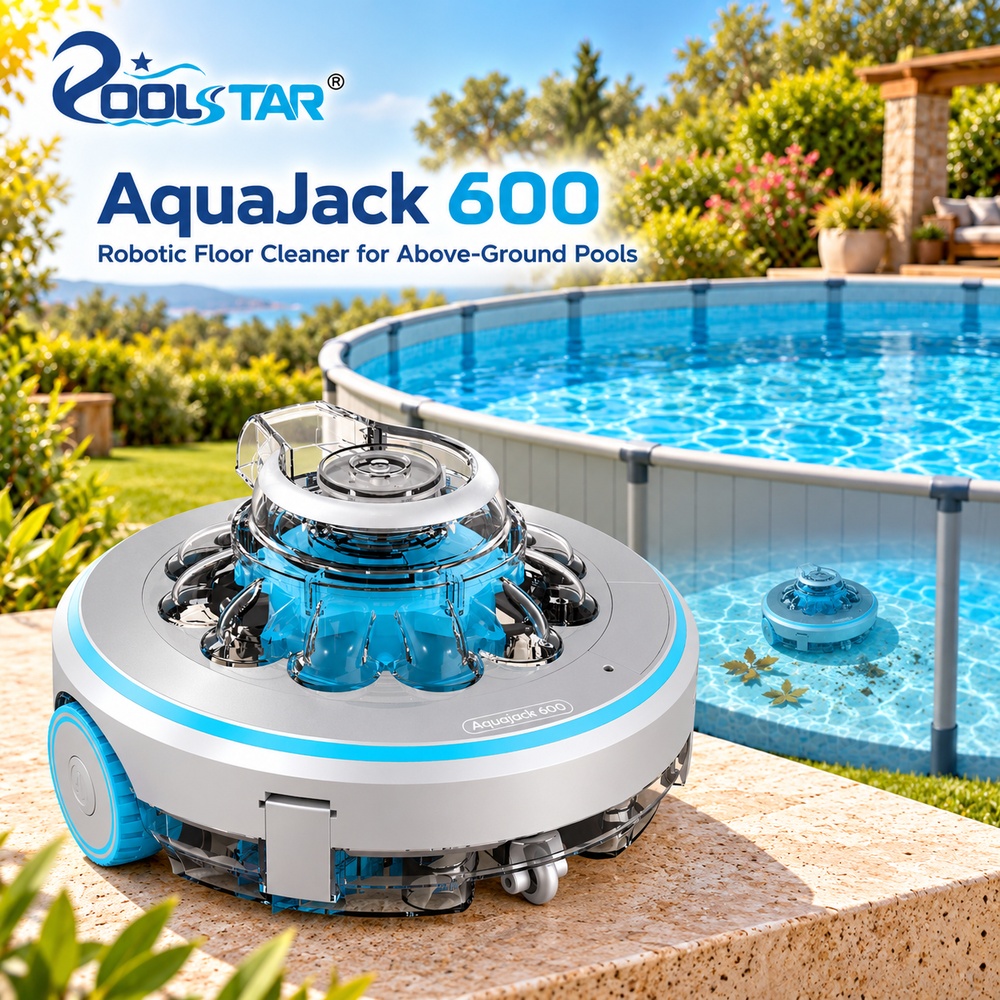
Choose an above-ground robot when: the pool is compact, the water depth stays within 10 ft (3 m), wall cleaning is not required, and a 60-minute floor-cleaning cycle fits the service routine.
Choose an inground robot when: the basin is larger, the operator needs 120 minutes or more of runtime, debris volume is high, or wall and waterline cleaning is part of the job.
Do not recommend the larger class when: the pool is a small seasonal above-ground unit, the end user has limited storage or lifting capacity, and the extra runtime would not change the cleaning result.
FAQ
Can I use an above-ground pool robot in an inground pool?
You should do so only when the inground pool matches the robot’s stated limits for area, depth, debris, and surface coverage. The AquaJack 600 is listed for above-ground pool floor cleaning up to 50 m² (540 ft²) and 10 ft (3 m) depth, so it is not the first choice for a large inground basin or wall cleaning.
Is a wall-climbing robot always better?
No. A wall-climbing robot is better only when the pool has walls or a waterline that need cleaning. For a simple above-ground pool where the buyer mainly needs floor cleaning, wall hardware can add cost and complexity without improving the visible result.
What specification matters most for a commercial pool?
Runtime, filter capacity, suction, retrieval behavior, and service access usually matter more than a single headline feature. A robot rated for 120 minutes or 240 minutes can support scheduled cleaning, but only if the filter and suction path can handle the debris load.
Which certifications should I request before placing an order?
Request the certificates that match the destination market and exact model. Depending on the SKU and market, Poolstar lists GS, CB, CE (LVD+EMC), RoHS, cETLus, FCC, UN 38.3, and transport documentation, while North American public-pool equipment discussions may also reference NSF/ANSI/CAN 50.
Why does Poolstar avoid a fixed cost percentage in this comparison?
Because the cited Poolstar product pages do not publish a first-party cost percentage between these robot classes, a fixed percentage would be invented. We compare cost drivers such as battery capacity, motor power, filter volume, control features, certification work, and service design instead.
How do I choose between the AquaJack 700 and AquaJack 800?
Choose the AquaJack 700 class when 120 m² (1,300 ft²) coverage and 120 minutes of runtime fit the pool. Choose the AquaJack 800 class when you need up to 200 m² coverage, 5,200 GPH water flow, a 4 L basket, dual filtration, app control, or floor, wall, and waterline modes.
If you are sourcing robotic pool cleaners for a distributor, retailer, hotel, or service fleet, send us the pool type, cleaning area, debris load, and destination market. We will map the application to the right AquaJack specification and compliance file.
Contact Poolstar