
 +86-574-5680 8878


0102030405
Aquajack 800 FAQ: Pool Size, Runtime, Cleaning Modes, App Control and Maintenance
2026-09-06
Aquajack 800 FAQ: Pool Size, Runtime, Cleaning Modes, App Control and Maintenance
Choosing a cordless robotic pool cleaner involves more than comparing battery runtime or suction power.
Pool owners want to know whether the robot is suitable for their pool, while distributors need clear information about performance, maintenance, spare parts and different market configurations.
This Aquajack 800 FAQ answers the most common questions about:
-
Suitable pool types
-
Pool size and cleaning coverage
-
Floor, wall and waterline cleaning
-
Battery runtime and charging
-
App-assisted operation
-
Debris collection and filtration
-
Maintenance and storage
-
OEM/ODM and distributor support
1. What Is Aquajack 800?
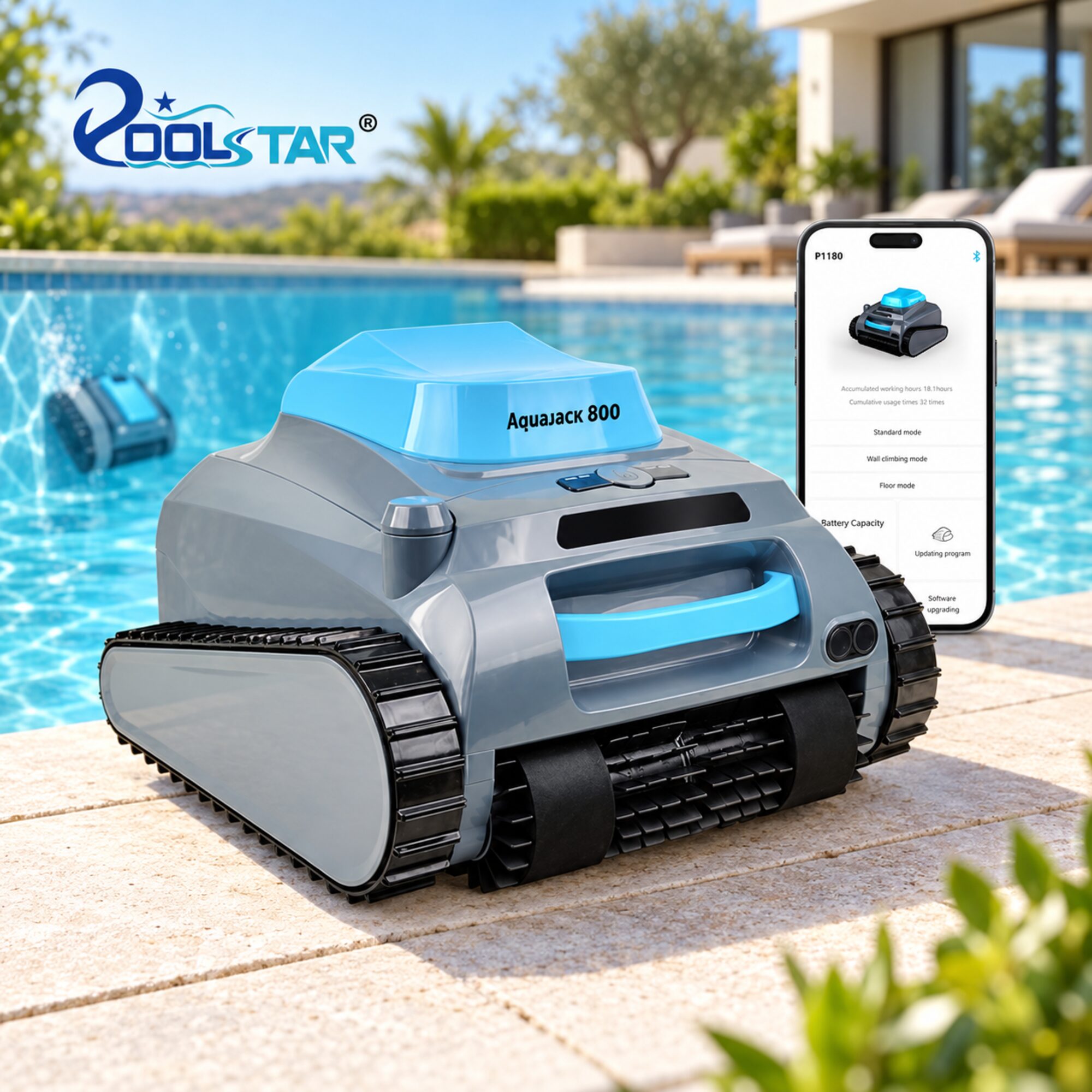
Aquajack 800 is a cordless robotic pool cleaner designed to clean pool floors, walls and the waterline.
Unlike suction-side or pressure-side pool cleaners, it does not need to be connected to the pool pump with a hose. It also operates without a floating electrical cable during cleaning.
Aquajack 800 combines:
-
Cordless operation
-
Floor cleaning
-
Wall climbing
-
Waterline cleaning
-
Selectable cleaning modes
-
Water flow of up to 296 L/min
-
Approximately 4 L of filter capacity
-
App-assisted settings
-
Different battery configurations for different market requirements
It is primarily positioned for residential inground pools and for distributors seeking a full-pool cordless cleaning solution.
2. What Pool Size Is Aquajack 800 Suitable For?
Aquajack 800 is designed for medium and large residential pools, but suitability should be determined by total cleaning area rather than pool length alone.
A robot cleaning only the pool floor travels a smaller area than a robot cleaning the floor, four walls and the waterline.
Before selecting a configuration, buyers should consider:
-
Pool length and width
-
Pool depth
-
Total floor and wall surface area
-
Required cleaning mode
-
Amount of debris
-
Pool shape
-
Battery configuration
Poolstar should confirm the recommended maximum coverage for the specific Aquajack 800 version supplied to each market.
3. Is Aquajack 800 Suitable for Large Pools?
Yes, Aquajack 800 is intended for demanding residential pool cleaning, including larger inground pools.
However, “large pool” does not have the same meaning in every market.
In the United States and Australia, residential pools may be described by length or gallons. In Europe and Latin America, pool size is more frequently expressed in metres or square metres.
For accurate product selection, distributors should compare the robot’s effective cleaning coverage with the complete pool surface area.
The expected cleaning mode must also be considered. A full floor, wall and waterline cycle normally requires more operating time than floor-only cleaning.
4. Can Aquajack 800 Clean the Pool Floor?
Yes. Pool-floor cleaning is one of the primary functions of Aquajack 800.
The robot moves across the bottom of the pool and collects common settled debris such as:
-
Leaves
-
Sand
-
Insects
-
Dust
-
Pollen
-
Small plant material
-
Loose dirt
Actual debris collection depends on the size of the debris, filter condition, suction opening, route coverage and pool surface.
Large branches, stones, toys and other oversized objects should be removed before starting the robot.
5. Can Aquajack 800 Climb Pool Walls?
Yes. Aquajack 800 is designed as a wall-climbing robotic pool cleaner.
Wall climbing requires the robot to maintain traction and stable surface contact while transitioning from the horizontal pool floor to a vertical wall.
Performance can be influenced by:
-
Pool surface texture
-
Wall angle
-
Floor-to-wall transition
-
Brush and track condition
-
Water flow
-
Filter cleanliness
-
Pool geometry
Distributors should test wall-climbing performance on the pool finishes commonly used in their local market.
6. Can Aquajack 800 Clean the Waterline?
Yes. Aquajack 800 is designed to reach and clean the waterline.
The waterline can collect:
-
Sunscreen
-
Body oils
-
Pollen
-
Dust
-
Floating contaminants
-
Light organic deposits
A waterline-capable robot must climb the wall and maintain controlled contact near the surface.
Waterline performance may vary according to the pool finish, wall shape and operating conditions. Heavy or hardened deposits may still require manual treatment.
7. Does Aquajack 800 Clean the Water Surface?
Aquajack 800 should not be described as a solar surface-skimming robot.
Its primary functions are cleaning the pool floor, walls and waterline. Floating leaves and insects should be removed by a pool skimmer or a dedicated robotic pool skimmer.
This distinction is important because “waterline cleaning” and “water-surface skimming” are different functions:
-
Waterline cleaning removes deposits around the upper pool wall.
-
Surface skimming collects floating debris from the top of the water.
Poolstar’s Aquajack 900 is positioned as a robotic pool skimmer for collecting floating surface debris.
8. Is Aquajack 800 Suitable for Inground Pools?
Yes. Aquajack 800 is primarily designed for residential inground pool cleaning.
Before purchase, users should confirm:
-
Pool dimensions
-
Pool surface
-
Wall-to-floor transition
-
Steps and ledges
-
Raised drains
-
Required cleaning coverage
-
Selected battery configuration
Unusual pool shapes or very sharp wall transitions should be tested before broad compatibility claims are made.
9. Can Aquajack 800 Be Used in Above-Ground Pools?
It depends on the construction and surface of the above-ground pool.
Some rigid above-ground pools may be suitable for robotic cleaning. However, not every above-ground pool wall is designed to support a wall-climbing robot.
Before use, confirm:
-
Wall strength
-
Liner type
-
Pool-bottom shape
-
Wall-to-floor transition
-
Manufacturer restrictions
-
Whether wall climbing should be enabled
For flexible or soft-sided pools, a lightweight floor-only robotic cleaner may be more appropriate.
10. Which Pool Surfaces Are Compatible with Aquajack 800?
Compatibility must be confirmed for the exact pool surface and product version.
Common residential pool surfaces include:
-
Concrete
-
Plaster
-
Tile
-
Mosaic
-
Fiberglass
-
Vinyl liner
-
Painted finishes
Surface texture affects traction and brush contact.
A rough concrete pool behaves differently from smooth tile. Flexible vinyl liners may also require different operating conditions.
Poolstar and its distributors should avoid using “suitable for all pools” unless this claim is supported by testing across all relevant surfaces.
11. Can Aquajack 800 Clean Sloped Pool Floors?
Aquajack 800 may be able to clean pools with slopes, but performance depends on the slope angle, surface material and transition design.
Gradual slopes are generally easier for a robotic cleaner to manage than sharp level changes.
For pools containing steep slopes, deep ends or unusual transitions, buyers should request application guidance or conduct a test before purchase.
12. How Long Does Aquajack 800 Run?
Runtime depends on the Aquajack 800 battery configuration and selected cleaning mode.
Poolstar’s published materials currently refer to different configurations, including a single-battery runtime and an extended dual-battery configuration.
Therefore, distributors should confirm:
-
Number of installed batteries
-
Rated runtime
-
Effective runtime by cleaning mode
-
Recommended pool coverage
-
Charging time
-
Operating conditions used for testing
Wall climbing generally requires more energy than cleaning a flat pool floor. Nominal runtime should therefore not be treated as guaranteed full-pool coverage in every pool.
13. Why Can Actual Runtime Differ from the Published Runtime?
Published runtime is normally measured under specified test conditions.
Actual operating time may vary due to:
-
Floor-only or wall-cleaning mode
-
Pool surface resistance
-
Water temperature
-
Battery condition
-
Number of wall climbs
-
Debris load
-
Filter blockage
-
Pool slope
-
Use and storage history
A clean filter and correctly maintained battery help the robot operate more consistently.
14. How Long Does Aquajack 800 Take to Charge?
Charging time should be confirmed according to the supplied battery and charger configuration.
Before publishing a charging claim, distributors should verify:
-
Battery capacity
-
Charger specification
-
Local voltage
-
Charging temperature
-
Whether one or two batteries are included
-
Whether both batteries can be charged simultaneously
The charger should always be used in a dry, ventilated area according to the operating instructions.
15. Does Aquajack 800 Need a Power Cable in the Pool?
No. Aquajack 800 operates without a floating power cable during cleaning.
The battery is charged outside the pool. Once charged, the cleaner can be placed in the pool and operated without connecting it to an electrical supply beside the water.
This provides several practical benefits:
-
No cable tangling
-
Faster preparation
-
Easier transport
-
Easier storage
-
Less equipment around the pool during operation
The robot must be recharged between cleaning cycles according to usage.
16. Does Aquajack 800 Require a Hose?
No. Aquajack 800 does not require a suction hose, pressure hose or booster-pump connection.
It operates independently from the main pool pump.
This makes it different from:
-
Suction-side pool cleaners
-
Pressure-side pool cleaners
-
Manual pool vacuums connected to a hose
The main pool circulation system should still operate according to the pool-maintenance schedule.
17. What Cleaning Modes Does Aquajack 800 Provide?
Aquajack 800 is designed with selectable modes for different pool-cleaning requirements.
Depending on the final market configuration, these may include:
-
Floor cleaning
-
Wall cleaning
-
Waterline cleaning
-
Combined full-pool cleaning
The exact mode names and app interface should be confirmed for the version being supplied.
Selectable modes allow users to focus on the areas that require attention instead of using the same full cleaning cycle every time.
18. Can Aquajack 800 Be Controlled Through an App?
Aquajack 800 supports app-assisted functions through a Bluetooth connection.
However, wireless communication behaves differently underwater. The product should not be described as continuously controllable underwater unless that function has been verified for the specific version.
Depending on the configuration, the app may be used to:
-
Select cleaning modes
-
Adjust settings
-
Check available product information
-
Support operation near the surface
-
Review product status
Poolstar should state clearly which app functions are available before entry, near the water surface and during the underwater cycle.
19. Does the App Require Wi-Fi?
The current product description refers to Bluetooth-assisted operation rather than permanent Wi-Fi connection.
Users should confirm:
-
Compatible mobile operating systems
-
Required app version
-
Bluetooth connection procedure
-
Connection distance
-
Whether settings must be selected before the robot enters the water
-
Whether the app is available in the local app store
Distributors should test the app with phones commonly used in their market before product launch.
20. What Happens When the Battery Becomes Low?
The exact low-battery and retrieval behaviour should be confirmed for the selected Aquajack 800 software version.
A cordless robotic pool cleaner should use its remaining battery efficiently and finish in a position that makes retrieval easier whenever possible.
Before publishing a “self-parking” or “automatic return” claim, Poolstar should confirm:
-
How low battery is detected
-
Whether the robot approaches a pool wall
-
Whether behaviour differs by cleaning mode
-
How the user retrieves the cleaner
-
Whether performance varies with pool geometry
These details should be explained in the user manual and distributor training materials.
21. How Powerful Is Aquajack 800?
Aquajack 800 is specified with water flow of up to 296 L/min.
Water flow is only one part of cleaning performance. The practical result also depends on:
-
Suction opening design
-
Brush contact
-
Filter condition
-
Filter capacity
-
Route coverage
-
Movement speed
-
Pool surface
-
Type of debris
For this reason, Aquajack 800 should be evaluated through real debris tests rather than only comparing its flow number with competitors.
22. What Is the Filter Capacity of Aquajack 800?
Aquajack 800 is specified with approximately 4 L of filter capacity.
This capacity supports the collection of common residential pool debris, especially in pools affected by leaves, insects and settled dirt.
The frequency of filter cleaning depends on:
-
Amount of debris
-
Debris size
-
Filter fineness
-
Pool environment
-
Cleaning frequency
Pools surrounded by trees may require the filter to be emptied after every cycle.
23. Can Aquajack 800 Collect Fine Sand?
Aquajack 800 is intended to collect common pool debris, including sand and settled dirt.
Fine-particle performance depends on the installed filter specification. A finer filter can retain smaller particles but may block more quickly.
Before making a precise micron-filtration claim, Poolstar should confirm the filter specification for the version being supplied.
In markets with frequent dust or sand, distributors should carry out local fine-debris tests.
24. Can Aquajack 800 Collect Large Leaves?
Aquajack 800 can collect common leaves and plant debris, subject to the size of the suction opening and filter condition.
Very large leaves, long branches and oversized objects should be removed manually before the cleaning cycle.
For leaf-heavy pools, users should:
-
Check the suction opening
-
Empty the filter regularly
-
Remove branches before operation
-
Use shorter, more frequent cleaning cycles during autumn
-
Inspect the robot after storms
A large filter basket does not eliminate the need for regular maintenance.
25. Can Aquajack 800 Remove Algae?
Aquajack 800 can help collect loose algae and deposits after they have been treated and brushed.
It does not replace:
-
Correct chlorine levels
-
Water-balance management
-
Algaecide treatment when appropriate
-
The main pool filtration system
-
Professional treatment for severe algae growth
Heavy algae should first be treated according to professional pool-care guidance. The robot can then support the removal of loosened material from the surfaces.
26. Does Aquajack 800 Replace the Main Pool Filtration System?
No.
Aquajack 800 collects debris from the pool floor, walls and waterline. The main filtration system circulates and filters the pool water.
Both systems have different roles:
| System | Primary purpose |
|---|---|
| Robotic pool cleaner | Removes debris from pool surfaces |
| Main pool filter | Circulates and filters pool water |
| Water-treatment system | Maintains chemical and biological water quality |
Using a robotic cleaner may reduce manual cleaning, but it does not eliminate normal pool-filtration and water-treatment requirements.
27. How Often Should Aquajack 800 Be Used?
Cleaning frequency depends on the pool environment and usage.
Aquajack 800 may need to operate more frequently when:
-
The pool is surrounded by trees
-
The weather is windy
-
The pool receives heavy use
-
There is frequent dust or pollen
-
The pool is uncovered
-
A storm has introduced debris
A relatively clean, covered pool may require fewer cycles.
It is generally more effective to clean the pool regularly than to wait until a large quantity of debris has accumulated.
28. How Should the Filter Be Cleaned?
After removing the robot from the pool:
-
Switch off the cleaner according to the instructions.
-
Open the filter compartment.
-
Remove the filter carefully.
-
Empty leaves and collected debris.
-
Rinse the filter with clean water.
-
Inspect it for blockage or damage.
-
Allow excess water to drain.
-
Reinstall the filter correctly.
Do not use sharp tools that may damage the filter material.
The exact procedure should follow the Aquajack 800 user manual.
29. Should the Filter Be Cleaned After Every Cycle?
The filter should be inspected after every cleaning cycle.
It should be cleaned immediately when:
-
The pool contained heavy leaves
-
Fine dust or sand was collected
-
Water flow appears reduced
-
The filter is visibly full
-
Wall-climbing performance has changed
Regular cleaning helps maintain water flow, debris collection and movement performance.
30. How Should Aquajack 800 Be Removed from the Pool?
Follow the retrieval procedure specified in the user manual.
The cleaner should be lifted using the designed handle or retrieval system. Users should not pull or lift a cordless robot by an unsuitable component.
Allow water to drain before carrying the robot away from the pool. This reduces lifting weight and prevents water from entering the storage or charging area.
31. Can Aquajack 800 Stay in the Pool Permanently?
It is generally better to remove, clean and store a battery-powered robotic cleaner after use.
Permanent exposure to:
-
Pool chemicals
-
Warm water
-
Direct sunlight
-
Weather
-
Moisture around the charging area
may shorten the service life of materials, seals and battery components.
Users should follow the official instructions for removal and storage.
32. How Should Aquajack 800 Be Stored?
Store Aquajack 800:
-
In a dry location
-
Away from prolonged direct sunlight
-
Away from extreme heat or freezing conditions
-
With the filter clean
-
With the charger protected from moisture
-
According to the recommended battery-storage level
Long-term storage instructions are particularly important in Germany, France, Italy, Spain, the United States, Chile and other markets with seasonal pool use.
33. What Maintenance Does Aquajack 800 Require?
Routine maintenance should include:
-
Cleaning the filter
-
Checking the suction opening
-
Inspecting brushes and tracks
-
Removing trapped hair or plant material
-
Inspecting visible seals and covers
-
Checking the charger and cable
-
Following correct battery-storage procedures
-
Replacing worn components when necessary
A serviceable product design can reduce the cost of replacing the complete robot when only one component is worn or damaged.
34. Are Replacement Parts Available?
Replacement-part availability should be confirmed according to the distributor agreement and destination market.
For long-term support, distributors should consider stocking:
-
Filters
-
Brushes
-
Tracks or wear components
-
Chargers
-
Sealing components
-
Approved battery modules
-
Other frequently serviced parts
Spare-parts planning should begin before the product is launched—not after warranty claims begin.
35. Can the Battery Be Replaced?
Battery service must follow the Aquajack 800 design and authorized repair procedure.
Because the battery operates in a water-related product, it should not be replaced using an unapproved part or an improvised sealing method.
Poolstar and its distributors should define:
-
Whether the battery is user-replaceable or service-replaceable
-
Authorized replacement components
-
Required sealing checks
-
Post-repair waterproof testing
-
Warranty procedures
-
Battery transportation and recycling requirements
This information is especially important for European, American and Australian distributors.
36. Is Aquajack 800 Waterproof?
Aquajack 800 is designed for underwater pool-cleaning operation.
The exact waterproof rating and test standard should be confirmed on the final specification sheet and certification documents for each market version.
Waterproof performance depends not only on design but also on:
-
Correct assembly
-
Seal condition
-
Charging-port condition
-
Approved repairs
-
Correct product use
-
Post-repair waterproof testing
Users should never open a sealed section unless the manual specifically permits it.
37. Is Aquajack 800 Suitable for Saltwater Pools?
Saltwater compatibility should be confirmed against the final material specification and recommended salinity range.
A saltwater pool still contains chlorine and can accelerate corrosion if components are not properly selected and maintained.
After use, owners should follow the recommended cleaning and storage procedure. Distributors should avoid making a universal saltwater-compatibility claim without verified test data.
38. Is Aquajack 800 Suitable for Commercial Pools?
Aquajack 800 is primarily positioned for residential pool applications.
Some light-commercial or professional applications may be possible, depending on:
-
Pool area
-
Cleaning frequency
-
Daily operating cycles
-
Debris load
-
Local regulations
-
Required service life
-
Maintenance capability
A residential robot should not automatically be marketed as a heavy-duty commercial cleaner without repeated-cycle validation.
39. What Should Distributors Test Before Launching Aquajack 800?
Distributors should conduct local tests covering:
-
Pool surfaces
-
Pool sizes
-
Floor-to-wall transitions
-
Waterline movement
-
Large leaves
-
Fine sand and dust
-
Filter-cleaning time
-
Actual runtime
-
Charging time
-
App compatibility
-
Retrieval behaviour
-
Repeated cleaning cycles
Test results should be documented with consistent conditions, photographs and videos.
This material can then support:
-
Dealer training
-
Product pages
-
Sales presentations
-
Customer FAQs
-
Warranty decisions
-
Technical support
40. Is Aquajack 800 Available for OEM or Private-Label Projects?
Aquajack 800 may be discussed with Poolstar for distributor, OEM and private-label opportunities.
Depending on order quantity and project requirements, discussions may include:
-
Branding
-
Product colour
-
Packaging
-
Manuals
-
Market-specific plugs and chargers
-
App presentation
-
Battery configuration
-
Accessories
-
Spare-parts packages
-
Training materials
Every customization request should be evaluated for certification, production, cost and minimum-order implications.
41. What Should an Importer Confirm Before Ordering?
Before placing an order, importers should confirm:
-
Final product specification
-
Battery number and capacity
-
Rated and effective runtime
-
Charging time
-
Recommended pool coverage
-
Filter specification
-
Compatible pool surfaces
-
Available cleaning modes
-
App functions
-
Local plug and voltage
-
Certification documents
-
Packaging configuration
-
Spare-parts list
-
Warranty procedure
-
Product and battery shipping requirements
A signed specification sheet should be used as the final commercial reference.
42. Why Is Serviceability Important in a Robotic Pool Cleaner?
A pool robot combines mechanical, electrical, battery and waterproof components.
During its service life, wear or damage may affect:
-
Brushes
-
Tracks
-
Filters
-
Chargers
-
Batteries
-
Seals
-
Drive components
If these parts can be diagnosed and replaced correctly, the distributor may avoid replacing the complete machine.
Serviceability can therefore reduce:
-
Warranty costs
-
Shipping expenses
-
Product waste
-
Customer waiting time
-
Distributor inventory pressure
For professional distributors, long-term service support can be more valuable than a small difference in purchase price.
Conclusion: Is Aquajack 800 the Right Robotic Pool Cleaner?
Aquajack 800 is designed for pool owners who want cordless cleaning of the floor, walls and waterline without connecting a hose or managing a floating power cable.
It may be suitable when the buyer requires:
-
Cordless operation
-
Inground pool cleaning
-
Wall climbing
-
Waterline cleaning
-
Multiple cleaning modes
-
Large filter capacity
-
Strong water circulation
-
Easier routine maintenance
However, the correct Aquajack 800 configuration should be selected according to the pool size, surface, geometry, debris type and required runtime.
For distributors and private-label buyers, product selection should also include local testing, documentation, spare-parts planning and after-sales procedures.
For detailed specifications, market configurations, OEM/ODM requirements or distributor testing support, contact Poolstar before placing an order.