
 +86-574-5680 8878


0102030405
Can a Cordless Robotic Pool Cleaner Clean Floors, Walls and the Waterline?
2026-09-05
Can a Cordless Robotic Pool Cleaner Clean the Floor, Walls and Waterline?
The short answer is yes—but only when the robotic pool cleaner is specifically designed for full-pool cleaning.
Many entry-level cordless pool robots clean only the flat pool floor. A more capable wall-climbing robotic pool cleaner needs sufficient traction, balanced water flow, effective brush contact and controlled movement to travel from the floor onto the walls and continue cleaning the waterline.
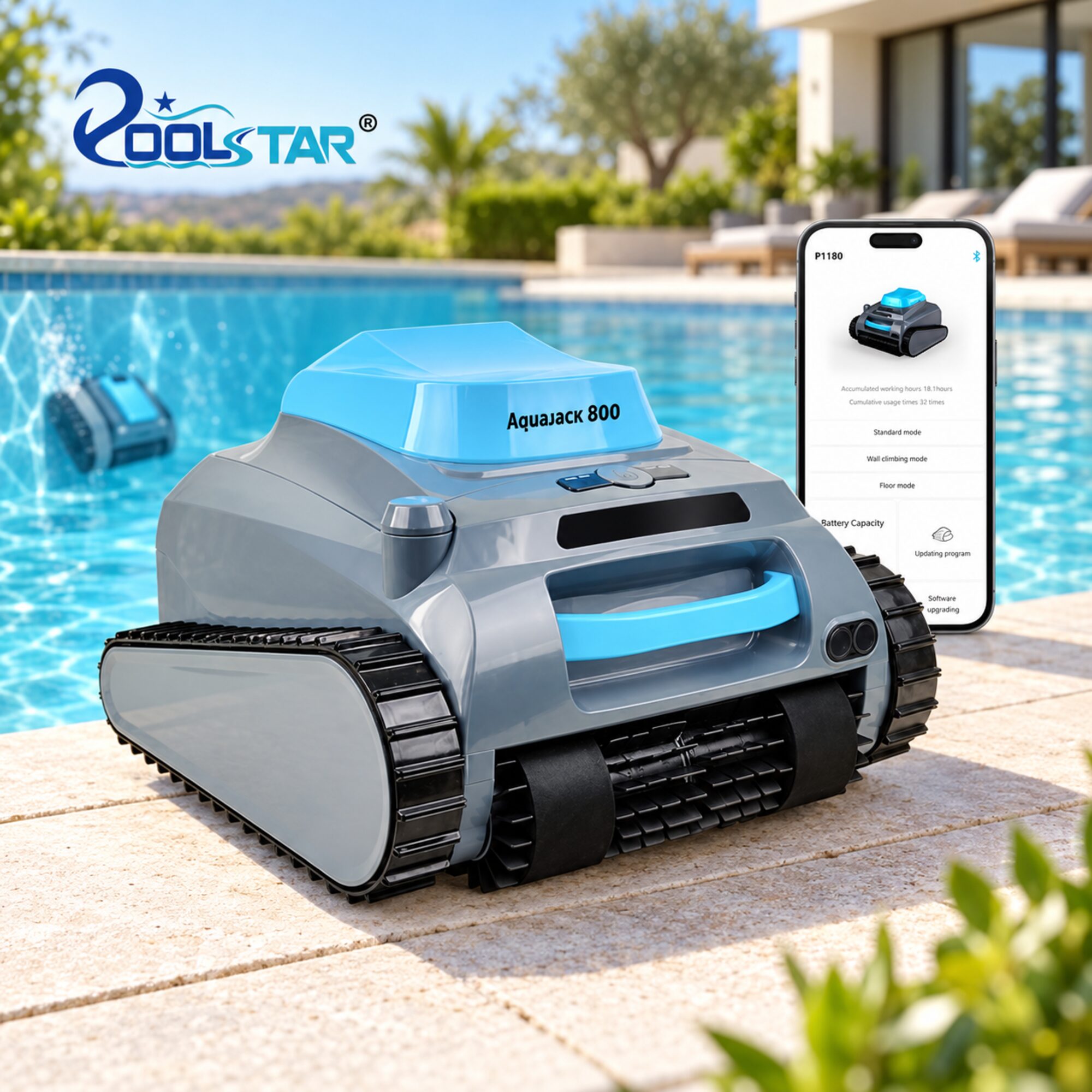
Aquajack 800 is designed as a cordless robotic pool cleaner for floor, wall and waterline maintenance. It combines powerful water circulation, selectable cleaning modes and app-assisted operation without requiring an external hose, booster pump or floating power cable.
However, buyers should look beyond a simple “wall-climbing” claim. Pool size, shape, surface material, wall angle, debris type, filtration and battery configuration all influence real cleaning performance.
What Is the Difference Between Floor, Wall and Waterline Cleaning?
The pool floor, walls and waterline present different cleaning challenges. A robot that performs well on a flat floor may not necessarily be able to climb walls or remain stable at the waterline.
Pool Floor Cleaning
The pool floor normally collects debris that sinks through the water, including:
-
Leaves
-
Sand
-
Insects
-
Dust
-
Small stones
-
Plant material
A robotic pool cleaner must maintain stable contact with the floor while moving enough water to lift debris through its suction opening and into the filter.
A floor-only pool robot may be sufficient for a small, flat pool with light debris. However, it does not eliminate the need to brush the walls and clean the waterline manually.
Pool Wall Cleaning
Pool walls can gradually collect dust, algae film and other deposits. If they are not cleaned regularly, these deposits may become more difficult to remove.
Climbing a pool wall requires more than high suction power. The robot also needs:
-
Sufficient traction
-
Stable water flow
-
Suitable brushes or tracks
-
Balanced weight distribution
-
Controlled buoyancy
-
The ability to transition from the floor to the wall
This is especially important for residential inground pools, where manually brushing the walls can be time-consuming.
Waterline Cleaning
The waterline is one of the most difficult parts of a swimming pool to maintain.
Sunscreen, body oils, pollen and floating contaminants often collect along the waterline and create a visible ring around the pool.
A waterline-capable robotic pool cleaner must reach the upper wall and maintain controlled movement long enough to brush this area effectively.
Not every robot advertised as a wall-climbing pool cleaner can provide consistent waterline cleaning. Buyers should therefore check the available cleaning modes, surface compatibility and actual product test results.
How Does a Cordless Pool Robot Climb Walls?
A cordless robotic pool cleaner does not climb walls simply because it has strong suction.
Successful wall climbing depends on several systems working together:
-
A drive system that provides sufficient traction
-
Continuous water flow that helps stabilize the robot
-
Brushes or tracks that maintain contact with the pool surface
-
Correct weight distribution and buoyancy
-
Software that controls the transition from floor to wall
-
A suitable pool surface and wall angle
Aquajack 800 is engineered to move across the pool floor, transition onto the walls and perform targeted wall and waterline cleaning through its selectable cleaning modes.
Its cordless design also removes one of the common problems associated with traditional electric robotic pool cleaners: managing a long floating power cable.
Can Aquajack 800 Clean the Floor, Walls and Waterline?
Yes. Aquajack 800 is designed to support different cleaning requirements, including:
-
Pool floor cleaning
-
Pool wall cleaning
-
Waterline cleaning
-
Combined full-pool cleaning
The user can select a cleaning mode according to the condition of the pool.
For example, a pool with heavy leaves on the bottom may first require a floor-focused cleaning cycle. If dirt or oily deposits are visible along the upper walls, the user can select a wall or waterline cleaning mode.
This flexibility can help reduce unnecessary operating time while allowing users to focus on the areas that need the most attention.
Actual performance will still depend on the pool surface, pool geometry, debris level and selected product configuration.
Does a Cordless Robotic Pool Cleaner Work on Every Pool Surface?
No robotic pool cleaner should be assumed to perform identically on every pool surface.
Common pool finishes include:
-
Concrete
-
Plaster
-
Tile
-
Mosaic
-
Fiberglass
-
Vinyl liner
-
Painted surfaces
Surface texture affects traction.
A rough concrete or plaster surface behaves differently from smooth tile. A flexible vinyl liner can also require a different balance of traction and brush contact.
Pool geometry is equally important. A curved transition between the floor and wall is normally easier for a robot to climb than a sharp 90-degree corner.
Before selecting a robotic pool cleaner, buyers should confirm:
-
The pool surface and its condition
-
The angle between the pool floor and wall
-
Whether the pool contains steps or ledges
-
Whether there are raised drains or unusual obstacles
-
The total pool area and depth
-
Whether floor-only or full-pool cleaning is required
For importers and distributors, testing the product on pool surfaces commonly used in the local market is more valuable than relying only on laboratory specifications.
Is Aquajack 800 Suitable for Large Inground Pools?
Aquajack 800 is positioned for residential inground pools and demanding cleaning applications where floor, wall and waterline coverage are required.
When choosing a robotic pool cleaner for a large pool, buyers should consider the total cleanable surface area—not only the length of the pool.
A robot cleaning the floor, four walls and waterline must travel much farther than a floor-only robot used in a pool of the same length.
The required battery capacity and cleaning time therefore depend on:
-
Pool dimensions
-
Total floor and wall area
-
Selected cleaning mode
-
Amount and type of debris
-
Pool surface
-
Water temperature
-
Operating conditions
Aquajack 800 may be supplied with different battery configurations according to market and distributor requirements.
Buyers should confirm the exact runtime, charging time and recommended cleaning coverage of the selected version instead of assuming that one published runtime applies to every Aquajack 800 configuration.
Is Suction Power Enough to Guarantee Better Pool Cleaning?
No. Suction or water-flow figures are important, but they do not describe the complete cleaning result.
Effective debris collection depends on the relationship between:
-
Water flow
-
Brush contact
-
Suction opening design
-
Filter fineness
-
Filter capacity
-
Cleaning route
-
Robot movement speed
-
Pool surface contact
Aquajack 800 provides water flow of up to 296 L/min and a 4 L filter capacity.
These specifications support the collection of leaves, sand and other pool debris. However, their practical value comes from combining water movement with effective surface contact, cleaning coverage and an accessible filtration system.
A pool robot with impressive water flow but poor route coverage may still leave areas untouched.
Similarly, a very fine filter may capture smaller particles, but it may require more frequent cleaning when used in a pool with a large amount of leaves.
The best filtration and cleaning configuration therefore depends on the local environment and the type of debris commonly found in the pool.
What Types of Debris Can Aquajack 800 Collect?
A full-pool robotic cleaner such as Aquajack 800 is designed for routine collection of common pool debris, including:
-
Leaves
-
Small plant debris
-
Sand
-
Settled dust
-
Insects
-
Pollen
-
Loose dirt
-
Light deposits loosened by brushing
The filter should be checked and cleaned after a heavy-debris cycle. A full or blocked filter can reduce water flow and affect suction and wall-climbing performance.
A robotic pool cleaner does not replace correct water chemistry or the pool’s main circulation and filtration system.
Heavy algae growth should first be treated according to professional pool-care recommendations. The robot can then help collect the loosened material from the pool surfaces.
This distinction is important:
A robotic pool cleaner maintains the pool surfaces, while the circulation, filtration and chemical treatment systems maintain the water quality.
Cordless vs Corded Robotic Pool Cleaners: Which Is Better?
Both cordless and corded robotic pool cleaners can provide effective cleaning, but they address different user requirements.
Advantages of a Cordless Robotic Pool Cleaner
A cordless pool robot offers:
-
No floating power cable
-
No cable tangling
-
Faster setup
-
Easier storage
-
Easier transportation
-
No electrical connection beside the pool during cleaning
The user charges the robot, selects the cleaning mode and places it in the pool.
Advantages of a Corded Robotic Pool Cleaner
A corded model provides continuous electrical power during its programmed cleaning cycle.
This may be suitable for users who require frequent or extended cleaning and do not mind managing and storing the cable.
However, the cable must be correctly positioned and maintained to reduce tangling and interference during operation.
Which Type Should a Pool Owner Choose?
The correct choice depends on:
-
Pool size
-
Required cleaning frequency
-
Preferred cleaning time
-
Storage conditions
-
Access to a safe power supply
-
Whether convenience or continuous power is the priority
For many residential pool owners, a cordless robotic pool cleaner offers a more convenient balance between cleaning performance and ease of use.
Does Aquajack 800 Require a Hose or Booster Pump?
No.
Aquajack 800 operates as a rechargeable cordless robotic pool cleaner. It does not need to be connected to the pool’s suction system, filtration pump or booster pump.
This means there is:
-
No suction hose to install
-
No booster line required
-
No floating electrical cable
-
No complicated connection before each cleaning cycle
This independent operation can make Aquajack 800 easier to use in residential pools and more convenient for pool owners who want to reduce manual setup.
How Should Pool Owners Use Aquajack 800 for Better Results?
Correct operation and regular maintenance help preserve cleaning performance.
Pool owners should:
-
Remove oversized branches or objects before starting the robot.
-
Select the cleaning mode that matches the current task.
-
Clean the filter after every heavy-debris cycle.
-
Check the suction opening for trapped leaves or objects.
-
Inspect the brushes and tracks regularly.
-
Keep the charger and charging area dry.
-
Avoid leaving the cleaner in the pool permanently.
-
Store the cleaner away from prolonged direct sunlight.
-
Follow the recommended charging procedure.
-
Follow the storage instructions during winter or long periods of non-use.
Regular filter cleaning is particularly important. A blocked filter can reduce water flow and may affect debris collection, movement and wall-climbing ability.
Can the Aquajack 800 App Control the Robot Underwater?
Wireless signals behave differently underwater.
Therefore, app functionality should always be described according to the exact Aquajack 800 product version and operating condition.
Depending on the configuration, the app may support functions such as:
-
Selecting a cleaning mode
-
Checking product information
-
Adjusting settings
-
Supporting operation near the water surface
-
Reviewing available product status information
Buyers and distributors should confirm which app functions are available before the robot enters the water, while it is near the surface and during the underwater cleaning cycle.
It is better to explain these functions accurately than to describe the product simply as a “fully app-controlled underwater robot.”
What Should Distributors Check Before Adding a Wall-Climbing Pool Robot?
Importers, wholesalers and pool-equipment retailers should evaluate more than headline specifications.
A professional product assessment should include:
-
Performance on locally common pool surfaces
-
Floor-to-wall transition capability
-
Waterline movement and stability
-
Fine-debris collection
-
Large-debris collection
-
Filter removal and cleaning time
-
Battery configuration
-
Charging time
-
Availability of replaceable components
-
Technical training and troubleshooting information
-
Product packaging
-
Spare-parts support
-
Certification required by the destination market
-
Warranty and after-sales procedures
These requirements can vary considerably by country.
In the United States and Australia, pool size, convenience and full-pool performance are common buyer concerns.
In France, Germany, Italy and Spain, distributors may also pay close attention to repairability, documentation, regulatory compliance and long-term spare-parts availability.
In Brazil and Chile, local pool construction, importing conditions, technical support and the availability of replacement parts can strongly influence the success of a robotic pool cleaner.
For distributors, local testing remains an essential part of product selection.
Frequently Asked Questions About Aquajack 800
Can Aquajack 800 clean the pool floor, walls and waterline?
Yes. Aquajack 800 is designed with selectable functions for cleaning the pool floor, walls and waterline. Actual results depend on the pool surface, geometry, condition and selected cleaning mode.
Is Aquajack 800 suitable for an inground pool?
Yes. Aquajack 800 is designed for residential inground pool cleaning. Buyers should confirm the pool dimensions, surface material, floor-to-wall transition and battery configuration before purchase.
Can Aquajack 800 be used in an above-ground pool?
Compatibility depends on the pool construction, surface and wall stability. Not every above-ground pool is designed for a wall-climbing robotic cleaner. The pool and product specifications should be checked before use.
Does Aquajack 800 need a suction hose?
No. Aquajack 800 is an independent cordless robotic pool cleaner. It does not require a suction hose, booster pump or connection to the main pool filtration system.
Can Aquajack 800 clean large leaves?
Aquajack 800 is designed to collect common pool debris, including leaves, insects, sand and settled dirt. Oversized branches or objects should be removed manually before starting the robot.
Does Aquajack 800 replace the main pool filtration system?
No. A robotic pool cleaner collects debris from pool surfaces. The main circulation and filtration system treats and circulates the pool water. The two systems perform different functions.
Can a wall-climbing robot work in every pool?
Not automatically. Wall-climbing performance can vary according to surface texture, wall angle, steps, drains, ledges and pool geometry. Compatibility should be checked, especially for pools with unusual designs.
How often should the filter be cleaned?
The filter should be checked after each cleaning cycle and cleaned whenever debris has accumulated. Pools with heavy leaves, sand or fine dust may require more frequent filter cleaning.
Should Aquajack 800 remain in the pool after cleaning?
The cleaner should be removed, cleaned and stored according to the product instructions. Leaving a battery-powered robot in pool water permanently may shorten the service life of components.
How should Aquajack 800 be stored?
Store the cleaner in a dry, ventilated location away from prolonged direct sunlight and extreme temperatures. Follow the specified battery-charging and long-term storage instructions.
A More Practical Way to Evaluate Complete Pool Cleaning
The most important question is not simply whether a cordless robot can climb a wall.
A better question is whether the robot can:
-
Clean the pool floor effectively
-
Transition reliably from the floor to the wall
-
Maintain contact while climbing
-
Clean the waterline
-
Collect the debris commonly found in the local market
-
Complete the required cleaning area
-
Remain easy to clean and maintain after each cycle
-
Be supported with replaceable components and after-sales service
Aquajack 800 was developed around this complete-pool cleaning approach.
For pool owners, it provides cable-free maintenance of the floor, walls and waterline.
For importers, distributors and private-label buyers, its value should be assessed through local pool testing, battery configuration, serviceability and long-term technical support—not through one headline specification alone.
To learn more about Aquajack 800 specifications, market configurations, OEM/ODM options or distributor testing, contact Poolstar for product information suitable for your market.