
 +86-574-5680 8878


0102030405
Do Solar-Powered Pool Skimmers Really Work?
2026-09-06
Do Solar-Powered Pool Skimmers Really Work?
Yes. A solar-powered robotic pool skimmer can effectively collect leaves, pollen, insects, dust and other floating debris before it sinks to the pool floor.
However, a robotic pool skimmer performs a specific job: it cleans the surface of the water.
It does not replace:
- A robotic pool cleaner for the floor and walls
- The main pool filtration system
- Water-chemistry management
- Manual treatment for heavy algae
- Professional pool maintenance
Aquajack 900 is designed as a solar-powered robotic pool skimmer that moves independently across the water surface. It collects floating debris in its filter basket and uses dual infrared sensing to detect walls, steps and other obstacles.
For pool owners who frequently remove leaves and insects with a hand net, an automatic pool surface cleaner can reduce daily work and help prevent floating debris from sinking.
Its value is not that it performs every pool-maintenance task. Its value is that it continuously addresses one of the most repetitive tasks in pool ownership: surface skimming.
What Is a Solar-Powered Robotic Pool Skimmer?
A solar robotic pool skimmer is an automatic floating cleaner designed to travel across the pool surface.
It normally combines:
- Solar panels
- A rechargeable battery
- Electric drive motors
- A debris intake
- A removable filter basket
- Wall or obstacle sensors
- Automatic navigation
As the robot moves forward, floating debris enters the collection area and remains inside the filter basket.
Solar energy can help maintain or extend operation during suitable daylight conditions, reducing the need for frequent manual charging.
Unlike a traditional built-in skimmer, a robotic pool skimmer moves around the pool instead of waiting for water circulation to bring debris to one fixed opening.
What Does Aquajack 900 Clean?
Aquajack 900 is designed to collect floating surface debris, including:
- Leaves
- Insects
- Dust
- Flower petals
- Grass clippings
- Light plant material
- Other floating organic debris
Collecting this material early is important.
A leaf is generally easier to remove while it is still floating. After becoming saturated, it may sink to the bottom and require a floor-cleaning robot or manual vacuum.
Pollen and fine organic material may also spread across the surface or enter the main pool system if they are not collected.
Aquajack 900 helps reduce this surface-debris load before it creates additional cleaning work.
How Does a Solar Pool Skimmer Work?
The operating process is relatively simple:
- Solar energy supports the rechargeable power system.
- The robot moves across the water surface.
- Floating debris is guided toward the front intake.
- Water passes through the collection area.
- Leaves and other material remain in the filter basket.
- Sensors help the robot detect walls and obstacles.
- The robot changes direction and continues cleaning.
The actual route depends on:
- Pool shape
- Wind direction
- Water circulation
- Obstacles
- Steps
- Robot navigation
- Surface conditions
Because floating debris is constantly moving, the robot does not necessarily need to follow the same precise route as a floor-cleaning robot.
Its objective is to repeatedly travel through different areas and intercept debris as it moves across the surface.
Why Is It Better to Collect Leaves Before They Sink?
Floating debris changes after entering the pool.
Leaves may absorb water, become heavier and sink. Once on the pool floor, they can:
- Create stains
- Break into smaller particles
- Increase the debris load on a floor-cleaning robot
- Become more difficult to collect
- Accumulate in corners
- Contribute organic material to the water
By collecting leaves while they are still floating, a robotic pool skimmer can reduce the amount of work required later.
This creates a practical division of labour:
| Cleaning equipment | Main task |
|---|---|
| Aquajack 900 | Collects debris floating on the water surface |
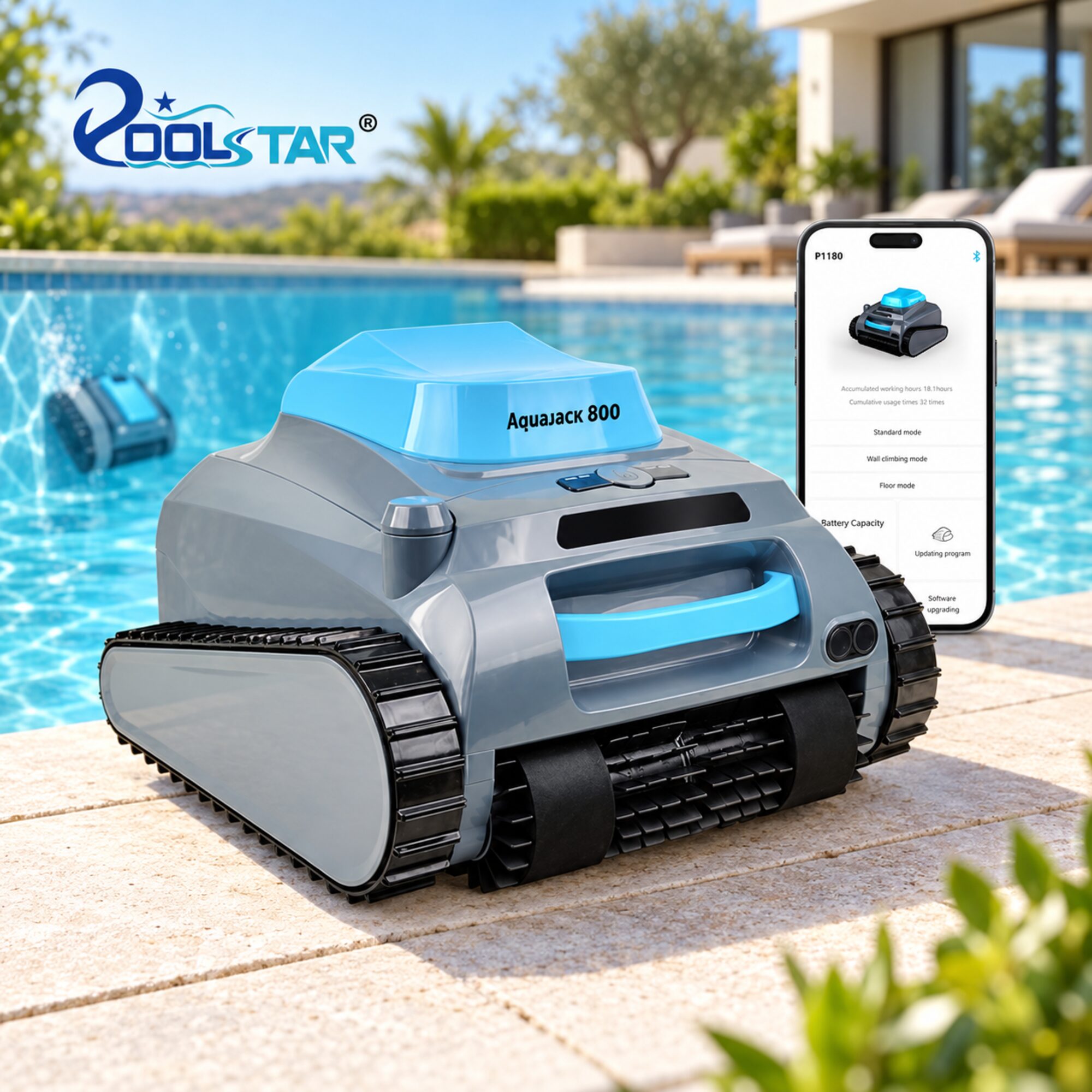
| Aquajack 800 or 810 | Cleans debris from the pool floor, walls and waterline |
| Main pool filtration system | Circulates and filters the pool water |
| Water-treatment system | Maintains chemical and biological water quality |
These systems complement one another. They do not perform the same function.
Can Aquajack 900 Collect Large Leaves?
Aquajack 900 is designed to collect common floating leaves and plant material.
Performance depends on:
- Leaf size
- Leaf shape
- Whether the leaf is wet or dry
- Quantity of debris
- Intake width
- Filter condition
- Wind and water movement
Very large branches, long palm leaves, pool toys and other oversized objects should be removed manually.
After storms or heavy winds, the pool owner should inspect the surface before operating the robot. Removing unusually large material can help prevent blockage or damage.
For normal daily debris, the 10 L collection capacity associated with Aquajack 900 can reduce how frequently the basket must be emptied compared with a small collection chamber.
The final basket specification should still be confirmed on the product sheet supplied to each market.
Can It Collect Pollen and Fine Surface Debris?
A solar robotic pool skimmer can help collect pollen, dust and fine organic material floating on the water surface.
Fine-debris performance depends on the filter structure and mesh specification.
In regions with heavy seasonal pollen, such as parts of the United States, France, Germany, Italy and Australia, users should check the basket more frequently.
Pollen can gradually restrict water flow through fine filtration material.
The filter should be rinsed regularly to maintain effective collection.
A surface robot may reduce visible pollen, but it does not replace the main filtration system or water treatment.
Can Aquajack 900 Collect Insects?
Yes. Floating insects are a suitable application for a robotic pool skimmer.
Pools may collect:
- Flies
- Mosquitoes
- Beetles
- Bees
- Moths
- Ants
- Other small insects
This is particularly common in warm climates and pools located near gardens.
Aquajack 900 travels across the water surface and collects insects before they sink or gather around the pool edges.
However, it does not prevent insects from entering the pool. Landscaping, lighting and pool covers may also affect insect activity.
Does Aquajack 900 Clean the Pool Floor?
No. Aquajack 900 is a surface-skimming robot.
It is not designed to vacuum sand, dirt or leaves that have already sunk to the pool floor.
For floor cleaning, a robotic pool cleaner such as Aquajack 800 or Aquajack 810 is more appropriate.
This distinction should be stated clearly on product pages:
- A robotic pool skimmer works on top of the water.
- A robotic pool cleaner works below the surface.
Using the term “robotic pool cleaner” without explaining this difference can cause customers to expect one product to clean every part of the pool.
Does It Clean Pool Walls and the Waterline?
Aquajack 900 travels on the water surface. It does not climb the underwater pool walls in the same way as Aquajack 800 or Aquajack 810.
It may collect floating debris near the pool edges, but it should not be presented as a wall-scrubbing robot.
Deposits attached to the waterline may still require:
- A wall-climbing robotic pool cleaner
- A waterline-cleaning mode
- A manual brush
- Suitable cleaning treatment
Surface debris collection and waterline scrubbing are different functions.
Does a Solar Pool Skimmer Replace the Built-In Pool Skimmer?
No. A robotic surface skimmer complements the built-in skimmer.
The built-in pool skimmer is part of the circulation and filtration system. It draws water and floating debris toward a fixed opening.
A robotic skimmer moves independently around the surface and collects debris in different parts of the pool.
The built-in skimmer may struggle when:
- Wind pushes debris away from the opening
- Water circulation is uneven
- Leaves collect in dead zones
- The pool pump is operating on a limited schedule
- Large amounts of debris enter the pool
Aquajack 900 can help reach areas that are not consistently served by the fixed skimmer.
However, the built-in skimmer basket, pump and filter still require regular maintenance.
Will a Solar Pool Skimmer Work on a Cloudy Day?
Solar performance depends on light intensity, weather conditions, battery state and the design of the charging system.
On a bright day, the solar panel can make a greater contribution to operation or battery charging.
On cloudy days, solar input may be lower.
Users should understand the difference between:
- Operating directly from available solar energy
- Using energy stored in the battery
- Recharging through solar exposure
- Optional external charging, if provided for the selected version
Before publication, Poolstar should confirm whether Aquajack 900 supports:
- Provides solar-only charging
- Supports solar and external charging
- Can operate while receiving solar energy
- Requires a minimum light level
- Includes a backup charging method
These details must be stated according to the final market configuration.
Does Solar-Powered Mean the Robot Runs Forever?
No.
“Solar-powered” does not mean unlimited operation under every condition.
Operating time may be influenced by:
- Sunlight
- Cloud cover
- Time of day
- Battery capacity
- Battery condition
- Motor load
- Amount of debris
- Obstacles
- Water and air temperature
- Solar-panel cleanliness
Solar energy can reduce dependence on plug-in charging and extend useful operating time, but the robot still relies on a battery and electrical components.
The product page should avoid claims such as “runs forever” or “unlimited cleaning” unless very specific test conditions are provided.
A more accurate message is:
Solar charging helps Aquajack 900 maintain automatic surface cleaning with less manual charging under suitable daylight conditions.
How Do the Dual Infrared Sensors Work?
Aquajack 900 uses dual infrared sensing to help detect:
- Pool walls
- Steps near the surface
- Edges
- Obstacles
- Objects in its path
When the robot identifies an obstacle, it can adjust its direction and continue moving across the pool surface.
Sensor performance may be affected by:
- Obstacle colour
- Surface reflectivity
- Bright sunlight
- Water movement
- Obstacle angle
- Distance
- Dirt on the sensor area
Infrared sensing should therefore be described as an obstacle-detection aid rather than a guarantee that the robot will never make contact with any object.
Can Aquajack 900 Get Stuck?
Any floating pool robot may experience difficult situations in certain pool environments.
Potential problem areas include:
- Narrow spaces
- Steps close to the surface
- Ladders
- Floating hoses
- Pool toys
- Water features
- Strong return jets
- Skimmer openings
- Irregular corners
Aquajack 900’s sensors are designed to help it detect obstacles and change direction.
Before use, pool owners should:
- Remove floating toys
- Secure loose hoses
- Check narrow areas
- Observe the first cleaning cycle
- Confirm that ladders or steps do not trap the robot
Distributors should test the cleaner in locally common pool designs before making universal compatibility claims.
Does Wind Affect a Robotic Pool Skimmer?
Yes. Wind affects both floating debris and the robot.
A light wind may move leaves toward one area, allowing the robot to collect them.
Strong wind may:
- Move debris rapidly
- Push the robot toward one side
- Create surface waves
- Reduce route consistency
- Introduce new debris while cleaning
A robotic pool skimmer may remain useful in windy conditions, but performance should not be judged from one fixed laboratory environment.
This is particularly relevant in:
- Coastal regions
- Open gardens
- Australian residential pools
- Southern European pools
- Texas, Florida and California
- Parts of Brazil and Chile
Local testing should include realistic wind and debris conditions.
Can Aquajack 900 Be Used in an Inground Pool?
Aquajack 900 is suitable for surface cleaning in compatible residential pools.
Before use, confirm:
- Pool shape
- Water-surface area
- Steps near the surface
- Ladder position
- Fixed skimmer openings
- Return-jet strength
- Water features
- Other floating equipment
Because the robot remains on the surface, pool depth is generally less important than surface area and obstacles.
Can Aquajack 900 Be Used in an Above-Ground Pool?
It may be suitable for many above-ground pools, provided the pool has:
- Sufficient open surface area
- Stable water conditions
- No narrow area that traps the robot
- Compatible ladders and return fittings
- Enough clearance for movement
Small or irregular soft-sided pools may not provide sufficient space.
Pool owners should confirm compatibility before use and observe the initial cleaning cycle.
Is Aquajack 900 Suitable for Saltwater Pools?
Saltwater compatibility should be confirmed against the final material specification and recommended salinity range.
Even saltwater pools use chlorine, and salinity can influence:
- Motor components
- Bearings
- Fasteners
- Electrical contacts
- Solar-panel materials
- Plastic components
If Aquajack 900 is approved for saltwater use, the product documentation should state:
- Maximum recommended salinity
- Required cleaning procedure
- Storage instructions
- Material and corrosion testing
- Warranty conditions
A universal saltwater claim should not be made without verified supporting data.
How Often Should Aquajack 900 Be Used?
Cleaning frequency depends on the pool environment.
Aquajack 900 may provide the greatest value when the pool is:
- Surrounded by trees
- Located near a garden
- Exposed to pollen
- Used frequently
- Uncovered
- Located in a windy area
- Affected by insects
Continuous or frequent surface cleaning can prevent debris from accumulating and sinking.
Pools with very little surface debris or pools that remain covered most of the time may require less frequent operation.
How Often Should the Filter Basket Be Emptied?
The basket should be checked regularly and emptied before it becomes completely full.
Cleaning frequency depends on:
- Basket capacity
- Amount of debris
- Leaf size
- Pollen level
- Wind
- Season
- Pool surroundings
During autumn, storms or heavy pollen periods, the basket may require more frequent cleaning.
A full basket can reduce water flow and debris collection.
Users should not assume that a large-capacity basket eliminates maintenance.
How Should Aquajack 900 Be Maintained?
Routine maintenance should include:
- Removing collected leaves and debris
- Rinsing the filter basket
- Checking the intake
- Inspecting the drive area
- Removing hair or plant material
- Cleaning the solar-panel surface
- Inspecting the sensor areas
- Checking for visible damage
- Following battery-care instructions
- Storing the robot correctly when not in use
Dirt or leaves covering the solar panel may reduce available solar charging.
The solar surface should be cleaned carefully according to the product instructions. Abrasive tools or unsuitable chemicals may damage it.
What Are the Main Limitations of a Solar Pool Skimmer?
A solar robotic pool skimmer cannot solve every pool-maintenance problem.
Its main limitations include:
- It does not vacuum the pool floor.
- It does not scrub underwater walls.
- It does not remove attached waterline stains.
- It does not balance pool chemicals.
- It does not treat algae.
- It does not replace the main filter.
- Solar charging depends on available light.
- Large objects may require manual removal.
- Some pool obstacles may interfere with movement.
- The basket still requires regular cleaning.
Explaining these limitations does not weaken the product.
It helps customers understand where Aquajack 900 provides real value and reduces the risk of unrealistic expectations.
Who Benefits Most from Aquajack 900?
Aquajack 900 may be particularly useful for:
- Pool owners surrounded by trees
- Homeowners who skim leaves manually every day
- Pools affected by pollen and insects
- Outdoor pools in sunny regions
- Pool owners seeking cordless automation
- Users who already have a floor-cleaning robot
- Hotels and residential facilities requiring frequent surface maintenance
- Distributors expanding their robotic pool-care range
It can work as a companion product to an underwater robotic pool cleaner.
Aquajack 900 collects floating material first, while Aquajack 800 or Aquajack 810 addresses debris that has already settled on the floor or walls.
What Should Distributors Test Before Launching Aquajack 900?
Importers and distributors should evaluate the product under realistic conditions.
Debris Collection Test
Use measured quantities of:
- Dry leaves
- Wet leaves
- Pollen or suitable test material
- Insects or comparable floating debris
- Grass clippings
Record:
- Collection rate
- Time required
- Debris left on the surface
- Debris pushed away
- Debris that sinks
- Basket capacity
Solar Performance Test
Evaluate:
- Bright sunlight
- Partial cloud
- Overcast conditions
- Morning and afternoon light
- Performance after several hours of operation
- Recovery after low battery
Obstacle Test
Test the robot around:
- Pool walls
- Steps
- Ladders
- Floating hoses
- Fixed skimmers
- Return jets
- Corners
- Water features
Maintenance Test
Measure:
- Basket-removal time
- Ease of emptying wet leaves
- Filter-rinsing time
- Solar-panel cleaning
- Ease of reassembly
Repeated-Cycle Test
Test:
- Drive motors
- Battery performance
- Sensor behaviour
- Basket durability
- Solar-panel exposure
- Outdoor material ageing
These results provide credible support for dealers and end users.
Frequently Asked Questions
Do solar-powered pool skimmers really work?
Yes. They can effectively collect floating leaves, pollen, insects and dust. They do not clean debris that has already sunk to the pool floor.
What does Aquajack 900 clean?
Aquajack 900 is designed to collect floating surface debris such as leaves, pollen, insects, dust and light plant material.
Does Aquajack 900 clean the pool floor?
No. It is a robotic surface skimmer. Use an underwater robotic pool cleaner for floor cleaning.
Does it replace the built-in pool skimmer?
No. It works independently and complements the fixed skimmer and main filtration system.
Can Aquajack 900 work on cloudy days?
Performance depends on available solar energy and stored battery power. Exact cloudy-weather operation should be confirmed for the selected product configuration.
Does a solar pool skimmer need charging?
Solar energy supports charging, but the exact charging options depend on the product configuration. Buyers should confirm whether external charging is also available.
Can Aquajack 900 collect large leaves?
It can collect common floating leaves. Oversized branches, pool toys and very large plant material should be removed manually.
Can it collect pollen?
It can help collect pollen and fine organic material on the water surface. The filter should be cleaned regularly during heavy pollen periods.
Can Aquajack 900 avoid walls and obstacles?
Aquajack 900 uses dual infrared sensing to help detect walls, steps and obstacles. Performance can still vary according to pool conditions and obstacle characteristics.
Can it be used with another robotic pool cleaner?
Yes. A surface-skimming robot and an underwater pool-cleaning robot perform different tasks and can form part of the same maintenance system.
Conclusion: Is a Solar-Powered Pool Skimmer Worth It?
A solar-powered robotic pool skimmer can be valuable when a pool regularly collects floating leaves, pollen, insects and dust.
Aquajack 900 is designed to move independently across the water surface, collect debris in its filter basket and use dual infrared sensing to identify walls and obstacles.
Its strongest benefit is prevention.
By collecting debris before it sinks, Aquajack 900 can:
- Reduce daily hand skimming
- Reduce the amount of debris reaching the floor
- Reduce the workload of the underwater cleaner
- Reduce debris entering the built-in skimmer
- Help maintain a cleaner-looking water surface
- Support more automated pool maintenance
It does not replace the floor-cleaning robot, main filtration system or correct water treatment.
Instead, it fills a specific gap in the pool-maintenance process: cleaning the surface before floating debris becomes a larger problem.
For pool owners, this means less repetitive manual skimming.
For distributors and private-label buyers, Aquajack 900 provides an opportunity to offer a complementary robotic cleaning system covering both the surface and underwater areas of the pool.
For Aquajack 900 specifications, charging configurations, OEM/ODM opportunities or local distributor testing, contact Poolstar for product information applicable to your market.