
 +86-574-5680 8878


0102030405
How to Remove Leaves and Large Debris from the Bottom of a Swimming Pool
2026-09-27
How to Remove Leaves and Large Debris from the Bottom of a Swimming Pool
Leaves are one of the most common problems for pool owners.
A few leaves floating on the surface are usually easy to remove with a skimmer. The problem starts when leaves, seed pods, small branches, and other large debris sink to the bottom of the pool.
At that point, a surface skimmer is no longer enough.
You need a cleaning tool that can reach the pool floor, collect large debris, and remove it without requiring you to manually pick up every leaf.
For many residential pools, a handheld rechargeable pool leaf vacuum can be a simple and practical solution.
Why Do Leaves Sink to the Bottom of the Pool?
Fresh leaves may initially float on the water surface.
Over time, however, they absorb water and become heavier. Wind and pool circulation can also push them toward the pool walls and floor.
Eventually, they sink.
The same can happen with:
-
Leaves
-
Acorns
-
Seed pods
-
Small twigs
-
Flowers
-
Fruit
-
Other large organic debris
Once this material reaches the bottom, a normal surface skimmer cannot collect it.
Leaving large amounts of organic debris in the pool for too long can also make routine pool maintenance more difficult.
That is why removing large debris early is an important part of regular pool care.
What Is the Easiest Way to Remove Leaves from the Pool Bottom?
There are several ways to remove leaves from the bottom of a swimming pool.
1. Pool Leaf Net
A traditional leaf net attached to a telescopic pole can collect large debris.
It is inexpensive and requires no electricity.
However, removing leaves from the bottom can take considerable effort, particularly when the debris is spread across a large area or the pool is relatively deep.
The user has to manually move the net through the water and repeatedly lift the debris out.
2. Manual Pool Vacuum
A traditional pool vacuum can remove debris from the pool floor, but it normally requires a hose, pole, and connection to the pool's filtration system.
This can be effective, but setup and cleanup may take additional time.
3. Rechargeable Handheld Pool Leaf Vacuum
A rechargeable handheld pool vacuum provides another option.
Instead of connecting the cleaning head to the pool's circulation system, the vacuum has its own rechargeable battery and motor.
The user simply guides the vacuum over the pool floor.
For pools that frequently collect leaves and other large debris, this can make spot cleaning much easier.
What Should You Look for in a Pool Leaf Vacuum?
Not every handheld pool vacuum is designed for the same type of debris.
If your main problem is leaves and large organic debris, several specifications are particularly important.
1. Strong Water Flow
Water flow affects how effectively the vacuum can pull debris into the filter bag.
A pool leaf vacuum with strong water flow can help collect larger pieces of debris without requiring the user to repeatedly go over the same area.
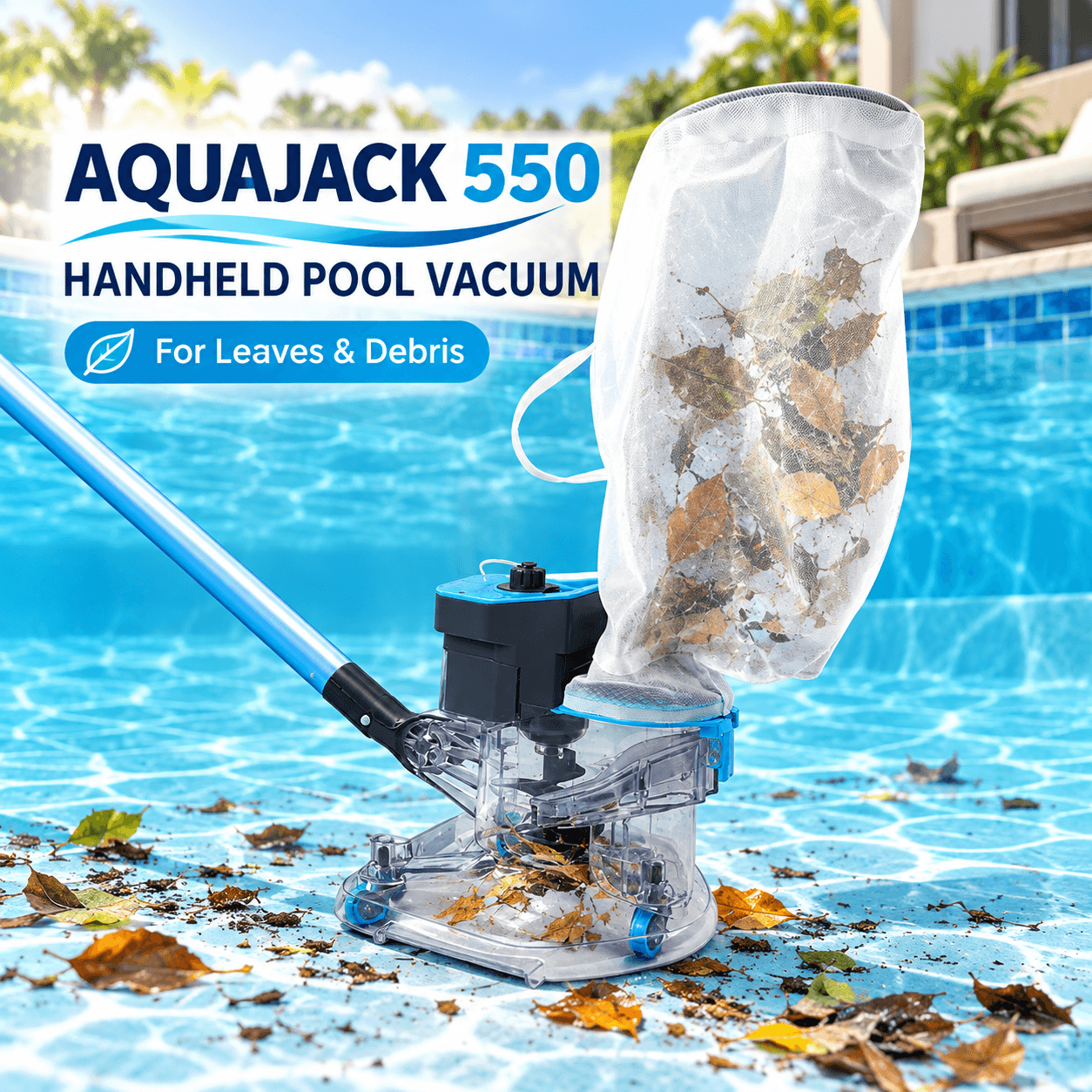
AquaJack 550 delivers up to 90 L/min water flow, providing strong suction performance for everyday pool-floor debris removal.
2. Large Filter Capacity
This is particularly important when dealing with leaves.
A small filter may need to be emptied frequently when the pool contains a large amount of debris.
AquaJack 550 comes with an extra-large 10-liter filter bag designed for collecting leaves, fruit, seed pods, and other large debris.
The larger capacity means users can collect more debris before stopping to empty the bag.
For a pool surrounded by trees, this can make a noticeable difference.
One Vacuum, Two Filtration Options
Large debris and fine debris are not the same.
A filter designed for leaves is optimized for collecting larger material.
But some pool owners also want to remove:
-
Sand
-
Dust
-
Fine dirt
-
Small particles
For this reason, AquaJack 550 can also use an optional 10-liter fine-mesh filter bag.
The standard large-debris filter bag is suitable for:
Leaves + fruit + seed pods + larger organic debris
The optional fine-mesh bag is designed for:
Sand + dust + finer debris
This gives the same handheld vacuum a more flexible cleaning application.
The important point is that users can choose the filter according to the type of debris they need to remove.
Why Is a 10-Liter Filter Bag Useful?
Consider a pool after a windy day.
Instead of finding only a few leaves, you may find dozens of leaves and pieces of organic debris scattered across the pool floor.
With a small filter bag, the vacuum may need to be stopped and emptied repeatedly.
A 10-liter filter capacity provides considerably more room for collecting large debris.
This is especially useful for:
-
Pools surrounded by trees
-
Pools near gardens
-
Pools exposed to seasonal leaf fall
-
Pools that are not cleaned every day
-
Pools with frequent large organic debris
The benefit is simple:
More debris per cleaning cycle means fewer interruptions.
75 Minutes of Runtime for Routine Pool Cleaning
Battery runtime is another important consideration for a cordless pool vacuum.
AquaJack 550 uses a 2600 mAh rechargeable lithium battery and provides up to 75 minutes of operating time.
For a handheld pool vacuum, this provides enough operating time for routine spot cleaning and regular removal of accumulated debris.
The cordless design also eliminates the need to manage a power cable while cleaning.
Simply charge the unit, place it in the pool, and begin cleaning.
See the Debris Being Collected
Another practical feature of AquaJack 550 is its transparent body.
When a pool vacuum has an opaque housing, the user may not immediately know whether debris is actually being collected.
The transparent body of AquaJack 550 provides visual feedback during operation.
Users can see debris moving into the collection area.
This can be especially useful when removing leaves and larger debris because the user can quickly confirm that the vacuum is working as expected.
It also makes it easier to understand when the collection system needs attention.
Why Use a Handheld Pool Leaf Vacuum Instead of a Robotic Cleaner?
A handheld pool leaf vacuum and a robotic pool cleaner serve different purposes.
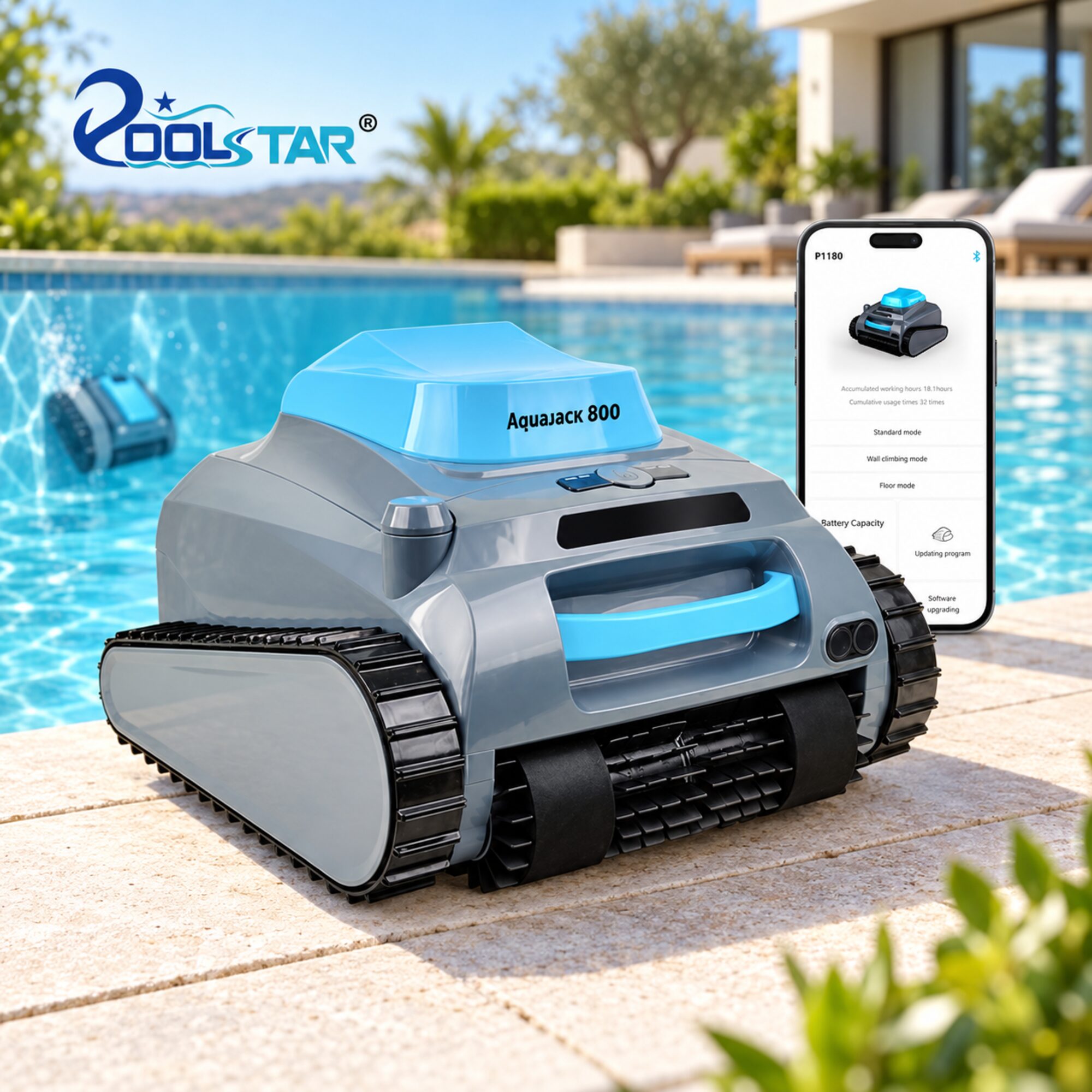
A robotic pool cleaner is generally designed to move automatically through the pool according to its cleaning program.
A handheld pool vacuum gives the user direct control over where the vacuum goes.
That makes a handheld leaf vacuum particularly useful for targeted cleaning.
For example:
-
A large pile of leaves has collected in one corner.
-
Several acorns have sunk to the pool bottom.
-
Fruit has fallen into the pool.
-
Wind has pushed debris against the pool wall.
-
A small area needs cleaning before swimming.
-
You do not want to run a complete robotic cleaning cycle.
In these situations, a handheld vacuum can be a practical complement to other pool-cleaning equipment.
It does not need to replace every other cleaning method.
Instead, it can handle the specific job it is designed for:
Quickly removing debris from the pool floor.
A Better Way to Handle Heavy Leaf Fall
For pool owners who live near trees, leaves are not an occasional problem.
They can become a recurring maintenance task during certain seasons.
A practical cleaning routine can be:
Step 1 — Remove floating debris
Use a surface skimmer or leaf net to remove material floating on the water.
Step 2 — Remove large debris from the bottom
Use a handheld pool leaf vacuum to collect leaves, fruit, seed pods, and similar debris.
Step 3 — Deal with finer particles
If necessary, switch to a fine-mesh filter bag to collect smaller particles such as sand and dust.
Step 4 — Empty and rinse the filter
Remove the collected debris, rinse the filter bag, and prepare the vacuum for its next use.
This approach allows different tools and filtration methods to handle different types of pool debris.
AquaJack 550 at a Glance
AquaJack 550 is designed as a rechargeable handheld pool leaf vacuum for removing debris from the bottom of residential swimming pools.
Key specifications
| Feature | AquaJack 550 |
|---|---|
| Product type | Rechargeable handheld pool leaf vacuum |
| Application | Pool-floor debris removal |
| Water flow | Up to 90 L/min |
| Runtime | Up to 75 minutes |
| Battery | 2600 mAh lithium battery |
| Standard filter | 10 L extra-large filter bag |
| Standard application | Leaves and large debris |
| Optional filter | 10 L fine-mesh filter bag |
| Optional application | Sand, dust and finer debris |
| Body | Transparent |
| Operation | Cordless handheld |
Is AquaJack 550 Right for Your Pool?
AquaJack 550 may be particularly useful if your pool frequently collects large debris such as leaves, fruit, seed pods, and similar organic material.
It is also useful when you want a cordless tool for targeted pool-floor cleaning rather than running a complete automatic cleaning cycle.
The optional fine-mesh filter provides additional flexibility for users who also need to collect smaller particles.
However, like any pool-cleaning product, it is important to choose the right tool for the right job.
If your primary problem is large debris on the pool floor, a handheld pool leaf vacuum is designed specifically for that task.
Final Thoughts
Removing leaves from a swimming pool does not have to mean repeatedly using a manual net or setting up a complete vacuum system.
A rechargeable handheld pool leaf vacuum provides a simpler alternative for targeted cleaning.
With 90 L/min water flow, up to 75 minutes of runtime, a 10-liter large-capacity filter bag, and a transparent body, AquaJack 550 is designed to make the removal of leaves and other large pool-floor debris more convenient.
And when finer debris needs to be collected, the optional 10-liter fine-mesh filter bag provides another filtration option.
For pool owners dealing with leaves, fruit, and seasonal debris, the goal is simple:
Pick up the debris, empty the bag, and get the pool ready to enjoy again.