
 +86-574-5680 8878



TL;DR — What pool equipment brand buyers and dealers need to know
- Fast charge reduces cycle life if not managed properly — a well-managed 0.5C-1C bulk charge keeps the cycle-life penalty to 10-20% vs standard charge.
- Li-ion pool robot batteries typically deliver 500-800 cycles to 80% capacity; LiFePO4 can deliver 1,500-2,500 cycles but at lower energy density.
- Operating temperature above 40C accelerates capacity fade 2x — store the robot in shade, not direct sunlight.
- UN 38.3 (transport) and IEC 62133 (portable battery safety) are required certifications for export markets; UL 1642 or UL 2054 covers cell-level safety in North America.
- The Battery Management System (BMS) is the silent decision-maker — a pool robot without cell-level voltage monitoring, thermal cutoff, and charge balancing cannot safely support fast charging.
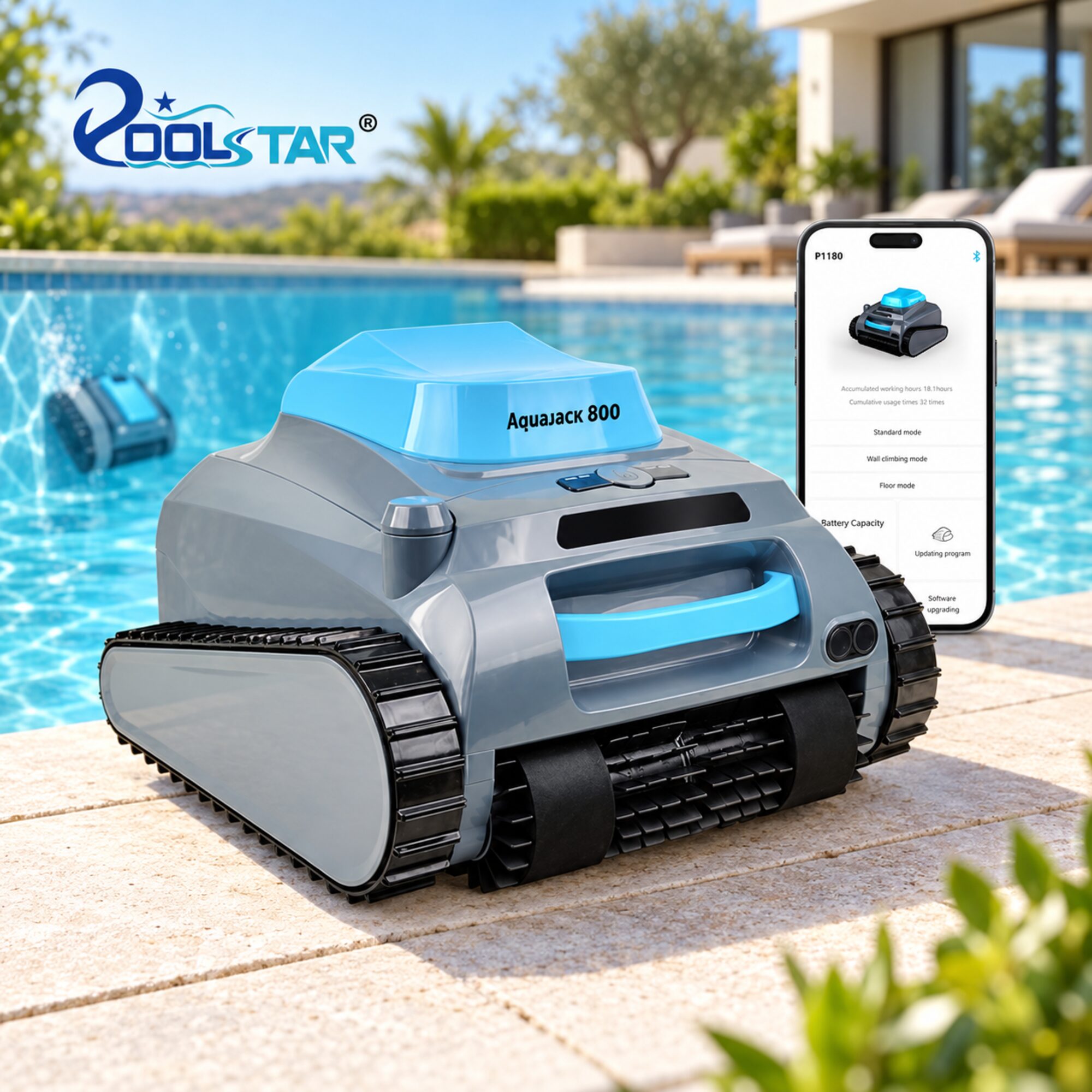
- Aquajack 650 uses fast-charge-capable Li-ion with thermal management and managed BMS for residential pool robot use cycle.
The cordless pool robot that ships with "fast charge" advertised is often the same robot that returns to the dealer under warranty 18 months later with a battery complaint. The fast-charge capability that consumers want is the same capability that reduces cycle life if not managed properly. The right OEM specification balances both — and the engineering decision lives in three layers: the cell chemistry, the charging profile, and the Battery Management System that sits between them.
I am Marketing Director at Poolstar, where I lead global brand positioning and channel development across Europe, America, and Asia-Pacific. Poolstar successfully launched the Aquajack series robotic pool cleaners. This article lays out the fast-charge vs battery-longevity trade-offs in cordless pool robot engineering, with the OEM specification framework we share with brand buyers. The same framework applies whether sourcing our Aquajack 650 or a custom OEM program. For deeper technical context, see our long-lasting battery technology explained reference.

What Is the Fast Charge vs Battery Longevity Trade-Off?
The fast charge vs battery longevity trade-off is a function of lithium-ion electrochemistry: higher charging current generates more heat and accelerates two degradation mechanisms — lithium plating on the anode and electrolyte decomposition at the cathode. The right OEM specification balances charging speed against cycle life penalty, using a managed charging curve that limits C-rate at different stages of the charge cycle. Because the trade-off is unavoidable, the engineering decision is not whether to accept it but how to manage it.
To frame the decision clearly: C-rate is the charge or discharge current relative to battery capacity. A 5,000 mAh battery charging at 0.5C receives 2.5 A; at 1C it receives 5 A; at 2C it receives 10 A. Higher C-rates mean faster charging, but also higher cell temperature and higher mechanical stress on the electrode interfaces. The relationship is non-linear: doubling the C-rate from 0.5C to 1C roughly triples the heat generated inside the cell. That is why a charging curve that steps the C-rate down as state-of-charge (SOC) climbs is more cycle-life-friendly than a flat high-C profile.
Why Fast Charging Affects Battery Life
Fast charging affects lithium-ion battery life through three mechanisms. First, higher C-rate during bulk charging causes lithium plating on the anode — metallic lithium deposits form instead of intercalating, reducing capacity and creating safety risk. Second, Joule heating accelerates electrolyte decomposition, consuming cyclable lithium and thickening the SEI (solid electrolyte interphase) layer. Third, higher end-of-cycle charge voltage stresses the cathode and accelerates structural degradation. The three mechanisms together reduce cycle life by 10-50%, depending on how aggressively the charging profile is engineered.
According to International Energy Agency (IEA) data on lithium-ion battery deployment, cells cycled at 1C to 4.2 V at 25C typically reach 80% capacity after 500-800 cycles; the same cells cycled at 0.5C can exceed 1,200 cycles under identical conditions. The US Department of Energy Vehicle Technologies Office battery program documents the same finding across its published test data — the difference between managed and unmanaged fast charge is large enough to double or halve real-world cycle life.
Engineering note: A well-managed fast-charge system that limits C-rate to 0.5C-1C during the bulk phase and 0.1C-0.2C during the saturation phase can keep the cycle-life penalty to 10-20% compared to standard 0.2C charging. A poorly-managed fast-charge system that pushes 2C-3C throughout can cut cycle life in half.
What Battery Chemistry Should a Pool Robot Use?
Lithium-ion (Li-ion) is the right default battery chemistry for modern pool robots — higher energy density, longer cycle life than NiMH, and lower self-discharge. Lithium iron phosphate (LiFePO4) is the alternative for premium programs where cycle life and thermal stability matter more than energy density. Because the right chemistry depends on the use case, the OEM specification should match chemistry to the consumer profile and warranty goal.
| Parameter | Lithium-ion (Li-ion) | Lithium Iron Phosphate (LiFePO4) |
|---|---|---|
| Energy density (cell-level) | 250-270 Wh/kg | 90-120 Wh/kg |
| Cycle life to 80% capacity (100% DoD, 25C) | 500-800 cycles | 1,500-2,500 cycles |
| Thermal stability (venting onset) | Moderate (~150C) | High (~250C) |
| Recommended bulk charge C-rate | 0.5C-1C | 1C-2C |
| Cost per Wh (cell-level) | Lower | Higher (~1.5-2x) |
| Pack size for equivalent runtime | Baseline | +30-40% larger |
| Self-discharge per month | 2-3% | 1-2% |
| Best fit | Residential pool robots (default) | Commercial / heavy-use programs |
The table shows the trade-off clearly: LiFePO4 lasts 2-3x longer in cycle terms but requires a larger battery pack. Li-ion is the right default for residential programs. LiFePO4 is the right default for commercial pool operator programs where cycle life matters more than pack size. Note also that LiFePO4 can accept higher bulk charge C-rates (1C-2C) without the same plating penalty that Li-ion suffers, which makes LiFePO4 the more forgiving chemistry for buyers who do not want to manage a complex charging profile.
What Does the Battery Management System (BMS) Actually Do?
The Battery Management System (BMS) is the printed circuit board inside the battery pack that monitors cell voltage, controls charge and discharge current, balances cells, and protects against thermal runaway. Without a properly specified BMS, a fast-charging lithium-ion pack is a safety risk and a warranty exposure. Because the BMS is invisible to the end consumer but visible in warranty cost, it is the layer where OEM buyers should focus their specification effort.
BMS Functions a Pool Robot Cannot Skip
Five BMS functions are non-negotiable for any cordless pool robot, residential or commercial:
- Cell-level voltage monitoring: Each cell in the pack is monitored individually. Over-voltage during charging (>4.2 V for Li-ion) causes cathode degradation; under-voltage during discharge (<2.5 V) causes copper dissolution and permanent capacity loss. The BMS disconnects the pack when any cell exceeds its safe window.
- Over-current and short-circuit protection: A fault current can weld contacts, ignite the separator, or trip the cell into thermal runaway within seconds. The BMS opens the pack circuit when current exceeds the safe limit, typically 1.5-2x the rated continuous current.
- Thermal cutoff: Cell temperature is monitored by thermistors mounted on the cell cases. The BMS reduces charge current or stops charging entirely when temperature exceeds 45-50C, and stops discharge when temperature exceeds 60C. Without this function, hot-climate operation can shorten cycle life by 30-50%.
- Cell balancing: In a multi-cell pack, individual cells drift apart in state-of-charge over time. Passive balancing burns off excess energy from the highest cells as heat; active balancing shuttles charge between cells. Without balancing, pack capacity is limited by the weakest cell and premature cutoff is common.
- State-of-charge (SOC) estimation: The BMS computes remaining runtime from cell voltage, current, and temperature history. This drives the user-visible battery indicator. A poorly calibrated SOC estimator is one of the top consumer-complaint categories in pool robot warranty data.
For pool robot OEM buyers, the right question to ask the supplier is not "do you have a BMS" — every reputable pack has one — but "which of these five functions does your BMS perform, and what IC chipset is it built on?" A BMS built on a tier-one IC (Texas Instruments BQ series, Analog Devices LTC series, NXP) is meaningfully different from one built on a generic Chinese clone IC, in both safety margin and SOC accuracy. The UL Solutions battery safety program documents the failure modes that a properly specified BMS prevents, and the related UL 1642 and UL 2054 cell-level safety tests are the de facto benchmarks in North America.
How Does Operating Temperature Affect Battery Longevity?
Operating temperature significantly affects pool robot battery longevity — storage or operation above 40C accelerates capacity fade at roughly 2x the rate of 25C operation. The right operating range for residential pool robots is 5-35C ambient, and the right storage practice is to keep the robot in shade when not in use. Because pool-side environments often exceed 40C in summer sun, charging practice and storage practice are the two operational levers that determine real-world battery life.
Temperature affects degradation through two pathways. The first is calendar aging: even when not in use, the cells lose capacity at a rate that roughly doubles for every 10C increase in storage temperature. A pool robot stored on a hot garage shelf at 45C loses capacity at 4x the rate of one stored at 25C. The second is cycling aging: high ambient temperature during charge compounds the Joule heating from the charging current itself, accelerating SEI growth and lithium plating. The IEA Global EV Outlook 2023 report documents this compound effect across consumer-grade lithium-ion cells and references the same Arrhenius-style doubling rule for every 10C of storage temperature increase.
Thermal Management in Pool Robot Design
Premium pool robot OEMs use three thermal management strategies. First, insulated battery compartments that protect cells from direct solar gain. Second, active cooling in commercial units. Third, charging profile management that reduces charge current when battery temperature exceeds a threshold (typically 45C). Thermal management is a real engineering decision that affects warranty cost, not just a marketing bullet point.
How Does Depth-of-Discharge Affect Real-World Cycle Life?
Depth-of-discharge (DoD) — the percentage of battery capacity used before recharging — is one of the strongest levers for extending cycle life. Cycling a lithium-ion battery to 100% DoD delivers 500-800 cycles; cycling to 80% DoD roughly doubles cycle count; cycling to 50% DoD can extend cycle life to 2,000-3,000 cycles. Because shallower DoD means less usable runtime per charge, pool robot OEMs size the battery pack to deliver the target runtime at around 80% DoD — the practical balance between runtime and longevity.
| Depth-of-Discharge (DoD) | Typical Cycles to 80% Capacity | Equivalent Service Years (3 cycles/week) | Trade-off |
|---|---|---|---|
| 100% DoD (full discharge) | 500-800 cycles | ~3-5 years | Maximum runtime per cycle |
| 80% DoD (typical pool robot target) | 900-1,400 cycles | ~6-9 years | Default OEM balance |
| 50% DoD (shallow cycling) | 2,000-3,000 cycles | ~12+ years | Bigger pack or shorter runtime |
The practical implication for OEM specification: a pool robot sized to deliver 2.0 hours of runtime at 100% DoD can be re-engineered to deliver the same 2.0 hours at 50% DoD by doubling the pack capacity. That bigger pack then lasts roughly 4x longer in cycle terms. The trade-off is pack size, weight, and cost — not consumer-facing runtime. This is one of the most under-discussed engineering levers in pool robot design.
What Certifications Are Required for Pool Robot Export?
Pool robot battery export requires UN 38.3 (transported per the IATA Lithium Battery Shipping Guidelines, which operationalize the UN Recommendations on the Transport of Dangerous Goods, Section 38.3) and IEC 62133-2 for portable battery safety. The European market additionally requires CE marking under the EU Battery Regulation (EU 2023/1542). North American markets require UN 38.3 plus UL 1642 or UL 2054 for cell and pack-level safety testing. Because certification is the buyer's first-line compliance check, factory buyers should request all four certificates at the RFQ stage.
Certification Documentation Checklist
The right compliance documentation package: UN 38.3 test report (transport — eight test series per the UN manual), IEC 62133-2 test report (portable safety), CE Declaration under the EU Battery Regulation 2023/1542, UL 1642 or UL 2054 cell-level safety report, and a manufacturer statement on the charge management profile. Buyers who export to multiple regions should require the full documentation package, plus an MSDS (Material Safety Data Sheet) for shipping. The IATA Lithium Battery Shipping Guidelines are the operational reference for air freight; the US Federal Register hazardous-materials rulemaking covers US-domestic transport and is the publication channel for new PHMSA and DOT battery shipping rules.
What Charging Profile Should an OEM Specify?
A well-designed charging profile balances three stages: pre-conditioning, constant-current bulk charge, and constant-voltage saturation. The right profile for a pool robot depends on the battery capacity and the use cycle. Because the charging profile is the engineering decision that determines cycle life in the field, the OEM specification should include the full charging curve, not just the peak charge rate.
Three-Stage Charging Profile
Three stages define a managed charging profile:
- Pre-conditioning (0-10% SOC): low C-rate (0.1C-0.2C) to warm the cells and avoid lithium plating on deeply discharged cells. This stage is often skipped by cheap chargers, which is one reason those chargers deliver shorter real-world cycle life.
- Constant-current bulk charge (10-80% SOC): moderate C-rate (0.5C-1C) for the bulk of the charge. This is where fast-charge capability is implemented. The C-rate during this stage is the visible "fast charge" metric on the marketing sheet.
- Constant-voltage saturation (80-100% SOC): declining C-rate as the cell voltage approaches the upper cutoff. Critical for cycle life — terminating too early wastes capacity and frustrates users with shorter-than-expected runtime; charging too aggressively accelerates cathode degradation.
The three stages together determine cycle life and charge time. Buyers tend to focus on bulk charge C-rate (the visible metric) — but the saturation stage is where cycle life is won or lost. A pool robot OEM that skimps on saturation-stage precision will see this as elevated warranty returns 12-18 months after launch, even when the bulk-stage C-rate looks competitive on the spec sheet.
How Should a Brand Calculate Total Cost of Ownership?
Total cost of ownership (TCO) for a cordless pool robot includes the upfront unit cost, expected battery replacement cost over the warranty horizon, and the warranty exposure from premature battery failure. Brands that optimize TCO — not just unit cost — typically spec a larger Li-ion pack (extending cycle life at 80% DoD) rather than the smallest Li-ion pack that meets the marketing runtime claim. Because warranty cost is the largest single line item in pool robot TCO, a chemistry and pack-size decision that adds modestly to unit cost but doubles cycle life can pay back several times over the program life.
A useful TCO framework breaks the cost into four buckets: upfront unit cost, expected battery replacements within the warranty window (typically zero for a well-specified residential program, one for a poorly specified one), service and logistics cost for warranty returns, and brand-equity cost from consumer complaints about short battery life. The first bucket is the only one the buyer can see at the RFQ stage. The other three are the actual cost drivers, and they are decided by the engineering specification — not the unit price. The IEA Global EV Outlook 2023 documents the same TCO framework at the EV level — including the same pattern that the upfront unit cost is the smallest cost driver over a product lifecycle, and that battery specification is the largest.
How Should a Brand Validate Battery Performance Before Committing?
A brand should validate battery performance in a real-world test before committing to mass production — typically 200-300 charge cycles at the program's charging profile, with capacity measurement every 50 cycles. The validation should run in the program's actual operating temperature range and use the actual charging hardware, not a bench setup. Because battery performance varies with cycling conditions, a validation that does not match the production operating environment will not predict production cycle life.
Validation Test Protocol
The right validation protocol runs 200-300 charge cycles with the following measurements: full charge capacity at cycle 0, 50, 100, 200, and 300; full discharge capacity at the same intervals; cycle time per cycle; charging time per cycle; battery temperature during bulk charging and saturation; and visual inspection at the end of the validation. Because the validation result drives the production-ready certification, the protocol should match the production operating environment and the target consumer use cycle. The validation should also include a "worst-case" leg at 40C ambient, since this is the realistic summer storage temperature for many pool-side consumers.
When Should a Buyer Reject Fast-Charge as a Spec?
Fast-charge is not the right spec for every pool robot program. Reject fast-charge when the consumer use cycle is weekly or less frequent (a standard 4-hour overnight charge is invisible to the consumer), when the target market is warranty-cost-sensitive (premium European retail channels, for instance, where 18-month battery returns are a known pain point), or when the OEM supplier cannot document the BMS function set and the charging curve in detail. Accept fast-charge when the consumer use cycle is daily or multi-cycle-per-day (commercial pool operators, vacation rentals), when fast turnaround is a competitive differentiator (rental market, hospitality pool service), or when the supplier can document the full BMS specification and the managed charging curve.
What Field Failure Patterns Should a Buyer Watch For?
Three field failure patterns appear repeatedly in pool robot warranty data: rapid capacity loss within the first 12 months, swelling of the battery pack, and runtime indicator error. Each pattern points to a different root cause, and each is preventable at the OEM specification stage. Because warranty data is the cheapest source of root-cause information, a buyer who tracks these three patterns in their first 1,000 units will catch specification gaps before they reach volume production.
Rapid capacity loss within 12 months typically indicates either a thermal management failure (cells running hot in storage) or a charging profile that is too aggressive for the cell chemistry. Pack swelling indicates gas generation inside the cells, usually from overcharge or from operation outside the safe temperature window — both are BMS failures. Runtime indicator error indicates a poorly calibrated SOC estimator, almost always an IC selection or firmware issue in the BMS. All three failure modes are documented in the failure-mode taxonomy used by SAE International's secondary battery and charging interface standards, and they are the same failure modes that show up in IEA EV battery deployment data and US Department of Energy test data on consumer-grade lithium-ion cells.
Frequently Asked Questions
How long does a pool robot battery last?
A pool robot battery typically lasts 2-4 years depending on chemistry, use frequency, and charging pattern. Li-ion: 500-800 cycles to 80% capacity. LiFePO4: 1,500-2,500 cycles.
Does fast charging reduce pool robot battery life?
Yes, if not managed properly. A well-managed 0.5C-1C bulk charge keeps the penalty to 10-20% vs standard charge. A poorly-managed 2C-3C system can cut cycle life in half.
What is the difference between Li-ion and LiFePO4 pool robot batteries?
Li-ion: higher energy density (250-270 Wh/kg), default for residential. LiFePO4: longer cycle life (1,500-2,500 cycles), better thermal stability, +30-40% larger pack for equivalent runtime.
What is the typical charging time for a cordless pool robot?
Standard charge: 2-4 hours. Fast charge: 1-2 hours. Aquajack 650 uses fast-charge-capable Li-ion.
What battery certification is required for pool robot export?
UN 38.3 (transport), IEC 62133 (portable safety), CE under EU Battery Regulation 2023/1542, UL 1642 or UL 2054 for North America.
How does operating temperature affect pool robot battery longevity?
Storage/operation above 40C accelerates fade 2x vs 25C. Right operating range: 5-35C ambient. Store in shade, not direct sunlight.
What does a Battery Management System (BMS) do in a pool robot?
The BMS manages cell voltage balancing, over-current and short-circuit protection, thermal cutoff (typically 60C), and state-of-charge estimation. A pool robot without a properly specified BMS cannot safely support fast charging and will see elevated warranty cost.
How does depth-of-discharge affect pool robot cycle life?
100% DoD: 500-800 cycles. 80% DoD: 900-1,400 cycles. 50% DoD: 2,000-3,000 cycles. Pool robot OEMs typically size the pack to deliver target runtime at 80% DoD, the practical balance between runtime and longevity.
Specifying a Cordless Pool Robot Program?
Poolstar supplies the Aquajack 650 cordless robotic pool cleaner with fast-charge-capable long-lasting Li-ion battery technology, managed BMS, and full UN 38.3 and IEC 62133 certification. OEM/ODM available for global pool equipment brands. Contact our engineering team to request the full battery specification sheet, charging profile, and validation report.
Request the Battery Spec Sheet