
 +86-574-5680 8878




A marketing director's data-led view on how robotic pool cleaners change the route-time math for service companies — and the operational questions worth asking before deploying them across a fleet.
Pool robot ROI for pool service is, in my experience, a route-time story before it is a unit-cost story. The decisive number is not what the robot costs the company — it is how many minutes the robot returns to the technician at every stop, and how that recovered time scales across a full week of routes. Across a typical residential pool route, a technician spends a large share of the on-site time on the floor-vacuum step, and a cordless robotic pool cleaner shifts that step from the technician's hands to a machine that can run in parallel with chemistry and filter work. Because recovered minutes at the per-stop level are the only number that compounds into weekly route capacity, the procurement conversation has to start with route time, not robot price.
Why Does Route Time Decide Pool Service Company Profit More Than Chemical Cost?
Most pool service owners I talk to assume their largest cost line is chemicals or labor wages. The actual answer, in my experience, is neither — it is route time. Because the technician is the constraint on how many stops a route can carry, and because the billable revenue per stop is set by the local market, the only variable a service company can move at scale is the number of stops a route can complete per day.
The minute-by-minute anatomy of a residential service stop
A typical residential stop splits into well-defined steps: greeting and walk-around, water testing and chemistry adjustment, brushing walls and waterline, vacuuming the floor, emptying baskets and cleaning the pump strainer, and customer communication. Because floor vacuuming is the single longest physical step on most residential stops, and because it can be parallelized with chemistry and filter work, it is the step where a robotic cleaner delivers the most disproportionate minutes per stop.
Why chemical cost rarely moves the profit line
Chemical cost is the line item service owners negotiate most aggressively, but it is also the line item that moves least across the year. Big swings come from source water hardness, seasonal algaecide demand, and chronic problem pools — none of which respond to a procurement conversation. Because chemical cost is largely fixed by geography and season, the profit line a service company can actually move is the other side of the ledger: stops per day, stops per route, stops per technician per week.
How Does a Robotic Pool Cleaner Change the Per-Stop Time Budget on a Service Route?
The change a robotic cleaner introduces to a service route is best understood by comparing the per-stop minute budget before and after, on the same pool, with the same technician.
Manual floor vacuum vs. drop-and-go robotic cleaning
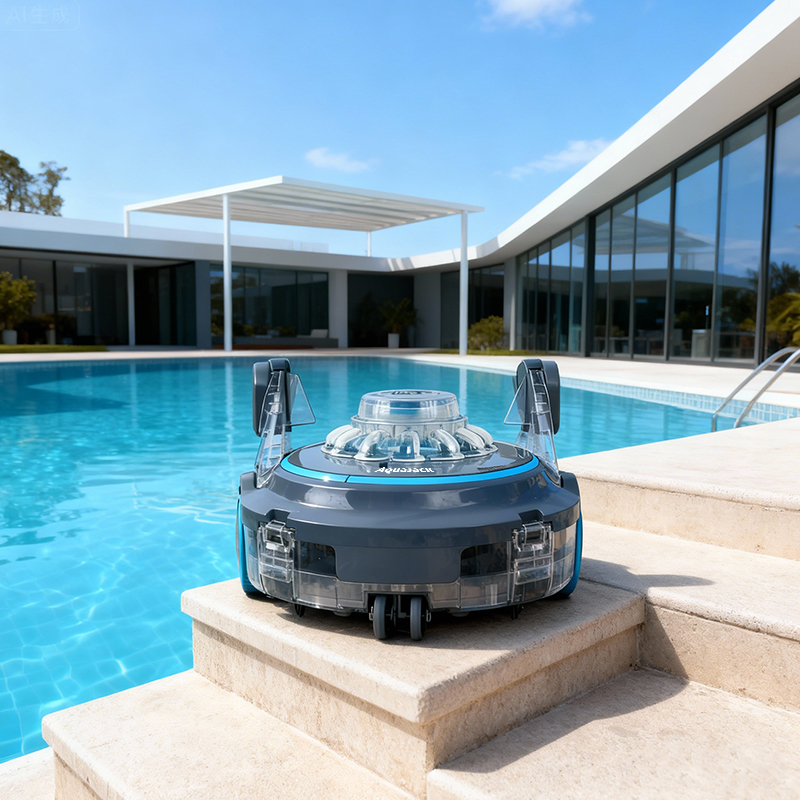
In a manual floor-vacuum step, the technician is the vacuum: pole, hose, head, and the physical minutes it takes to cover the floor footprint. In a drop-and-go robotic cleaning step, the technician places the AquaJack 700 cordless robotic pool cleaner in the pool at the start of the stop, runs the cycle while doing chemistry and filter work, and retrieves the robot at the end of the stop. Because the technician is no longer the vacuum, the minutes that were absorbed by manual vacuuming are released back into the stop — and on a typical residential stop that release is a meaningful fraction of the on-site total.
Cycle time, battery life, and pool-size coverage
For a residential pool, the relevant cycle time on a cordless robotic cleaner is typically in the order of a couple of hours, with a battery life long enough to cover multiple stops on a single charge when the technician rotates robots between pools. Because a service route does not need a robot to clean a single pool in under thirty minutes, the engineering question is not “how fast” but “how long on a charge and how many pools per day per robot” — and that question is the one the fleet math actually answers.
Filter-loading, basket emptying, and downstream steps
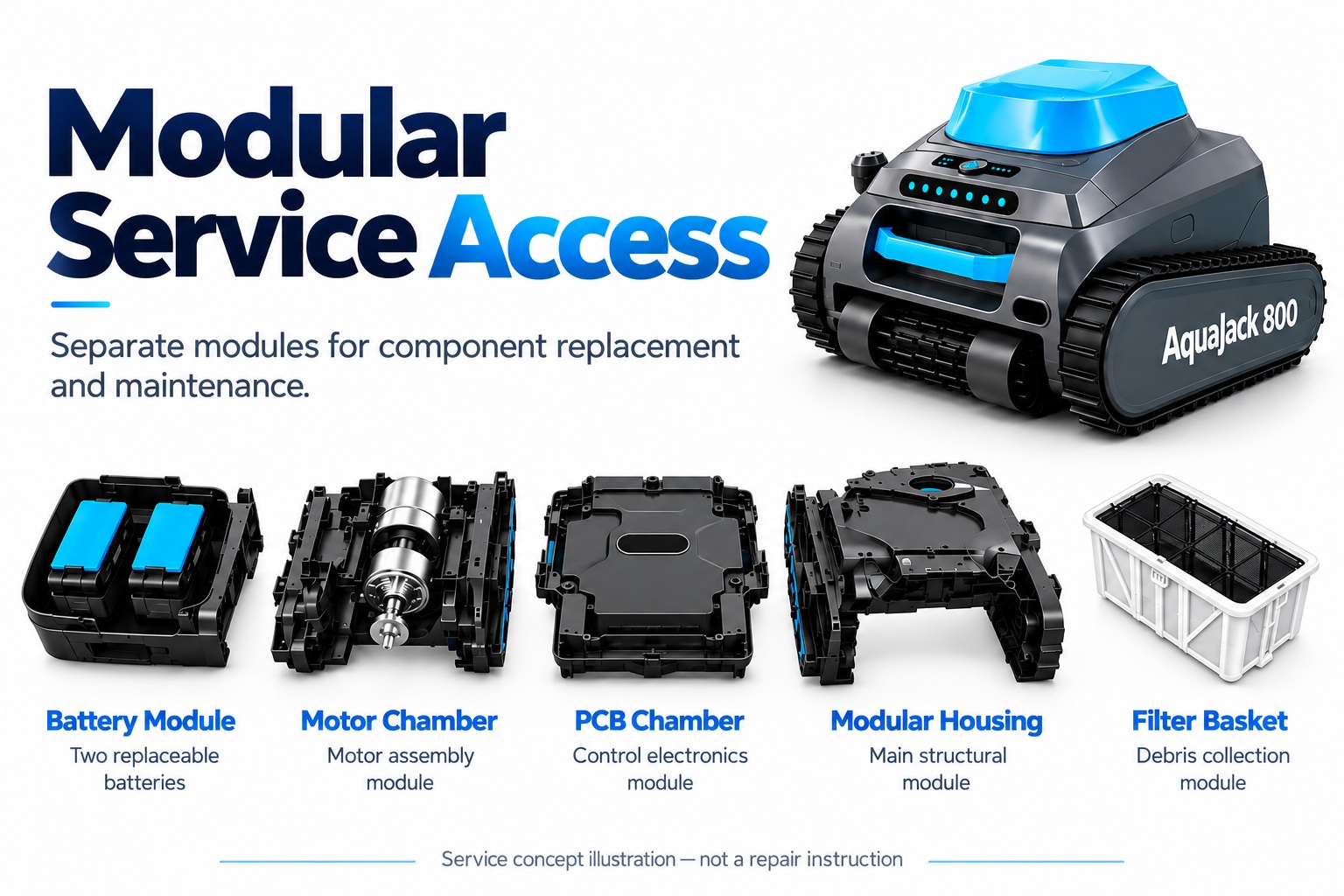
Robotic cleaners do not eliminate filter and basket work, but they do change its character. The technician is emptying a small, easy-to-handle basket instead of a vacuum head and a pump strainer in sequence. Because the basket-empty step is faster and less messy than the manual strainer-clean step, the technician spends less time bent over the equipment pad and more time talking to the customer.
How Should a Service Company Model Pool Robot ROI Before Buying a Fleet?
The fleet payback model is short, and once a service company writes it down honestly the answer is usually obvious. The mistake I see most often is treating the robot as a single-stop productivity tool and ignoring the weekly compounding.
The four inputs that actually drive the math
There are four numbers that drive the entire payback model: recovered minutes per stop, stops per week per route, billable rate per stop, and the per-unit cost of the robot amortized over its expected service life. Because the first three numbers are local to the company's own routes, the only number that varies between suppliers is the per-unit cost and the service-life estimate — and a supplier who refuses to put a service-life estimate in writing is a supplier whose math the company should not trust.
Per-stop recovered minutes times stops per week
The first multiplication is per-stop minutes times stops per week. A company running five routes a week, with eight stops per route, multiplies recovered minutes by forty to get the weekly minutes released. Because released minutes are the input that converts into additional stops, additional billings, or additional recovery time for the technician, this is the number the company should track weekly once robots are deployed.
From weekly minutes to annual route capacity
The second multiplication is weekly minutes by fifty weeks, divided by the average on-site minutes per stop, which converts recovered minutes into additional annual stops the route can carry. Because additional stops at the existing billable rate are essentially incremental margin, the annual route-capacity number is what should be compared against the robot's per-unit cost.
Honest service-life assumptions
The third input is service life, and it is the input most likely to be inflated. A consumer-grade cleaner rated for occasional residential use is not the same product as a commercial-duty unit engineered for daily route deployment, and conflating the two is how fleet ROI models collapse. Because the robot's expected service life in commercial duty is the single most sensitive input in the payback model, the procurement team should ask the supplier for a service-life statement tied to a commercial-use cycle count, not a generic residential warranty.
How Do Cloud-Connected Robots Change the Service Company Operating Model?
The next step in the ROI conversation is the cloud-connected operating model, and it is the step most service owners underestimate. Cloud control for service efficiency is not a feature on the robot — it is a new operating model for the company.
Cycle confirmation without staying beside the pool
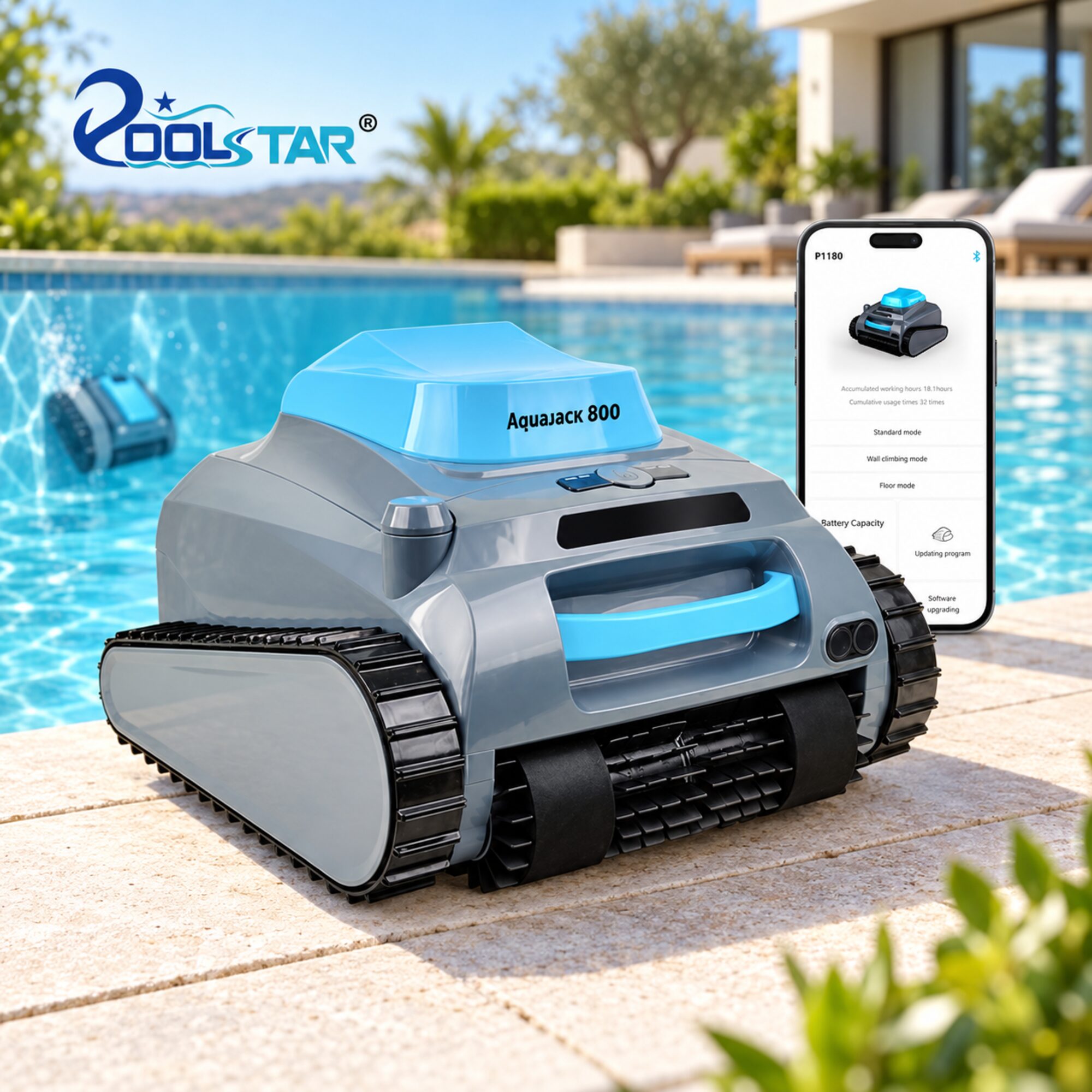
On a connected stop, the technician can drop the robot, leave the pool area, finish chemistry and filter work elsewhere on the property, and confirm cycle completion from a phone screen. Because the technician no longer has to stay beside the pool to monitor the cycle, the on-site minutes that the robot occupies can be spent on higher-value work.
Remote diagnostics and reduced callback trips
A connected robot surfaces diagnostics that a non-connected robot cannot. Battery health, cycle history, filter-load status, and any error condition are visible from the office without a callback trip. Because a service company that can read a robot's status remotely can dispatch a replacement robot or a service visit before the customer notices a problem, the callback-trip reduction is often a meaningful line item in the operating model.
Fleet visibility for the owner or operations manager
For the owner or operations manager, the cloud-connected fleet is a visibility layer. Every robot is on a dashboard, every cycle is logged, every battery state is readable from the office. Because route planning, robot rotation, and service-life tracking all become data problems instead of guesswork, the connected fleet is what makes a multi-route service company scalable without proportionally scaling the back office.
What Operational Questions Should a Pool Service Company Ask Before Standardizing on Robots?
Standardization is the moment when the fleet math either compounds or breaks. The questions below are the ones I would expect a serious operations manager to put in writing before signing a fleet order.
- What is the expected service life in commercial duty, in cycle count or in years? A consumer warranty is not a service-life statement. Ask for the supplier's commercial-duty cycle count in writing.
- What is the per-stop minute recovery on a typical residential pool in our route mix? Ask the supplier for case-study data on similar pools, and run a four-week pilot on one route before standardizing.
- What is the per-unit cost amortized over the service life, including battery replacement? Battery replacement is a real cost line; ask for the battery's expected cycle count and the cost of a replacement pack.
- What is the cloud platform's data ownership, retention, and export policy? Operational data generated by the fleet should belong to the service company, not the supplier. Get the data policy in writing.
- What is the supplier's service and warranty turnaround time for commercial customers? A consumer-grade repair cycle does not work in a daily route. Ask for the commercial service-level commitment, not the residential one.
How Should a Service Company Track the Route-Time Wins After Deployment?
Tracking is the part most service companies skip, and it is the part that determines whether the fleet math holds up across a year.
Per-stop minutes, measured weekly
The first metric is per-stop minutes, measured weekly, on a representative sample of pools. Because per-stop minutes are the only metric that converts directly into additional stops, additional billings, and additional route capacity, the weekly measurement is the one the operations manager should review with the technician team every Monday morning. A small change in per-stop minutes, sustained across a quarter, is what compounds into a route-capacity gain.
Robot utilization and battery health
The second metric is robot utilization and battery health, which the cloud platform surfaces automatically. Utilization tells the operations manager how many pools each robot is cleaning per day, and battery health tells them when a pack is approaching end of life. Because underutilized robots are a hidden cost and end-of-life batteries are a sudden cost, the utilization and battery metrics are the ones that keep the fleet's effective per-unit cost honest.
Frequently Asked Questions
How many minutes does a robotic pool cleaner actually save per stop?
On a typical residential stop, the recovered minutes depend on pool size, debris load, and the technician's manual pace. The number I see most often is a single-digit to low-double-digit minute recovery on a standard residential pool. Because per-stop minutes are the only number that compounds into additional stops, the right question is not “how many minutes per stop” but “how many additional stops per route per week.”
Is cordless better than corded for service-company routes?
For most service routes, yes. A cordless robot removes the cable-management step, which is itself a source of on-site minutes, and it lets the technician rotate robots between pools without dragging a long cable through the customer's yard. Because cable management is a hidden time line on corded deployments, a cordless robotic cleaner usually returns a small additional minute saving per stop — and that compounds across a full week of routes.
How long does the battery last in commercial service-company use?
Battery life depends on cycle count, pool size, and the cleaning mode. For a commercial-duty cordless unit on residential pools, the typical daily duty cycle is a small number of full cycles per day, and the expected battery service life is a multi-year window in that duty profile. Because the battery is the single most likely consumable in a robotic cleaner fleet, the operations team should ask for the battery's cycle count spec and the cost of a replacement pack before standardizing the fleet.
Can one robot cover a full route of eight or ten stops?
One robot can cover a small number of stops per day on a single charge, but a full route usually needs two or three robots rotating through pools while the previous one recharges. Because the bottleneck is the battery's daily cycle count, the fleet math has to include the right number of robots per route to keep the per-stop minute saving consistent across the day.
What is the actual payback period for a service-company robot fleet?
Payback depends on per-stop minute recovery, stops per week, billable rate, and the robot's per-unit cost amortized over service life. Because the per-stop minute recovery is the most variable input, the only honest answer is the one the company calculates from its own route sheets — the most common range I see in field pilots is payback within a small number of service seasons.
Does the cloud platform actually change the operating model?
Yes, in two specific ways. First, the technician is no longer required to stay beside the pool to monitor the cycle. Second, the operations manager gains fleet-wide visibility that is not possible with non-connected robots. Because the connected operating model is what makes a multi-route service company scalable without proportionally scaling the back office, the cloud platform drives the strongest per-route ROI in the second year of deployment — not the first.
Is a robotic cleaner worth it for a small two-person service company?
Often yes, and the smaller the company, the more concentrated the per-stop minute saving is. A two-person company running two routes a day, five days a week, gets the same compounding benefit per robot as a large fleet, just on a smaller absolute base. Because the recovered minutes are the same on a per-stop basis, the proportional impact on weekly route capacity is larger for a small company than for a large one.