
 +86-574-5680 8878


0102030405
Sizing Solar Panels for Pool Pumps: A Worked Example (2026)
2026-09-09
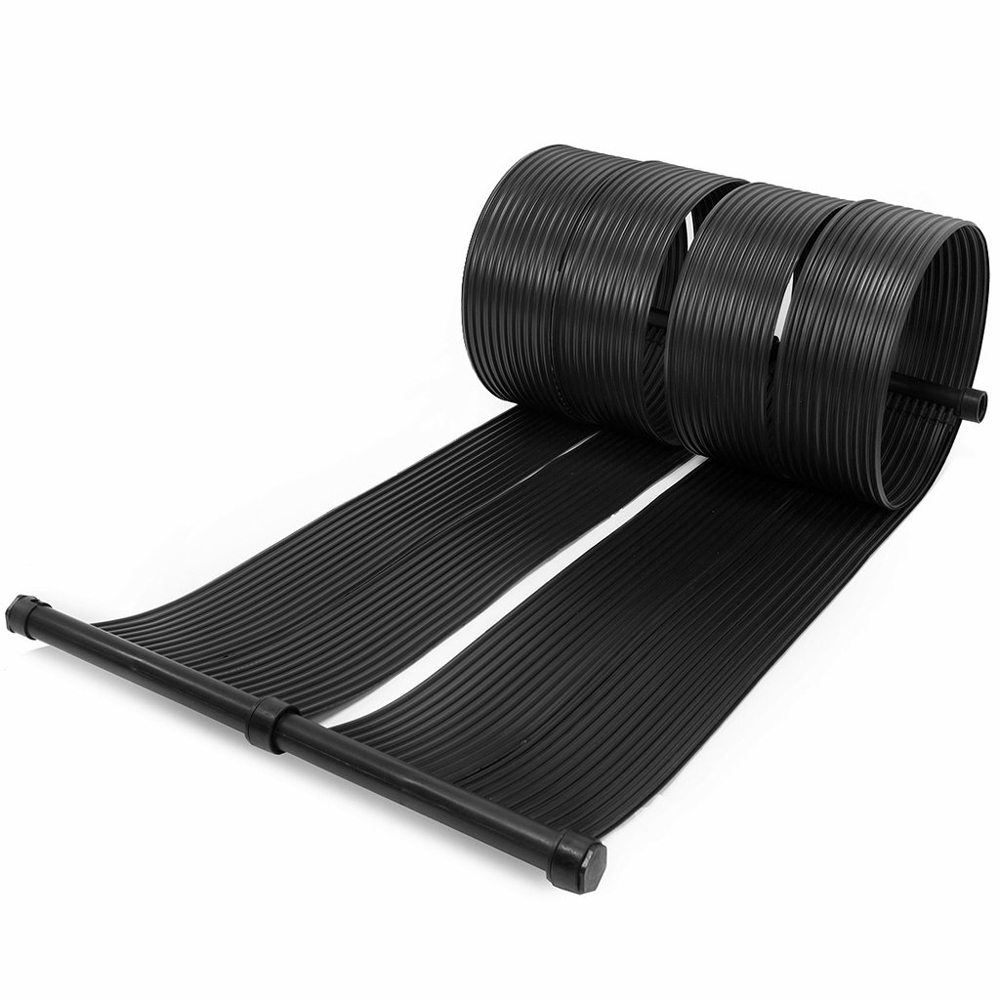
If you have ever tried to size a solar pool heating system from a forum post, you already know how the conversation usually goes. Someone says "1 square meter per 1,000 liters," someone else says "half the pool surface," and a third person chimes in with "just add another panel." None of those answers is wrong on its own, but none of them is a calculation either.
What follows is the actual calculation, end to end, applied to a real pool, a real pump, and a real product line — the Poolstar P2650–P2653 solar heating series. By the end you will have a defensible panel count, a panel model, and a clear list of the assumptions you need to verify before placing an order. Because solar panel for pool pump sizing is a chain of four coupled decisions — energy budget, square-meter budget, panel selection, and hydraulic compatibility — skipping any one of them produces a system that either underperforms on cold mornings or trips its pump on hot afternoons.
The Reference Pool: Inputs That Drive Everything Else
To make the math concrete, this worked example uses a single residential pool from start to finish. The numbers below are the ones I will carry through every later section, so you can swap in your own at each step and re-derive a result.
| Parameter | Reference Value | Where to Find Yours |
|---|---|---|
| Pool volume | 50 m³ (roughly 10 × 4 × 1.25 m) | Length × width × average depth |
| Pool surface area | 40 m² | Length × width |
| Pump model | 0.75 HP variable-speed pool pump | Nameplate on the pump |
| Pump nominal flow at filter | 10 m³/h (about 167 L/min) | Pump curve at current filter setting |
| Target temperature lift on a sunny day | +6 °C above unheated pool | Owner preference; usually 4 to 8 °C |
| Climate | Temperate, swim season May to September | Local peak-sun-hour table |
| Roof orientation | South-facing, 30° tilt | Compass + roof angle |
| Available roof area for panels | 12 m² clear of shade 9 a.m. to 4 p.m. | Measured on the roof |
Why these eight inputs: Volume and surface area set the thermal mass and the heat-loss floor. Pump size and flow set the hydraulic ceiling. Temperature lift sets the energy budget. Climate sets the available solar resource. Roof orientation and area set the geometric ceiling. If any of these inputs is wrong by more than about 20 percent, the panel count will be wrong by roughly the same factor.
Step 1 — Convert the Temperature Lift into a Daily Heating Budget
A pool is just a very large mass of water with a defined specific heat. Raising 1 kg of water by 1 °C takes 4,186 joules, or 1.16 watt-hours. For the full 50 m³ pool, that scales linearly:
Energy budget per °C of lift50 m³ × 1,000 kg/m³ × 1.16 Wh/(kg·°C) = 58,000 Wh = 58 kWh per °C
For a target lift of 6 °C on a sunny day, the gross daily heating budget is:
Gross daily energy budget58 kWh/°C × 6 °C = 348 kWh per day
This is the upper bound. Real solar collectors cannot deliver all of it because of optical losses, header losses, and the fact that the pool is also losing heat to the air and ground at the same time it is gaining heat from the panels. The next step applies those losses.
Step 2 — Translate the Energy Budget into Square Meters of Panel
Unglazed polypropylene solar collectors of the type Poolstar manufactures typically deliver between 500 and 700 W per square meter at peak insolation. For a sunny May afternoon at mid-latitude, peak insolation on a south-facing 30° tilt panel is about 900 W/m²; after optical losses and the temperature-dependent efficiency drop, the realistic peak delivery is around 600 W/m².
The next variable is how many hours of useful sun the panel actually sees. Peak-sun-hour (PSH) values for the swim season are usually 4 to 6 h/day in temperate climates, 5 to 7 in subtropical ones, and 6 to 8 in desert or Mediterranean belts. For our reference pool in a temperate climate, I will use 5 PSH/day.
Daily energy per square meter of panel600 W/m² × 5 h = 3,000 Wh = 3 kWh per m² per day
Required panel area before system losses348 kWh ÷ 3 kWh/m² = 116 m² of gross panel area
116 m² is an obvious impossibility on a 12 m² residential roof, so the answer cannot be "heat the whole 50 m³ pool by 6 °C in one sunny day." The honest target is "extend the swim season by several weeks and add a few degrees on typical sunny days," and the honest sizing rule is based on pool surface area, not on a one-day full-lift scenario.
Step 3 — Use the Pool-Surface Rule, Then Adjust for Climate
The rule residential solar pool heating installers have converged on over the past two decades is to start at 50 to 100 percent of the pool's surface area, then shift up or down for climate:
- Temperate swim season (May to September): 75 to 100 percent of pool surface area.
- Cool temperate or short season: 100 to 125 percent, because peak-sun hours are lower and air temperatures reduce net gain.
- Subtropical to tropical: 50 to 75 percent, because the goal shifts from season extension to comfort lift and the solar resource is stronger.
For our 40 m² pool in a temperate climate, the starting band is 30 to 40 m² of panel. That is still bigger than the available 12 m² of roof, so we are constrained by roof real estate, not by the math — and the realistic outcome is that the system will lift the pool by 3 to 4 °C on a sunny day, not the 6 °C the gross budget assumed. That is normal and is what every residential solar pool heater actually delivers.
Practical insight: Solar pool heating is a season extender, not a thermostat. A correctly sized residential array in a temperate climate typically adds 3 to 6 °C on a sunny day and extends the swim season by 6 to 10 weeks at each end. Buyers who expect "set it to 28 °C and walk away" end up disappointed; buyers who expect "April swims instead of June swims" are delighted.
Step 4 — Pick the Panel Model and Count
Now we have a target of 12 m² of roof area. Each Poolstar panel in the series has the same 76 cm width and 6 cm depth, with lengths from 300 cm (P2650) to 700 cm (P2651). The collector area per panel is therefore just width × length:
| Model | Dimensions (L × W × D) | Collector Area | Panels for 12 m² |
|---|---|---|---|
| P2650 | 300 × 76 × 6 cm | 2.28 m² | 5 to 6 panels |
| P2652 | 480 × 76 × 6 cm | 3.65 m² | 3 to 4 panels |
| P2653 | 600 × 76 × 6 cm | 4.56 m² | 2 to 3 panels |
| P2651 | 700 × 76 × 6 cm | 5.32 m² | 2 to 3 panels |
For this pool, the practical choice is 2 × P2653 (600 × 76 cm each, 9.12 m² total). Three reasons drive the choice over P2651 or four P2650 panels:
- Hydraulic friction. Each additional panel and each additional coupler adds about 0.05 to 0.1 m of head loss at design flow. Two long panels create less total friction than four short panels.
- Heat gain per unit friction. Long panels give water more dwell time under the absorber, so a 600 cm panel typically outperforms two stacked 300 cm panels for the same roof footprint and the same pump load.
- Installation footprint. Two 600 cm panels fit a typical residential roof slope with one continuous manifold run, while four 300 cm panels require extra couplers and more roof penetrations.
If the climate were cooler, the right move would be to step up to 3 × P2653 (13.68 m²), accepting that the array now slightly exceeds the conservative 12 m² roof assumption. That extra ~14 percent over the basic 12 m² roof area is the difference between a temperate-climate install and a cool-climate install in the same product family.
Step 5 — Verify the Pump Can Push Water Through the Array
The most common reason residential solar pool heating systems underperform is that the pump is barely able to push water through the array once the filter, heater, and solar panels are all in series. The hydraulic check is short and worth doing before any panel is bolted to a roof.
The reference pump delivers 10 m³/h (167 L/min) at the filter with no solar array attached. Industry guidance for 2-inch header collectors is to operate between 30 and 80 L/min per panel. For two P2653 panels in parallel, the array flow target is roughly 60 to 160 L/min combined — comfortably within the pump's output. If we instead chose four P2650 panels in series, the same flow target would drop to 30 to 80 L/min total, which would starve the panels and reduce heat transfer dramatically.
Hydraulic sanity checkPump flow: 167 L/min
Two P2653 panels in parallel, 2-inch headers, target 30 to 80 L/min per panel: 60 to 160 L/min combined — within range
Expected friction loss across both panels + 6 m of 2-inch pipe: roughly 0.6 to 1.0 m of head
Pump head available at 167 L/min: about 8 m — ample margin
Two P2653 panels in parallel, 2-inch headers, target 30 to 80 L/min per panel: 60 to 160 L/min combined — within range
Expected friction loss across both panels + 6 m of 2-inch pipe: roughly 0.6 to 1.0 m of head
Pump head available at 167 L/min: about 8 m — ample margin
If the available margin were less than about 2 m of head, the right move would be to drop one panel from the array, not to oversize the pump. Pump energy use is the largest operating cost of any solar pool heating system, and over-pumping to chase a few extra degrees is almost always a worse trade than sizing the array to the pump.
Step 6 — The Controller, Bypass, and Where Energy Actually Goes
Residential solar pool heating systems use a small differential temperature controller to decide whether flow should go through the panels or bypass them. The controller continuously compares roof temperature to pool temperature and diverts flow to the panels only when the roof is several degrees warmer than the pool — usually 4 to 6 °C of differential. Below that threshold, the bypass valve routes water straight back to the pool, because circulating pool water through a cool panel would lose heat rather than gain it.
The bypass valve, the actuator, and the controller should be sized to the same flow range as the panels — typically a 2-inch motorized ball valve or a 3-way diverting valve matched to the pump's flow at the design point. This is also where most DIY installations go wrong: undersized valves create pressure spikes that can trip the pump's thermal overload on a hot afternoon.
For an at-a-glance summary of how the full chain of decisions flows, this is the same logic Poolstar's service team uses internally when we review a customer sizing request before quoting:
- Measure the pool, the pump, the climate, and the roof.
- Set a realistic temperature-lift target — 3 to 6 °C per sunny day for residential, not 10 °C.
- Budget 50 to 100 percent of pool surface area as the starting panel area.
- Constrain by available roof real estate, then pick the panel model that maximizes collector area per friction-loss unit.
- Verify the array's flow range sits inside the pump's usable band after friction losses.
- Complete the system with a properly sized differential controller, motorized bypass valve, and a check valve on the return line.
Sizing for Different Pool Types: How the Math Changes
The same six-step logic applies to almost any pool, but the panel-area-per-pool-surface-area band shifts with use case. Here is how the result changes for the four most common residential and light-commercial scenarios:
| Pool Type | Typical Surface | Panel Area Starting Point | Reference Poolstar Array |
|---|---|---|---|
| Small backyard plunge pool (20 m³) | 15 m² | 8 to 12 m² | 2 × P2652 or 1 × P2653 + 1 × P2650 |
| Standard residential (40 to 60 m³) | 25 to 40 m² | 15 to 30 m² | 2 to 3 × P2653 |
| Larger residential or small commercial (80 to 120 m³) | 50 to 80 m² | 35 to 60 m² | 4 to 6 × P2653, parallel banks |
| Public or semi-public high-bather-load pool | 100 m² and up | 50 to 100 m² (cap by roof) | Use the high-capacity pump reference for matching flow first, then size panels to hydraulic ceiling |
"For high-bather-load pools, panel sizing is the easy part. The hard part is matching the circulation pump to the array's hydraulic ceiling. If the public-pool designer doesn't anchor that decision first, no amount of panel area will fix water clarity." — Poolstar commercial-pool engineering desk
For buyers comparing panel options before placing a procurement order, the Poolstar solar panel category page shows the full P2650–P2653 series along with mounting hardware, coupler kits, and the universal 32 to 38 mm hose / D50 mm PVC adapter that ships with each panel.
Common Sizing Mistakes and How to Avoid Them
- Confusing pool area with roof area. A 50 m³ pool needs roughly 30 to 40 m² of panel; a 50 m³ pool sitting on a 50 m² roof still only has the 30 to 40 m² it needs, not 50 m².
- Sizing to annual average solar resource. The swim season is the constraint. Use spring/autumn peak-sun-hour values, not the annual figure that includes cloudy winter months.
- Ignoring shade. A south-facing roof shaded by a single tree between 10 a.m. and 2 p.m. can lose a third of its daily heat gain. Measure shade before measuring the roof.
- Oversizing the array for the pump. If the pump cannot push the design flow, the array underperforms and the pump overheats. Drop a panel before you oversize the pump.
- Forgetting the bypass. Without a working differential bypass, the array becomes a heat sink at night and on cold mornings, slowly cooling the pool instead of warming it.
Frequently Asked Questions
How many solar panels does a typical residential pool pump need?
For a typical 40 to 60 m³ residential pool with a 0.5 to 1.0 HP pump running 4 to 6 hours per day in a temperate climate, a single P2651-class collector (about 700 × 76 cm) usually matches the pump's flow rate and adds roughly 11 to 15 °C of warming on a sunny day. Most homes end up with 2 to 4 panels connected in series to balance roof area, pump head, and target temperature lift.
Does a solar pool panel need to match my pool pump's flow rate?
Yes. A solar heating panel must operate within its published flow range, typically 30 to 80 L/min for a residential 2-inch header collector. Below that range, water stratifies inside the absorber and heat transfer collapses. Above it, the pump works against excessive back pressure, which can trip thermal overloads on smaller pumps and waste energy on larger ones.
What size solar panel array heats a pool faster: longer panels or more of them?
Within the same total square-meter budget, a small number of long panels tends to heat faster than a larger number of short panels because the longer flow path gives water more dwell time under the absorber. The trade-off is hydraulic: longer panels create more friction loss, so the pump must be able to push the design flow through them without starving the filter circuit. For most residential pumps, two P2653 panels (600 × 76 cm each) outperform four P2650 panels (300 × 76 cm each) for the same roof footprint, because the hydraulic penalty is lower than the heat-gain gain.
Can I run my pool pump directly from solar panels?
Indirectly, yes — almost every modern solar pool heating system uses the existing AC pump to push water through the solar collectors, with a small solar controller diverting flow to the panels when roof temperature is high enough and back to the normal circuit when it is not. Direct DC pump operation from solar panels is possible for very small booster pumps but is not how residential pool heating is normally wired.
What roof orientation and tilt give the best solar pool heating?
In the northern hemisphere, a south-facing roof at a tilt roughly equal to the local latitude captures the most energy over a swim season. East- and west-facing roofs still work but lose 10 to 20 percent of usable heat gain. Flat-roof mounting is fine if the panels are tilted to within 15 degrees of latitude. Shade from trees or chimneys between roughly 9 a.m. and 4 p.m. is the single biggest performance killer — even partial morning shade can drop daily heat gain by a third on a clear day.