
 +86-574-5680 8878


0102030405
What Happens When Water Gets Into a Cordless Pool Robot?
2026-09-28
What Happens When Water Gets Into a Cordless Pool Robot?
A cordless robotic pool cleaner is designed to operate in a demanding environment.
It repeatedly enters the pool, moves underwater, climbs or travels across wet surfaces, collects debris and then returns to be removed, cleaned and recharged.
Because of this, water management is one of the most important considerations in robotic pool cleaner design.
The battery, motor, electronics and other electrical components need appropriate protection from the pool environment.
But what happens if water reaches a component that is supposed to remain dry?
And perhaps more importantly:
What happens when that component needs to be serviced or replaced?
The answer depends heavily on the product's architecture.
A highly integrated design may make component-level service more complicated.
A modular design can provide a different approach: identify the affected module, service or replace it, and preserve the rest of the machine when practical.
This is one of the reasons serviceability by design matters in cordless robotic pool cleaners.
Why Water Protection Matters in a Pool Robot
A pool robot operates in an environment that combines:
-
Water
-
Moisture
-
Pool chemicals
-
Temperature changes
-
Repeated immersion
-
Mechanical movement
-
Charging and electrical systems
The machine therefore needs appropriate sealing, housing and electrical protection.
A well-designed robotic pool cleaner should be engineered so that water remains separated from components that require a dry environment.
This is particularly important for:
-
Battery
-
Electronic control components
-
Charging interfaces
-
Motor-related electrical components
Water resistance is not simply a marketing specification.
It is part of the product's overall engineering.
What Can Happen If Water Reaches an Electrical Component?
The consequences depend on where the water enters, how much enters, how long it remains there and which component is affected.
Potential problems may include:
-
Electrical malfunction
-
Corrosion
-
Reduced battery performance
-
Charging problems
-
Motor problems
-
Intermittent operation
-
Complete component failure
A water-related problem should therefore be treated seriously.
Users should always follow the manufacturer's inspection and safety instructions rather than continuing to operate or charge a machine that shows signs of abnormal electrical behavior.
The Important Question: Does One Failed Component Mean the Whole Robot Must Be Replaced?
Not necessarily.
This is where product architecture becomes important.
Consider a robotic pool cleaner containing several major systems:
Battery
Motor
Electronics
Filtration
Mechanical structure
If one component develops a problem, the condition of the other components may be completely different.
For example:
A battery can fail while the motor and mechanical structure remain usable.
Or:
A motor module can require service while the battery remains functional.
This raises an important engineering question:
Can the affected component be serviced independently?
That is one of the fundamental advantages a modular architecture is designed to provide.
Integrated Design vs. Modular Design
There are different ways to build a cordless robotic pool cleaner.
Some designs integrate multiple components into a compact assembly.
Others separate important functions into modules.
Neither approach automatically determines whether a product is reliable.
However, the architecture can make a significant difference when maintenance is required.
| Situation | Highly Integrated Architecture | Modular Architecture |
|---|---|---|
| Battery problem | May require extensive service | Battery module can be addressed separately |
| Motor problem | May require more disassembly | Motor module can be addressed separately |
| Water-related component failure | Service complexity depends on construction | Affected module can potentially be isolated |
| Spare-part replacement | May involve larger assemblies | More suitable for component-level replacement |
| After-sales approach | Can be more replacement-oriented | Can support component-level service |
The key word is potentially.
Modular design does not eliminate failures.
It provides a product architecture that can make selected failures easier to diagnose and service.
Why Battery Protection and Battery Replacement Are Different
These two concepts are often confused.
Battery Protection
The product is designed to prevent water and other environmental factors from reaching the battery.
Battery Replacement
If the battery eventually reaches the end of its useful life or requires replacement, the product provides a practical way to replace it.
A good cordless pool cleaner needs to consider both.
The goal is not:
“The battery can be replaced, so sealing does not matter.”
The goal is:
Protect the battery during normal operation, while also making battery service practical when service is eventually required.
This is a much more useful way to think about product design.
What If the Battery Has Been Exposed to Water?
If there is any indication that water has reached the battery compartment or battery itself, users should stop and follow the manufacturer's safety instructions.
Do not assume that a wet battery is safe simply because the machine still turns on.
Depending on the situation, appropriate service may include:
-
Stop using the product.
-
Do not charge a potentially damaged battery unless instructed by the manufacturer.
-
Inspect the relevant area according to the service procedure.
-
Have the battery or affected component assessed if necessary.
-
Replace the affected component if required.
The exact procedure depends on the product architecture and the nature of the damage.
This is another reason why serviceable battery architecture can be valuable.
Why a Modular Battery Can Make After-Sales Service More Practical
Imagine a cordless robotic pool cleaner with an integrated battery.
A battery-related problem occurs.
The service provider needs to determine whether the battery can be safely accessed and replaced.
Depending on the construction, this may involve significant disassembly.
Now consider a product with a dedicated battery module.
The service process can be more straightforward:
Identify battery-related problem
↓
Remove battery module
↓
Inspect / replace module
↓
Test the machine
↓
Return to operation
The exact service process will always depend on the manufacturer's service procedures.
But separating the battery as a module creates a clear boundary between the battery and the rest of the machine.
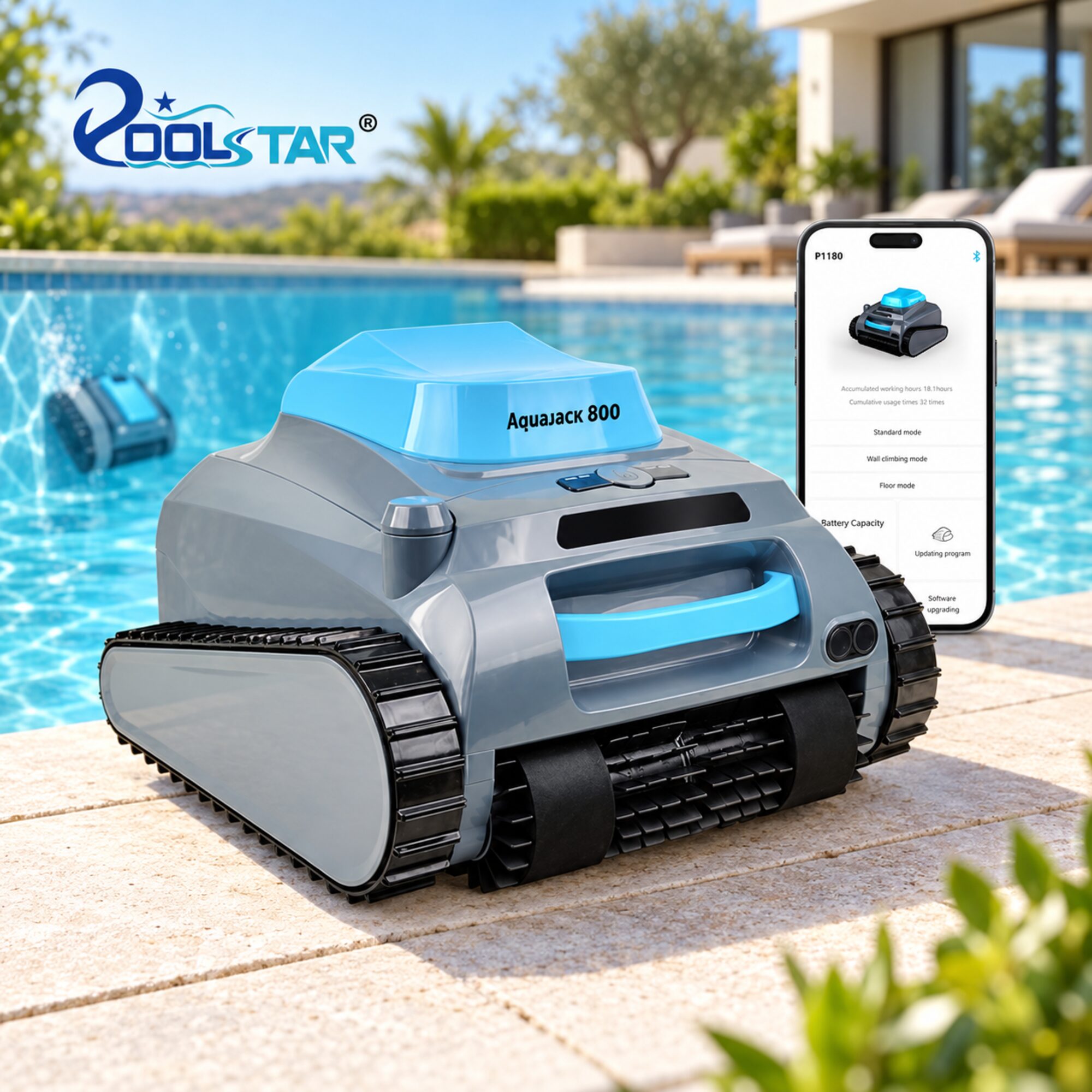
AquaJack 800: Separating Serviceable Components
AquaJack 800 was designed with this service philosophy in mind.
Its modular architecture separates important components so that selected parts can be addressed individually during service.
The battery is designed as a removable battery module.
The motor is designed as a serviceable motor module.
This means that the machine is not designed around the assumption that every major component must remain permanently integrated throughout the entire ownership period.
Instead:
Battery
→ removable / replaceable
Motor
→ serviceable module
Other components
→ maintained according to the applicable service procedure
The objective is simple:
Make the machine more serviceable over its useful life.
Modular Design Does Not Replace Good Sealing
It is important to make one point very clear:
Modular design is not an alternative to proper waterproofing and sealing.
A pool robot must first be properly engineered for its intended underwater environment.
Modularity addresses a different problem.
Water protection
Helps prevent water from reaching protected components during normal operation.
Modularity
Helps make selected components more accessible when maintenance or replacement is required.
These are complementary design principles.
A well-designed pool robot needs both.
Why This Matters After Several Seasons
A new robotic pool cleaner may perform perfectly when it first enters the pool.
But long-term ownership is different.
After repeated:
-
Charging cycles
-
Pool cleaning cycles
-
Temperature changes
-
Immersion
-
Handling
-
Storage
-
Maintenance
individual components can eventually require attention.
This is normal for equipment that is used repeatedly.
The important question is what happens at that point.
A product designed only around initial performance asks:
How well does it work when new?
A service-oriented product also asks:
How can it be maintained after years of use?
That second question is increasingly important for cordless pool equipment.
Two Batteries Add Another Layer of Flexibility
AquaJack 800 can accommodate two battery modules.
Each battery can provide up to approximately two hours of operation, depending on operating conditions and usage.
Used sequentially, two batteries can provide:
Up to approximately 4 hours of total cleaning operation.
For example:
Battery 1
→ Up to 2 hours
↓
Battery 2
→ Up to another 2 hours
↓
Total
→ Up to 4 hours
The two-battery system provides more than additional runtime.
It also fits the modular architecture.
A battery becomes a separate component that can be removed, exchanged and serviced according to the manufacturer's procedures.
What Should Buyers Look For?
When purchasing a cordless robotic pool cleaner, waterproofing is obviously important.
But buyers should also look beyond the basic water-resistance question.
Consider asking:
1. How is the battery protected?
Look for information about the manufacturer's sealing and battery-protection design.
2. Can the battery be replaced?
A rechargeable battery is a component that can age over time.
3. Can the motor be serviced?
Ask whether the motor is accessible as a serviceable component.
4. What happens if a water-related problem occurs?
Understand the manufacturer's inspection and after-sales process.
5. Are replacement components available?
A modular architecture is more valuable when replacement modules and service support are available.
6. Who performs the repair?
Check whether replacement is intended for the end user, an authorized service center or a qualified technician.
What Should Pool Distributors Consider?
For a pool distributor, water-related failures can become more than a technical problem.
They can become an after-sales problem.
A customer may report:
“The robot stopped working.”
The actual cause could be:
-
Battery problem
-
Charging problem
-
Motor problem
-
Electronics problem
-
Water ingress
-
Mechanical issue
A modular architecture can potentially help the service team isolate the affected component instead of immediately treating the entire machine as a replacement unit.
This can support a more structured after-sales system:
Diagnose
↓
Identify module
↓
Replace / service component
↓
Test
↓
Return to customer
For distributors managing thousands of units over several seasons, this service-oriented approach can be commercially meaningful.
A Better Question for Long-Term Ownership
When evaluating a cordless robotic pool cleaner, consumers often ask:
“Is it waterproof?”
That is important.
But there is another question worth asking:
“What happens if something eventually goes wrong?”
Good product design should address both questions.
How does the product protect its critical components?
and
How can those components be serviced when necessary?
The first is about reliability.
The second is about serviceability.
Together, they contribute to a better long-term ownership experience.
AquaJack 800: Designed With Serviceability in Mind
AquaJack 800 combines:
-
Modular construction
-
Removable battery module
-
Serviceable motor module
-
Two-battery capability
-
Up to approximately four hours of total operation with two batteries used sequentially
The philosophy is straightforward:
Protect the components during normal operation.
Make important components serviceable when required.
Replace individual components when practical.
Keep the machine in service for as long as its overall condition allows.
That is what serviceability by design means.
Final Takeaway
A cordless robotic pool cleaner operates in water, so protection against water ingress is fundamental.
But long-term product design should not stop at waterproofing.
A battery can age.
A motor can eventually require service.
Electrical components can develop problems.
When that happens, the architecture of the product determines how the problem can be addressed.
A highly integrated product may require more extensive service depending on its construction.
A modular product can provide a more practical path toward component-level inspection, replacement and repair.
AquaJack 800 takes this approach with a removable battery module and a serviceable motor module.
Because the goal of a long-life pool robot is not simply to prevent every possible failure.
It is also to make the product more practical to maintain when maintenance eventually becomes necessary.
Protect the machine. Service the components. Extend the product's useful life.
That is the thinking behind AquaJack 800.