
 +86-574-5680 8878


0102030405
Why Modular Design Matters in a Cordless Robotic Pool Cleaner
2026-09-27
Why Modular Design Matters in a Cordless Robotic Pool Cleaner
When choosing a cordless robotic pool cleaner, most buyers naturally focus on cleaning performance, battery runtime, navigation and price.
But there is another question that is often overlooked:
What happens when one of the important components eventually needs to be replaced?
A cordless robotic pool cleaner is still a piece of equipment with batteries, motors, electronics, seals and other working components. Over time, some of these components may require maintenance or replacement.
This is where modular design can make a meaningful difference.
A modular robotic pool cleaner is designed so that important components can be accessed, removed and replaced more easily, rather than treating the entire machine as one highly integrated unit.
For pool owners, this can mean easier maintenance and potentially longer product service life. For pool distributors, it can also mean a more service-friendly after-sales model.
What Is a Modular Robotic Pool Cleaner?
A modular robotic pool cleaner is designed around separate functional modules.
Instead of integrating every major component into one difficult-to-service assembly, the product architecture allows selected components to be independently accessed, serviced or replaced.
Depending on the product design, these modules may include:
-
Battery module
-
Motor module
-
Electronic components
-
Charging components
-
Filtration components
-
Other serviceable mechanical parts
The important concept is not simply that a product can be taken apart.
The real benefit is serviceability by design.
A product designed with serviceability in mind can make it easier to identify a failed component, replace that component and return the machine to operation.
Why Does Modularity Matter for a Cordless Pool Robot?
Cordless robotic pool cleaners depend on several key components working together.
The battery provides energy.
The motor drives the cleaning system.
Electronics control the machine.
Mechanical components operate in a wet environment.
Over the lifetime of the product, these components do not necessarily age at the same rate.
For example, a battery may reach the end of its useful life before the motor or mechanical structure does.
If the battery is difficult to replace because it is deeply integrated into the machine, servicing the product can become more complicated.
A modular architecture takes a different approach:
If one major component reaches the end of its service life, replace the component rather than automatically replacing the entire machine.
That is the fundamental idea behind serviceable product design.
The Battery Is a Wear Component
Battery technology has made cordless pool cleaning much more convenient.
There is no floating power cable and no need to manage a long electrical connection while the robot operates in the pool.
But rechargeable batteries naturally experience capacity degradation over time.
After repeated charging and discharging cycles, a battery may no longer provide the same operating time it provided when new.
This creates an important ownership question:
What happens when the battery reaches the end of its useful life?
With some highly integrated product architectures, battery replacement can be difficult or expensive.
In a service-oriented design, the battery can instead be treated as a replaceable module.
This distinction matters because the rest of the robotic pool cleaner may still be perfectly usable.
A worn battery does not necessarily mean a worn-out machine.
Replace the Battery, Not Automatically the Robot
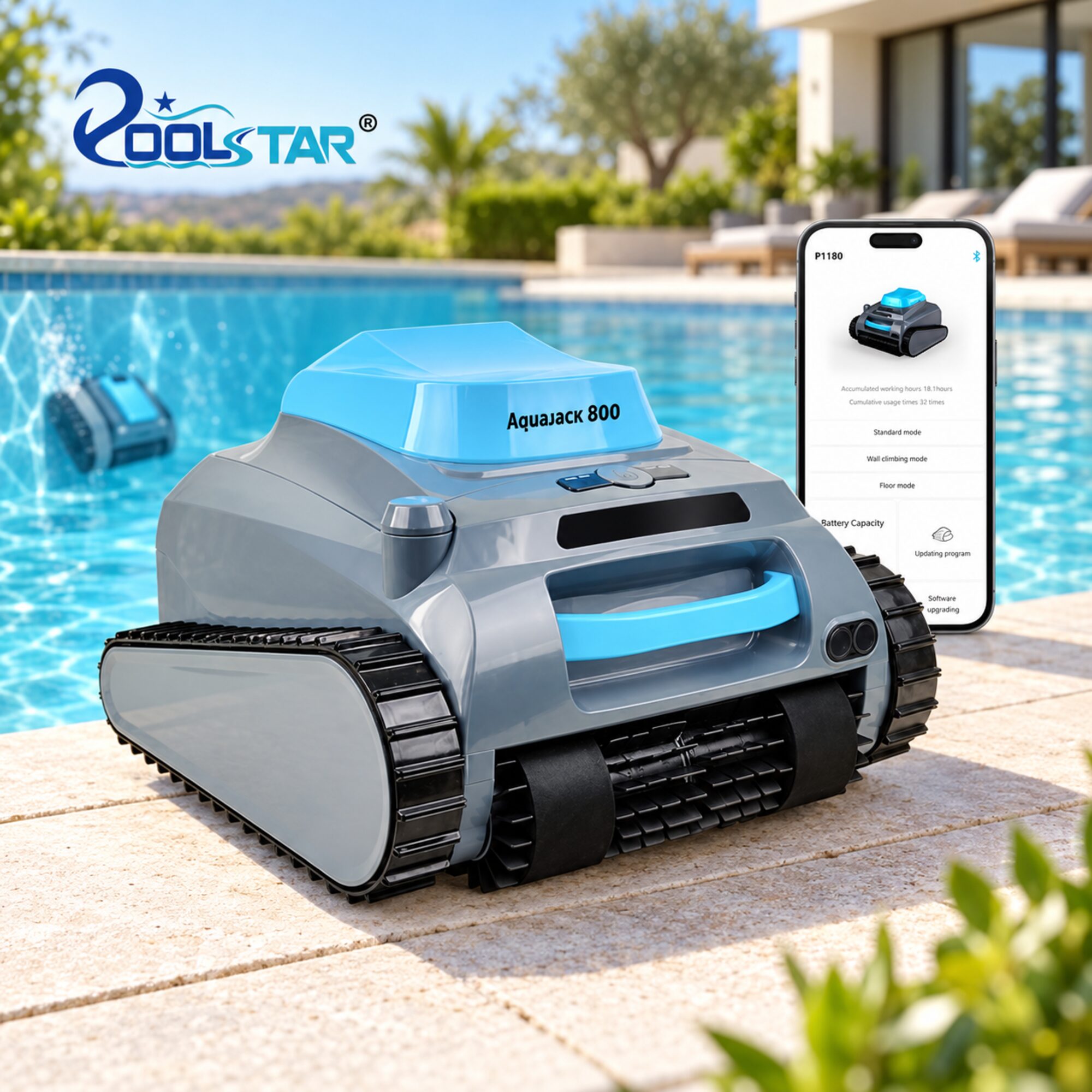
This is one of the principles behind the AquaJack 800.
The AquaJack 800 uses a removable battery module designed to make battery replacement and after-sales servicing easier.
The concept is straightforward:
Battery reaches the end of its service life
↓
Remove the battery module
↓
Install a replacement battery
↓
Continue using the robotic pool cleaner
Instead of designing the ownership cycle around replacing the complete machine, the architecture supports component-level servicing.
This can be particularly valuable for a product that is expected to be used for multiple seasons.
What About the Motor?
The same principle applies to the motor.
A robotic pool cleaner is a working machine. Its motor operates repeatedly and is an important part of the cleaning system.
If a motor or motor-related component eventually requires service, a modular architecture can make the repair process more manageable.
The AquaJack 800 is designed with a serviceable motor module, allowing the motor assembly to be addressed as a component rather than automatically treating the complete robot as the replacement unit.
This is what we mean by:
Serviceability by Design
The objective is not to suggest that components will never fail.
The objective is to make the product easier to service when a component does require attention.
Modular Design vs. Highly Integrated Design
Different robotic pool cleaners use different product architectures.
A highly integrated design can provide advantages in terms of compactness, manufacturing and assembly.
A modular design places greater emphasis on accessibility and component-level service.
The difference can be summarized as follows:
| Consideration | Highly Integrated Design | Modular Design |
|---|---|---|
| Battery replacement | May be more difficult depending on construction | Designed for easier access and replacement |
| Motor servicing | May require extensive disassembly | Designed around a serviceable module |
| Component replacement | May involve larger assemblies | Individual modules can be addressed |
| After-sales service | Can be more replacement-oriented | More suitable for component-level service |
| Product ownership | More dependent on whole-unit condition | Can benefit from replacing selected components |
| Long-term maintenance | Architecture dependent | Serviceability is considered during design |
Neither architecture automatically determines product quality.
The important question for buyers is:
Which design better matches their expectations for long-term ownership and service?
Why Serviceability Matters to Pool Owners
A robotic pool cleaner is not normally a one-time-use product.
Pool owners may expect to use the same machine across multiple swimming seasons.
That makes long-term maintenance an important consideration.
When comparing cordless robotic pool cleaners, it is worth asking:
1. Can the battery be replaced?
Battery capacity naturally changes over time. A replaceable battery can provide a practical path for continued use.
2. Can important mechanical components be serviced?
A product with accessible service modules can potentially simplify repairs.
3. Are replacement parts available?
A serviceable product is much more useful when the manufacturer can provide the appropriate replacement components.
4. Can the product continue operating after one component fails?
This is the central question behind modular architecture.
The goal is simple:
Keep the machine in service for as long as practical.
Two Batteries, Up to Four Hours of Total Operation
The AquaJack 800 also takes a modular approach to battery capacity.
It can accommodate two battery modules.
Each battery can provide up to approximately two hours of operation, allowing the system to support up to four hours of total cleaning operation when the two batteries are used sequentially.
This creates flexibility in how the product is used.
For example:
Battery 1 → up to 2 hours
Battery 2 → up to another 2 hours
Total → up to 4 hours
The two-battery architecture also fits naturally with the modular philosophy.
Instead of treating the battery as a permanent part of the robot, the battery becomes a serviceable and replaceable part of the overall system.
Longer Runtime Is Useful. Longer Product Life Is Different.
When discussing cordless pool cleaners, runtime often receives most of the attention.
But runtime and product life are two different things.
Runtime
How long can the machine operate between battery charges?
Product life
How long can the machine remain useful before it needs to be replaced?
A product can have a long runtime but still be difficult to service.
Conversely, a serviceable product can provide a practical path to continued use even when individual components eventually require replacement.
That is why AquaJack 800 focuses on both:
Longer operating flexibility
and
Serviceable product architecture.
Why This Matters to Pool Distributors
Modular design is not only relevant to consumers.
For pool distributors, after-sales service can be an important part of the total cost of selling an electrical pool-cleaning product.
Consider a typical warranty or service situation:
Customer reports a battery problem
If the battery cannot be serviced separately, the distributor may need to manage a complete-unit replacement.
If the battery is a replaceable module, the service process can potentially become:
Identify the failed component
↓
Supply the replacement module
↓
Replace the component
↓
Return the product to service
The exact service process will depend on the product, warranty terms and failure condition, but the underlying architecture can make component-level service more practical.
This can be particularly relevant for distributors who want to build a long-term product line rather than rely entirely on replacement sales.
A Different Way to Think About Cordless Pool Cleaners
The cordless pool-cleaning market has traditionally emphasized:
-
Battery capacity
-
Cleaning performance
-
Smart functions
-
Navigation
-
Convenience
-
Price
These are important.
But as cordless robotic pool cleaners become more common, another product characteristic deserves attention:
Serviceability
Before buying a cordless pool robot, consider asking:
What happens when the battery reaches the end of its life?
What happens if the motor needs service?
Can individual components be replaced?
Are spare parts available?
Can the machine continue operating after a component is replaced?
These questions shift the conversation from simply buying a machine to considering the total ownership experience.
AquaJack 800: Modular by Design
The AquaJack 800 was developed around this philosophy.
Its modular architecture focuses on three key areas:
Removable Battery Module
The battery can be removed and replaced, providing a practical service path when the battery reaches the end of its useful life.
Serviceable Motor Module
The motor is designed as a serviceable module, helping simplify component-level maintenance.
Two-Battery Capability
The system can accommodate two batteries, with each battery providing up to approximately two hours of operation and up to four hours of total operation when used sequentially.
Together, these features create a different approach to cordless robotic pool cleaner design:
Modular structure
→ Easier component service
→ Replace individual components
→ Support longer product use
The Future of Pool Robots Is Not Only About Smart Technology
A smarter pool robot is useful.
A more powerful pool robot is useful.
A longer-running pool robot is useful.
But there is another question worth asking:
How was the product designed to be maintained after the first few seasons?
For equipment that operates repeatedly in a demanding environment, good engineering should consider not only how the machine performs when it is new, but also how it can be maintained throughout its useful life.
That is the idea behind modular design.
And it is the philosophy behind AquaJack 800:
Built to Be Serviced. Designed for a Longer Life.
A cordless robotic pool cleaner should not only make pool cleaning easier.
It should also make long-term ownership more practical.
Frequently Asked Questions
Is AquaJack 800 a modular robotic pool cleaner?
Yes. AquaJack 800 uses a modular architecture designed around serviceable components, including a removable battery module and serviceable motor module.
Can the battery in AquaJack 800 be replaced?
Yes. The battery is designed as a removable module, allowing it to be replaced when required.
How long does one AquaJack 800 battery last?
Each battery can provide up to approximately two hours of operation, depending on operating conditions and usage.
Can AquaJack 800 use two batteries?
Yes. AquaJack 800 can accommodate two battery modules.
How long can AquaJack 800 operate with two batteries?
With two batteries used sequentially, AquaJack 800 can support up to approximately four hours of total cleaning operation.
Why is a replaceable battery important?
Rechargeable batteries naturally lose capacity over time. A replaceable battery provides a way to address battery aging without necessarily replacing the complete robotic pool cleaner.
Can the motor module be serviced?
The AquaJack 800 is designed with a serviceable motor module to support component-level maintenance.
Does modular design guarantee a longer product life?
No design can guarantee a specific product lifespan. However, replaceable components can provide a practical way to maintain a product when individual components reach the end of their service life.
Why should pool distributors care about modular design?
A serviceable architecture can potentially make component-level warranty and after-sales service more practical, reducing the need to treat every component failure as a complete-unit replacement.
Final Thought
When comparing cordless robotic pool cleaners, don't look only at what the machine can do today.
Also ask:
What happens when one of its key components needs to be replaced?
That question may be just as important as battery runtime, cleaning performance and smart features.
AquaJack 800 takes a modular approach — because a replaceable component should not necessarily mean replacing the entire machine.