
 +86-574-5680 8878


0102030405
Why a Replaceable Battery Can Extend the Life of a Robotic Pool Cleaner ?
2026-10-16
Why a Replaceable Battery Can Extend the Life of a Robotic Pool Cleaner
Understanding Battery Replacement, Long-Term Ownership Costs, and the Benefits of Modular Cordless Pool Cleaner Design
When choosing a cordless robotic pool cleaner, battery runtime is often one of the first specifications buyers compare.
A cleaner that runs for two hours may seem more attractive than one that runs for only 90 minutes.
But there is another battery-related question that deserves just as much attention:
What happens when the battery eventually needs to be replaced?
Rechargeable batteries do not last forever. Their capacity gradually declines with age, charging cycles, and operating conditions.
However, a battery reaching the end of its useful life does not necessarily mean the entire robotic pool cleaner has reached the end of its life.
This is where a replaceable battery design can make a meaningful difference.
For pool owners, it can provide greater flexibility and potentially reduce long-term replacement costs.
For professional pool distributors, it can create a more practical approach to after-sales service and spare parts management.
1. Why Battery Replacement Matters in Cordless Pool Robots
Cordless robotic pool cleaners rely on rechargeable batteries to power their motors, pumps, and control systems.
These batteries operate in a demanding environment.
The cleaner may be used frequently during the swimming season, charged repeatedly, and stored for extended periods between seasons.
Over time, battery performance may change.
Common signs of battery aging include:
-
Shorter cleaning runtime
-
Reduced operating time between charges
-
Changes in charging performance
-
Reduced capacity compared with the battery's original condition
These symptoms do not always indicate battery aging. Other faults can produce similar results, so appropriate diagnosis is important.
Nevertheless, battery aging is a normal consideration for rechargeable equipment.
The key question is whether the cleaner has been designed to accommodate battery replacement.
2. Does a Dead Battery Mean You Need a New Pool Robot?
Not necessarily.
A cordless robotic pool cleaner contains several major components:
-
Battery
-
Motor and drive system
-
Pump and water-flow components
-
Control electronics
-
Housing and sealing components
-
Filters and cleaning mechanisms
These components do not necessarily reach the end of their useful lives at the same time.
For example, a battery may gradually lose capacity while the motor, housing, and other components remain in suitable working condition.
If the battery is replaceable, the owner may be able to restore the cleaner's operating time by replacing the battery module.
If battery replacement is difficult or unavailable, the owner may face a more expensive repair or whole-unit replacement decision.
This is why battery architecture matters.
The service life of the battery should not automatically determine the service life of the entire robotic pool cleaner.
3. Replaceable Battery vs. Integrated Battery: What's the Difference?
Cordless robotic pool cleaners can use different battery architectures.
Some incorporate batteries into highly integrated internal assemblies.
Others use removable or replaceable battery modules.
Both approaches can be engineered to provide reliable operation, but they may offer different service options.
| Feature | Replaceable battery architecture | Highly integrated battery architecture |
|---|---|---|
| Battery access | Designed for battery removal or replacement | May require extensive disassembly |
| Battery replacement | Can be handled as a separate service operation | Depends on construction and manufacturer support |
| Maintenance flexibility | Supports battery-specific servicing | May involve larger assemblies |
| Spare parts | Battery module can be supplied separately | Replacement parts vary by model |
| Long-term ownership | May support continued use after battery replacement | Depends on repairability and service options |
| Waterproof protection | Requires appropriate sealing and interfaces | Requires appropriate sealing |
An important point: a highly integrated battery is not necessarily non-replaceable.
Similarly, a removable battery does not automatically mean that every consumer should replace it without technical guidance.
The actual procedure depends on the manufacturer's design and safety instructions.
4. How a Replaceable Battery Can Extend Product Service Life
Imagine a cordless robotic pool cleaner that has been used regularly for several swimming seasons.
The battery now provides significantly less runtime than it did when new.
However, the motor, filter system, housing, and other major components remain functional.
There are two possible service pathways.
Scenario A: Battery Replacement Is Not Practical
The owner may need to consider extensive repair, replacement of a large integrated assembly, or purchasing another cleaner.
Scenario B: Battery Replacement Is Supported
The affected battery module can be diagnosed and replaced according to the manufacturer's service procedures.
If the rest of the cleaner remains in suitable condition, the machine can continue operating.
The second scenario illustrates the potential advantage of replaceable battery architecture.
It does not guarantee unlimited product life.
But it helps prevent a single aging component from automatically becoming the reason to retire an otherwise functional product.
5. AquaJack 800: A Modular Approach to Battery Replacement
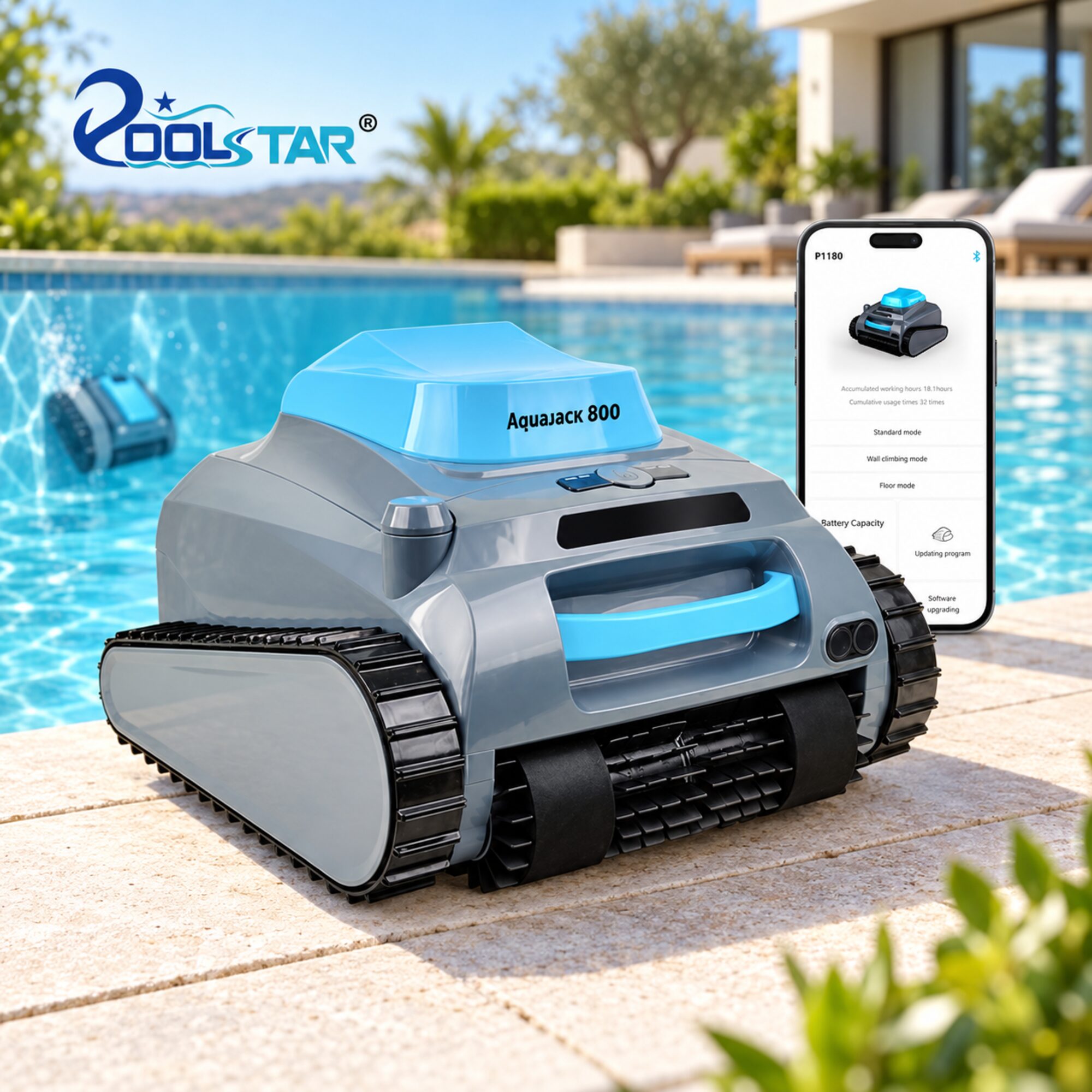
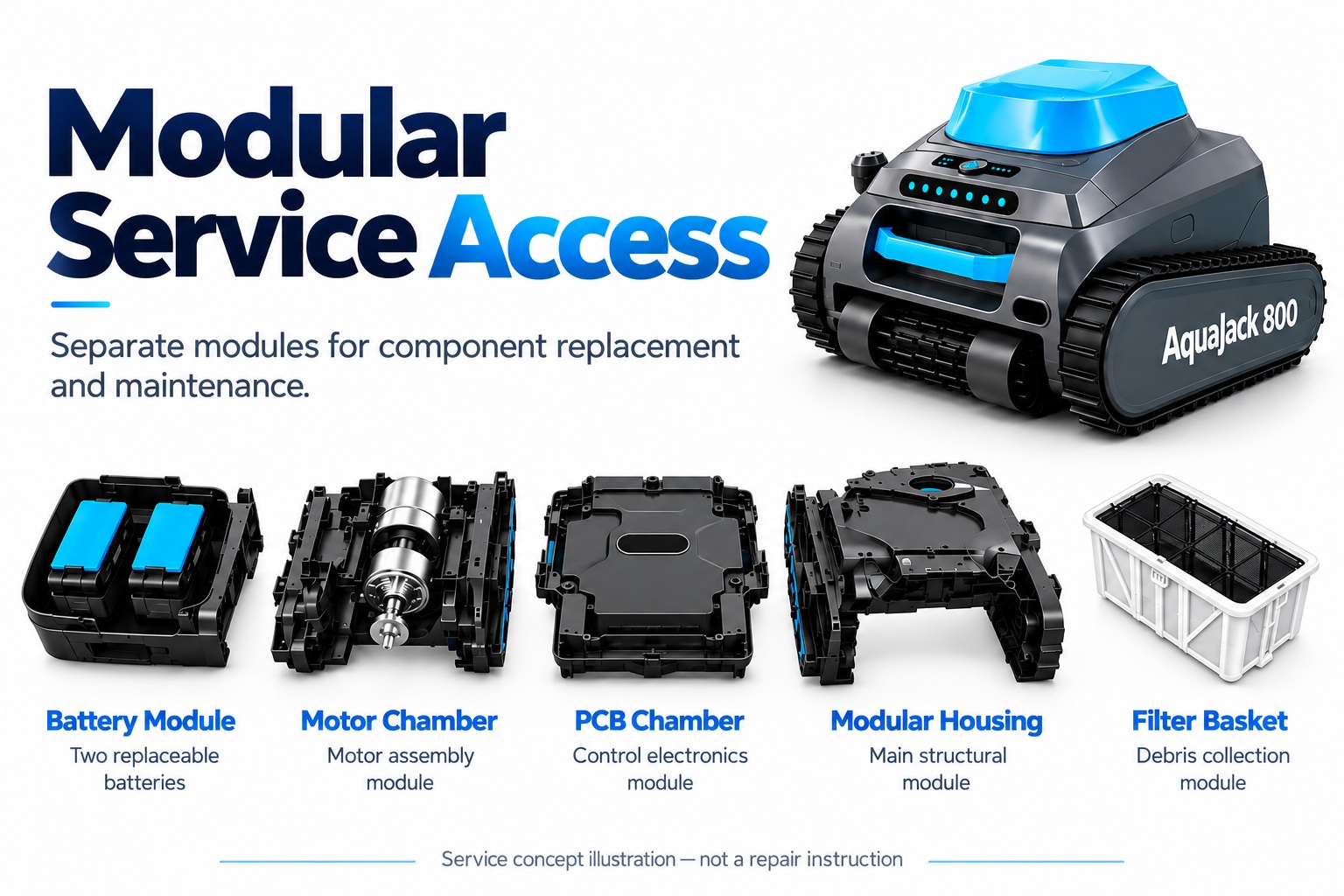
The AquaJack 800 cordless robotic pool cleaner was developed around a modular product architecture.
One of its important design features is a removable battery module.
Instead of treating the battery as an inseparable part of the complete machine, the design allows the battery to be handled as a separate module.
This supports a more practical approach to battery-related maintenance and replacement.
The modular philosophy also extends beyond the battery.
AquaJack 800 incorporates a serviceable motor module, helping create a product architecture that considers future servicing as part of the design process.
This is the principle behind AquaJack 800:
Built to Be Serviced. Designed for a Longer Life.
6. One Battery or Two? More Flexibility for Pool Cleaning
AquaJack 800 also supports a two-battery operating arrangement.
Each battery module provides up to approximately two hours of cleaning operation, depending on operating conditions.
When two batteries are used sequentially, the system can provide up to approximately four hours of total cleaning operation.
This distinction is important.
A single battery does not provide four hours of runtime.
Rather, the second battery offers an additional operating period when needed.
For pool owners, this creates flexibility when planning longer cleaning sessions.
For distributors, it creates an opportunity to explain the product's battery architecture in terms of both daily usability and long-term serviceability.
The benefits are different but complementary:
Battery runtime determines how long the cleaner can operate during a cleaning session.
Battery replaceability determines whether an aging or faulty battery can be addressed separately from the entire machine.
Both deserve attention when evaluating a cordless pool robot.
7. Can a Replaceable Battery Reduce Long-Term Ownership Costs?
Potentially, yes.
The initial purchase price of a robotic pool cleaner is only one part of its total ownership cost.
Over several years, owners may also encounter expenses related to:
-
Replacement batteries
-
Replacement filters
-
Motor-related service
-
Spare parts
-
Shipping for warranty or repair
-
Whole-unit replacement
A replaceable battery can reduce the need for whole-unit replacement when the battery is the primary issue.
However, the financial benefit depends on several factors, including the price of the replacement battery, labor, shipping, and the remaining condition of the cleaner.
Illustrative Cost Comparison
The following figures are hypothetical and are not AquaJack 800 retail prices or actual service quotations.
| Cost item | Illustrative amount |
|---|---|
| Purchasing a replacement robotic pool cleaner | $300 |
| Replacement battery module | $70 |
| Battery replacement labor and shipping | $30 |
| Total battery-related service cost | $100 |
| Potential avoided expenditure | $200 |
In this simplified example, replacing the battery costs less than purchasing another complete cleaner.
Actual savings may be smaller, larger, or nonexistent depending on the specific product and repair situation.
The important point is not a guaranteed saving.
It is that a replaceable battery gives owners an additional economic option.
8. Why Replaceable Batteries Matter for Pool Equipment Distributors
Professional pool equipment distributors have responsibilities that extend beyond selling a robotic cleaner.
They may also handle:
-
Warranty inquiries
-
Product troubleshooting
-
Customer complaints
-
Replacement parts
-
Technical support
-
Returns and replacements
-
After-sales service
Battery-related issues can become part of these operations.
When a cleaner is designed with a replaceable battery module, distributors can potentially establish a more structured service process.
For example:
Customer reports reduced runtime
→ Distributor collects usage and charging information
→ Technical support identifies the likely cause
→ Battery and other relevant systems are evaluated
→ If the battery is confirmed to be the problem, an appropriate replacement module is supplied
→ The cleaner is returned to operation after the required checks
This approach depends on the manufacturer's support procedures and parts availability.
Nevertheless, a modular architecture makes component-level service a practical consideration from the product-design stage.
For importers and private-label brands, that can become an important factor in product selection.
9. Can Replaceable Batteries Help Reduce Electronic Waste?
Replacing a failed component rather than discarding an otherwise usable product can help reduce unnecessary whole-product replacement.
This principle is relevant to many rechargeable products, including cordless robotic pool cleaners.
If a battery can be replaced safely and economically, the remaining components may continue to be used.
However, environmental outcomes depend on the actual repair, product lifespan, manufacturing impacts, and battery recycling practices.
A replaceable battery should therefore be viewed as an opportunity to support longer product use, rather than an automatic guarantee of environmental benefits.
Used lithium batteries should be handled through appropriate battery collection or recycling channels according to local requirements.
10. What Makes a Replaceable Battery System Practical?
Not all replaceable battery systems provide the same experience.
When evaluating a cordless robotic pool cleaner, buyers and distributors should consider several questions.
Battery Accessibility
Can the battery module be removed without unnecessarily dismantling the entire cleaner?
Electrical Safety
Are the battery connection and protection systems designed for the intended service procedure?
Waterproofing
Does the product provide appropriate protection against water intrusion during normal operation?
Replacement Parts
Will compatible battery modules be available when replacement becomes necessary?
Service Instructions
Does the manufacturer provide clear replacement procedures and technical support?
Replacement Economics
Is the cost of battery replacement reasonable compared with the value and condition of the complete cleaner?
A successful modular product strategy requires more than a removable component.
It also requires reliable engineering, replacement-part support, and a practical after-sales process.
11. Battery Replaceability Is Only One Part of Long-Term Serviceability
A replaceable battery is an important feature, but it should not be the only consideration.
Other major components may also require attention during a robotic pool cleaner's useful life.
This includes motors, drive systems, filters, and certain mechanical assemblies.
That is why AquaJack 800 emphasizes modular architecture rather than battery replacement alone.
Its design combines:
-
Removable battery module
-
Serviceable motor module
-
Modular product construction
-
Two-battery operating capability
Together, these features reflect a broader approach to product development.
A robotic pool cleaner should be designed not only to operate, but also to be serviced when necessary.
12. What Should Pool Owners Ask Before Buying?
Before choosing a cordless robotic pool cleaner, consider asking the manufacturer or seller:
-
Can the battery be replaced?
-
Is a replacement battery available separately?
-
What is the battery replacement procedure?
-
Can the motor be serviced or replaced?
-
What replacement parts are supported?
-
What happens if the battery loses capacity after the warranty period?
-
Does the manufacturer offer technical support?
-
What are the estimated battery replacement costs?
These questions help buyers evaluate the product beyond its initial specifications.
A cleaner with strong runtime is useful.
A cleaner with a practical long-term service strategy may offer additional value over its ownership lifecycle.
Frequently Asked Questions
Can you replace the battery in a robotic pool cleaner?
It depends on the product design. Some robotic pool cleaners use replaceable battery modules, while others have more integrated battery assemblies. AquaJack 800 features a removable battery module.
Does replacing the battery make a pool robot last longer?
Battery replacement may extend the useful life of a robotic pool cleaner when the battery is the main problem and the rest of the product remains functional and safe.
How long does a robotic pool cleaner battery last?
Battery lifespan varies according to battery chemistry, charging cycles, operating temperature, storage, and usage. There is no universal replacement interval for all cordless robotic pool cleaners.
Is a replaceable battery better than a built-in battery?
A replaceable battery can offer advantages in serviceability and long-term maintenance. However, overall product quality also depends on reliability, sealing, battery protection, and engineering.
Does AquaJack 800 have a replaceable battery?
Yes. AquaJack 800 is designed with a removable battery module to support battery replacement and servicing.
Can AquaJack 800 use two batteries?
Yes. AquaJack 800 supports two battery modules used sequentially, providing up to approximately four hours of total cleaning operation under suitable conditions.
Can I replace a pool robot battery myself?
Not necessarily. Removable or replaceable does not always mean consumer-serviceable. Follow the manufacturer's instructions, and use qualified service personnel where required.
What happens if water gets into a robotic pool cleaner battery?
Stop using the affected equipment and follow the manufacturer's safety and service instructions. A potentially damaged rechargeable battery should not be charged or reused without appropriate assessment.
Is it cheaper to replace a battery than buy a new pool robot?
It can be, but the answer depends on battery price, labor, shipping, the cleaner's condition, and the cost of a replacement machine.
Why do distributors prefer serviceable robotic pool cleaners?
A serviceable architecture can support component-level repairs, spare parts management, warranty handling, and more structured after-sales service.
Conclusion: Replace the Battery, Not Automatically the Entire Robot
A cordless robotic pool cleaner contains many components with different lifecycles.
The rechargeable battery is one of them.
When a battery eventually loses capacity, the rest of the cleaner may still have useful service life remaining.
A replaceable battery architecture creates an opportunity to address that component separately.
For pool owners, this can mean greater maintenance flexibility and potentially lower long-term replacement costs.
For distributors, it can support a more practical after-sales service strategy.
The AquaJack 800 brings this philosophy into its product architecture through a removable battery module, serviceable motor module, and flexible two-battery operating system.
AquaJack 800 — Removable Battery. Serviceable Motor. Modular Design.
Built to Be Serviced. Designed for a Longer Life.
Related Reading
-
Article 01: Why Modular Design Matters in a Cordless Robotic Pool Cleaner
-
Article 02: Can You Replace the Battery in a Robotic Pool Cleaner?
-
Article 03: What Happens When Water Gets Into a Cordless Pool Robot?
-
Article 04: Modular vs. Highly Integrated Robotic Pool Cleaners: What Is the Difference?
-
Article 05: How Long Does a Cordless Robotic Pool Cleaner Last?
Explore: AquaJack 800 Cordless Robotic Pool Cleaner