
 +86-574-5680 8878

0102030405
Why Serviceable Product Design Matters for Pool Equipment Brands
2026-10-19
Why Serviceable Product Design Matters for Pool Equipment Brands
How Modular Robotic Pool Cleaners, Replaceable Batteries, and Long-Term After-Sales Support Can Help Brands Build Lasting Value
The robotic pool cleaner market has become increasingly competitive.
New products enter the market with longer battery runtimes, advanced cleaning features, attractive designs, and competitive prices.
For pool equipment brands, importers, and distributors, this creates a familiar challenge:
How can a brand differentiate its robotic pool cleaners without relying entirely on lower prices?
Product performance remains essential. Consumers expect effective cleaning, convenient operation, and reliable equipment.
However, professional pool equipment brands must consider more than the initial sale.
They also need to think about warranty support, spare parts, product maintenance, customer satisfaction, and the long-term value of their product portfolio.
This is where serviceable product design becomes increasingly relevant.
A robotic pool cleaner designed with replaceable components can provide additional options for after-sales service and long-term ownership.
For brands building a sustainable product business, that can become an important part of their product strategy.
1. Why Product Differentiation Is Becoming More Difficult
Many cordless robotic pool cleaners are marketed using similar specifications.
Common selling points include:
-
Battery runtime
-
Cleaning performance
-
Suction and water flow
-
Filtration
-
Navigation
-
Ease of use
-
Retail price
These features matter to consumers.
However, when competing products offer similar headline specifications, buyers may find it difficult to understand why one brand deserves a higher price.
This can increase pressure on brands and distributors to compete through discounts.
A more sustainable differentiation strategy should consider features that create value beyond the initial purchase.
One such area is serviceability.
Instead of asking only:
"How well does this cleaner work when new?"
Brands can also ask:
"How practical will this product be to maintain and support throughout its useful life?"
2. What Is Serviceable Product Design?
Serviceable product design means considering maintenance, diagnosis, component replacement, and repair during product development.
For robotic pool cleaners, this may involve:
-
Removable battery modules
-
Serviceable motor assemblies
-
Replaceable wear components
-
Accessible filtration systems
-
Defined service procedures
-
Appropriate spare-parts support
The objective is not to make every component user-repairable.
Some operations require qualified technicians or authorized service providers.
Instead, the goal is to provide practical service options when selected components require attention.
A serviceable product architecture can help avoid treating the entire machine as a single inseparable assembly.
This is particularly relevant for cordless robotic pool cleaners, where rechargeable batteries have their own aging characteristics.
3. Battery Replacement Can Become a Brand Advantage
Rechargeable batteries gradually lose capacity over time.
This is a normal consideration for cordless equipment.
A battery may eventually require replacement even when the cleaner's motor, housing, and other components remain functional.
For a brand, the battery replacement experience can influence customer satisfaction.
Consider two situations.
Situation A: Battery Replacement Is Difficult
The customer reports reduced runtime.
The battery is difficult to access, and a practical replacement option may not be available.
The customer may need to consider extensive repair or replacing the entire cleaner.
Situation B: Battery Replacement Is Supported
The customer reports reduced runtime.
The battery can be diagnosed and, when appropriate, replaced as a separate module.
The cleaner may then continue operating if its other components remain in suitable condition.
The second situation can provide a more practical ownership experience.
For pool equipment brands, this creates an opportunity to communicate long-term product support rather than focusing exclusively on the initial sale.
4. Why Motor Serviceability Matters to Professional Brands
Battery replacement is only one part of the serviceability equation.
Motors and drive systems are critical components of robotic pool cleaners.
Over time, these assemblies may require inspection, maintenance, or replacement.
A product designed with a serviceable motor module can provide an additional repair pathway.
For distributors and brands, this may support:
-
Component-level technical diagnosis
-
More targeted replacement-part arrangements
-
Structured warranty handling
-
Reduced dependence on complete-unit replacement in certain cases
-
More practical long-term service support
Actual benefits depend on the product's reliability, service procedures, spare-parts availability, and repair costs.
A modular architecture does not eliminate failures.
It provides options for addressing selected failures when servicing is appropriate.
5. AquaJack 800: Serviceability by Design
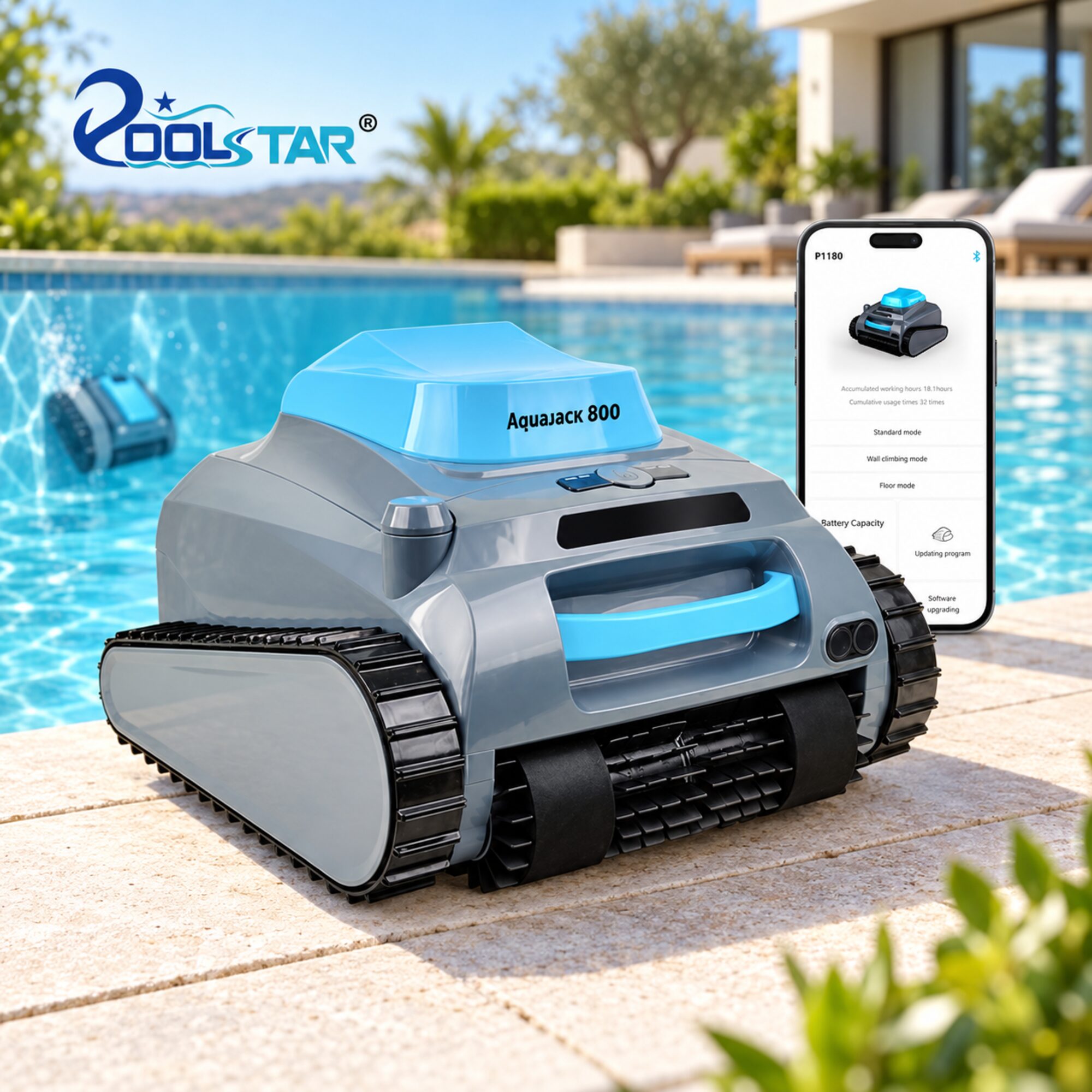
AquaJack 800 is a cordless robotic pool cleaner developed around a modular product architecture.
Its design includes several important characteristics.
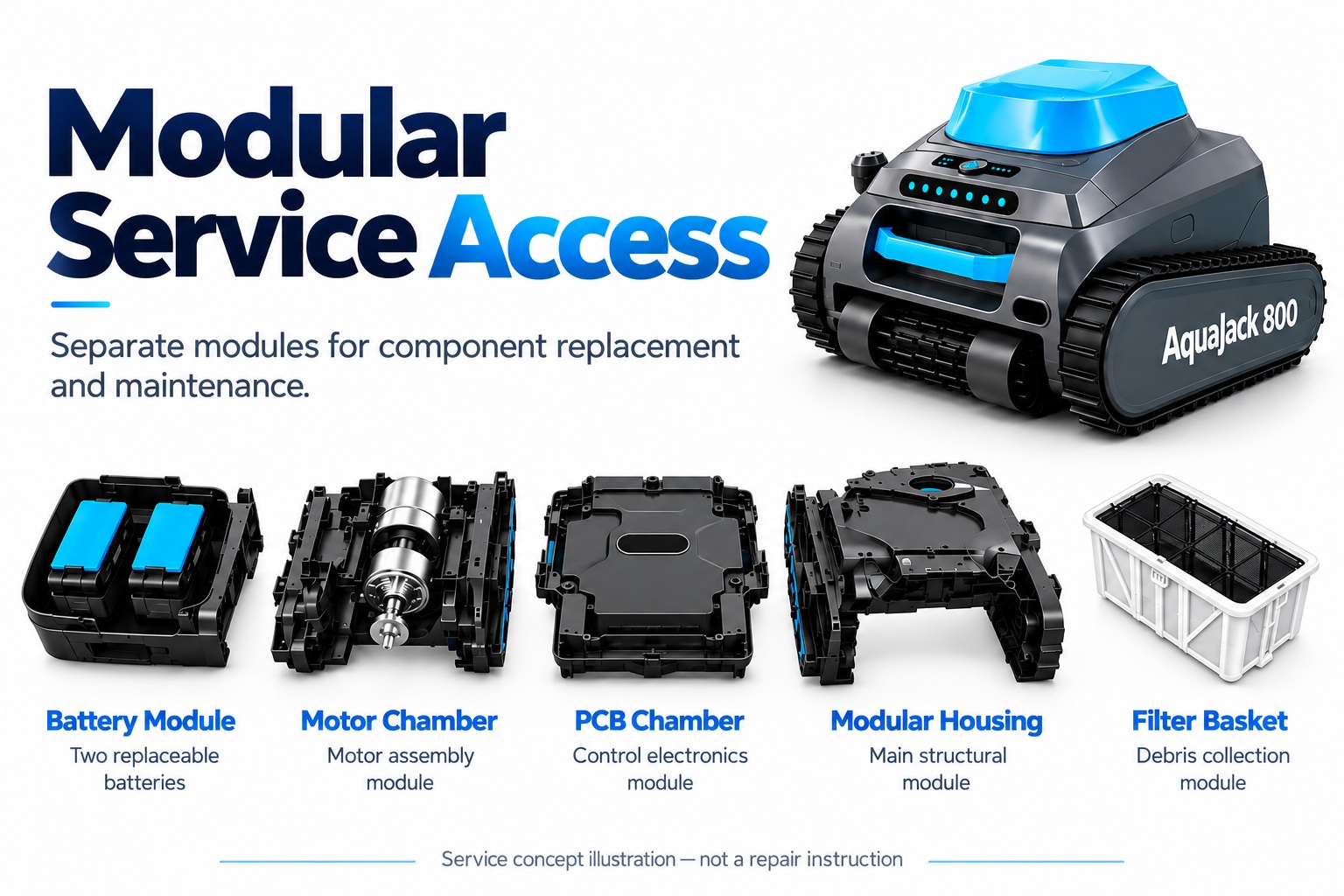
Removable Battery Modules
The battery modules are designed to be removed and replaced according to the manufacturer's service procedures.
Serviceable Motor Module
The motor module is designed to support component-level maintenance.
Flexible Battery Configuration
AquaJack 800 supports two independent battery modules installed simultaneously.
It can also operate with one battery and a dedicated ballast weight installed in the second battery position.
| Configuration | Installed components | Maximum stated runtime |
|---|---|---|
| Single-battery mode | 1 battery + ballast weight | Up to approximately 2 hours |
| Dual-battery mode | 2 independent batteries | Up to approximately 4 hours |
Actual runtime depends on operating conditions and battery condition.
Modular Architecture
The overall product design considers access to selected components and future servicing.
Together, these features create a product concept that goes beyond battery runtime.
AquaJack 800 is designed around both daily cleaning flexibility and long-term serviceability.
6. Serviceability Can Support Better Warranty Management
Warranty management is an important consideration for pool equipment brands.
When a customer reports a problem, the brand or distributor must determine the cause and select an appropriate resolution.
Depending on the failure, possible solutions may include:
-
Technical guidance
-
Maintenance instructions
-
Replacement of a supported component
-
Authorized repair
-
Product replacement
A modular product architecture can support more targeted solutions when the affected component is replaceable.
For example, a confirmed battery-related problem may be addressed through an approved battery module replacement rather than automatically replacing the entire robotic cleaner.
However, this depends on accurate diagnosis and the manufacturer's warranty and service policies.
For brands, the potential value lies in developing a more structured after-sales process.
7. Spare Parts Should Be Part of the Product Strategy
A product is not truly practical to service if replacement components cannot be obtained.
For this reason, brands should discuss spare-parts arrangements with their manufacturing partners before launching a robotic pool cleaner.
Important considerations include:
Supported components
Which batteries, motors, filters, brushes, and other assemblies can be supplied separately?
Part identification
Are spare parts identified by clear part numbers and compatible product versions?
Availability
What replacement-part supply arrangements can be established?
Lead times
How quickly can service parts be delivered?
Technical documentation
Are appropriate replacement procedures available?
Service responsibilities
Which tasks can be performed by consumers, dealers, authorized technicians, or the manufacturer?
A spare-parts strategy should be planned alongside product commercialization rather than considered only after warranty problems arise.
8. Can Serviceable Design Improve Customer Loyalty?
Potentially.
Customer loyalty is influenced by several factors, including product performance, reliability, service quality, and the overall ownership experience.
A customer who can obtain appropriate support and replacement components may have a better experience than one who encounters a problem without a practical resolution.
This can influence how customers perceive the brand.
For professional pool dealers, the ability to provide technical support and replacement parts may also strengthen the relationship with the end user.
However, serviceability alone does not guarantee customer loyalty.
The brand must also deliver reliable products, responsive support, fair warranty policies, and consistent service.
A serviceable product creates opportunities for better support. The brand must still deliver that support effectively.
9. Total Cost of Ownership Matters More Than the Initial Price
When brands evaluate robotic pool cleaners, FOB price is often an important commercial consideration.
However, the total cost of supporting the product may be more relevant over time.
Potential costs include:
-
Warranty claims
-
Replacement products
-
Spare parts
-
Technical support
-
Return freight
-
Service labor
-
Inventory management
-
Customer compensation
A product with a lower purchase price may not necessarily offer the lowest total commercial cost.
Similarly, a serviceable product may not always be cheaper to maintain if replacement parts or labor are expensive.
Brands should evaluate the complete cost structure.
The important question is:
Does the product architecture provide practical and economically reasonable options when service is required?
This is where modular design can offer meaningful commercial value.
10. Why Serviceable Design Can Help Brands Compete Beyond Price
Competing only on purchase price can be difficult to sustain.
A product differentiation strategy may instead emphasize:
-
Reliable cleaning performance
-
Appropriate battery runtime
-
Convenient maintenance
-
Replaceable batteries
-
Serviceable motor modules
-
Spare-parts support
-
Long-term ownership value
These features give distributors and professional dealers additional reasons to recommend a product.
For example, rather than focusing only on a four-hour runtime claim, a brand can explain that the cleaner supports flexible battery configurations and replacement of selected components.
This provides a more complete product story.
It also helps sales teams communicate benefits that are relevant after the initial purchase.
11. Why OEM/ODM Manufacturers Matter in Serviceable Product Development
A serviceable product strategy requires cooperation between the brand and its manufacturing partner.
The manufacturer must consider how product architecture affects:
-
Component accessibility
-
Waterproofing
-
Electrical safety
-
Mechanical reliability
-
Manufacturing consistency
-
Service procedures
-
Spare-parts compatibility
-
Product documentation
A modular product should not compromise safety or reliability simply to make components removable.
For example, removable battery modules require appropriate attention to electrical interfaces, sealing, installation, and product balance.
This is why modular design should be treated as an engineering decision rather than a marketing feature added after development.
For private-label brands, choosing a manufacturer that understands both product performance and long-term service requirements can be an important part of the sourcing strategy.
12. A Practical Checklist for Private Label Pool Equipment Brands
Before introducing a new cordless robotic pool cleaner, brands should discuss the following questions with their manufacturer.
| Evaluation area | Key question |
|---|---|
| Product positioning | What makes this cleaner different from competing models? |
| Cleaning performance | Does it meet the intended pool and debris requirements? |
| Battery architecture | Can the battery be replaced independently? |
| Motor service | Can the motor assembly be serviced or replaced? |
| Waterproofing | Are removable interfaces appropriately protected? |
| Spare parts | Which replacement components are supported? |
| Quality control | What reliability and production tests are performed? |
| Warranty | How will failures be diagnosed and resolved? |
| Product documentation | Are technical and service materials available? |
| Ownership cost | Are replacement and service costs commercially reasonable? |
| Long-term support | How will spare parts and product revisions be managed? |
These questions can help brands evaluate not only the product's selling points but also its ability to support a long-term distribution business.
13. Serviceability and Sustainability: A Practical Connection
Extending the useful life of a product can help reduce unnecessary replacement.
When a battery or another component can be replaced safely and economically, the remaining functional components may continue to be used.
This may help reduce avoidable whole-product disposal.
However, the environmental outcome depends on factors such as actual product lifespan, replacement-part manufacturing, transportation, repair practices, and battery recycling.
Therefore, brands should avoid making unsupported claims that a modular product is automatically more sustainable.
A more accurate message is:
Serviceable design can support longer product use and provide alternatives to unnecessary whole-unit replacement.
This is a practical product-design principle that can be communicated without overstating environmental benefits.
14. Building a Long-Term Robotic Pool Cleaner Product Strategy
For pool equipment brands, a successful product strategy should consider the complete lifecycle.
Product Development
Select features that meet customer needs and provide meaningful differentiation.
Manufacturing
Establish appropriate quality-control and reliability requirements.
Market Launch
Communicate product capabilities accurately and clearly.
Distribution
Provide product information and technical support to dealers.
After-Sales
Establish warranty procedures and spare-parts arrangements.
Product Improvement
Use field feedback and service information to identify opportunities for future improvements.
Serviceability connects several of these stages.
A product designed with removable modules can support a more structured approach to maintenance, repair, and future product development.
15. AquaJack 800: A Product Concept for Long-Term Brand Value
AquaJack 800 reflects a product-development philosophy centered on modularity and serviceability.
Its removable battery modules, serviceable motor module, and configurable battery system provide features that can support both consumer convenience and professional after-sales service.
For pool owners, the benefits include flexible runtime configurations and additional maintenance options.
For distributors, the architecture can support component-level service and replacement-part planning.
For private-label brands, it provides a product concept that can be differentiated through long-term ownership value rather than relying only on headline specifications.
The central idea is simple:
A robotic pool cleaner should be designed not only for the first cleaning cycle, but also for the years of ownership that follow.
Frequently Asked Questions
Why is serviceability important for pool equipment brands?
Serviceability can provide more options for warranty handling, component replacement, spare-parts management, and long-term customer support.
What is a serviceable robotic pool cleaner?
A serviceable robotic pool cleaner is designed so that selected components can be accessed, maintained, or replaced according to the manufacturer's procedures.
How can modular design benefit distributors?
Modular architecture can support component-level service, replacement-part planning, and more structured after-sales operations.
Does a replaceable battery make a robotic pool cleaner last longer?
It may help extend useful product life when the battery is the primary issue and the remaining components are functional and safe.
Does AquaJack 800 have a replaceable battery?
Yes. AquaJack 800 uses removable battery modules designed for replacement and servicing.
Can AquaJack 800 use one or two batteries?
Yes. It supports one battery with a dedicated ballast weight, or two independent battery modules installed simultaneously.
How long can AquaJack 800 operate?
Up to approximately two hours with one battery, or up to approximately four hours with two batteries installed, depending on operating conditions.
Can the AquaJack 800 motor be serviced?
AquaJack 800 incorporates a serviceable motor module designed to support component-level maintenance.
Can serviceable design reduce warranty costs?
It may reduce costs in certain situations by allowing component-level service instead of whole-unit replacement. Actual savings depend on failure rates, labor, parts, shipping, and warranty arrangements.
What should private-label brands look for in a robotic pool cleaner manufacturer?
They should evaluate product reliability, quality control, serviceable architecture, OEM/ODM capabilities, technical documentation, spare-parts support, and long-term cooperation arrangements.
Conclusion: Build Products for the Entire Ownership Lifecycle
The robotic pool cleaner market will continue to evolve as brands introduce new features, designs, and performance specifications.
But long-term competitiveness requires more than attractive product specifications.
For professional pool equipment brands, reliability, serviceability, spare-parts support, and customer experience are important parts of product value.
AquaJack 800 demonstrates how modular product architecture can support this approach.
With removable battery modules, a serviceable motor module, and flexible one- or two-battery configurations, it provides a product concept focused on both cleaning convenience and long-term maintenance.
For importers, distributors, and private-label brands, serviceability deserves a place in the product sourcing and development strategy.
AquaJack 800 — Modular Cordless Robotic Pool Cleaner.
Built to Be Serviced. Designed for a Longer Life.
Related Reading
-
Article 01: Why Modular Design Matters in a Cordless Robotic Pool Cleaner
-
Article 06: Why a Replaceable Battery Can Extend the Life of a Robotic Pool Cleaner
-
Article 10: What Should You Look for in a Serviceable Robotic Pool Cleaner?
-
Article 11: What Should Pool Distributors Look for in a Robotic Pool Cleaner Supplier?
Explore: AquaJack 800 Modular Cordless Robotic Pool Cleaner
Manufacturer: Poolstar
Website: www.cnpoolstar.com
Looking for a Robotic Pool Cleaner OEM/ODM Manufacturing Partner?
Poolstar works with professional pool equipment importers, distributors, wholesalers, and private-label brands.
Explore the AquaJack robotic pool cleaner range and discuss your product positioning, branding, battery configuration, and sourcing requirements with our team.
Contact Poolstar: www.cnpoolstar.com