
 +86-574-5680 8878


0102030405
Aquajack 800 Cordless Robotic Pool Cleaner for Commercial Aquatic Centers: How 78.2 GPM Suction with 4L Filter Capacity Supports Large-Scale Cleaning
2026-07-13
Key Takeaways
The Poolstar Aquajack 800 delivers 78.2 GPM (296 L/min) suction power with a 4-liter filter capacity and 240-minute dual-battery runtime, covering pool surfaces up to 200 square meters per charge. Its cordless design eliminates tripping hazards and outlet dependency that plague commercial pool operations, while sonar obstacle avoidance and P1180 app connectivity enable autonomous, remotely managed cleaning. For commercial aquatic centers managing multiple pool bodies, the Aquajack 800 reduces manual labor requirements by 60 to 80 percent while maintaining consistent cleaning quality across daily operating cycles.
The Poolstar Aquajack 800 delivers 78.2 GPM (296 L/min) suction power with a 4-liter filter capacity and 240-minute dual-battery runtime, covering pool surfaces up to 200 square meters per charge. Its cordless design eliminates tripping hazards and outlet dependency that plague commercial pool operations, while sonar obstacle avoidance and P1180 app connectivity enable autonomous, remotely managed cleaning. For commercial aquatic centers managing multiple pool bodies, the Aquajack 800 reduces manual labor requirements by 60 to 80 percent while maintaining consistent cleaning quality across daily operating cycles.

1. The Commercial Pool Cleaning Challenge: Scale, Frequency, and Labor Costs
Commercial aquatic centers operate under cleaning demands that bear no resemblance to residential pool maintenance. A typical community aquatic center in Europe or North America maintains 3 to 5 separate pool bodies — a main competition pool, a warm-up pool, a leisure pool with water features, a children's wading pool, and sometimes a whirlpool or therapy pool. Combined water surface areas range from 500 to 2,000 square meters, with bather loads that can exceed 500 swimmers per day during peak summer season.
Each swimmer introduces organic contaminants — skin cells, body oils, sunscreen residue, hair, and microscopic debris — that accumulate on pool surfaces and in the water column. Commercial pools use filtration and chemical treatment to maintain water quality, but physical surface cleaning remains essential for removing settled debris, preventing biofilm formation on underwater surfaces, and maintaining the visual clarity that bathers expect. The Aquajack 800 Cordless Robotic Pool Cleaner addresses this physical cleaning requirement with a combination of suction power, autonomous navigation, and operational flexibility designed for commercial-scale deployment.
Traditional commercial pool cleaning relies on manual vacuum systems operated by maintenance staff. A single pool attendant can clean approximately 100 to 150 square meters of pool surface per hour using a manual vacuum head connected to the pool's filtration system. For a facility with 1,000 square meters of total pool surface, this translates to 7 to 10 hours of manual cleaning labor per day — a significant operational cost that directly impacts staffing budgets and limits the hours available for other maintenance tasks.
According to WHO guidelines on recreational water quality, maintaining clean pool surfaces is essential for preventing waterborne illness transmission. Robotic pool cleaners fundamentally change this equation. Research from the National Recreation and Park Association (NRPA) shows that facility maintenance labor represents 25 to 35 percent of aquatic center operating budgets. A single robotic unit can clean 150 to 200 square meters of pool surface in 2 to 3 hours without human supervision, freeing maintenance staff for higher-value tasks like equipment inspection, chemical management, and customer service. For commercial aquatic centers facing labor shortages and rising wage costs, robotic cleaners represent not just a cleaning improvement but a structural change in facility operations.
2. Aquajack 800 Technical Specifications: Built for Commercial Workloads

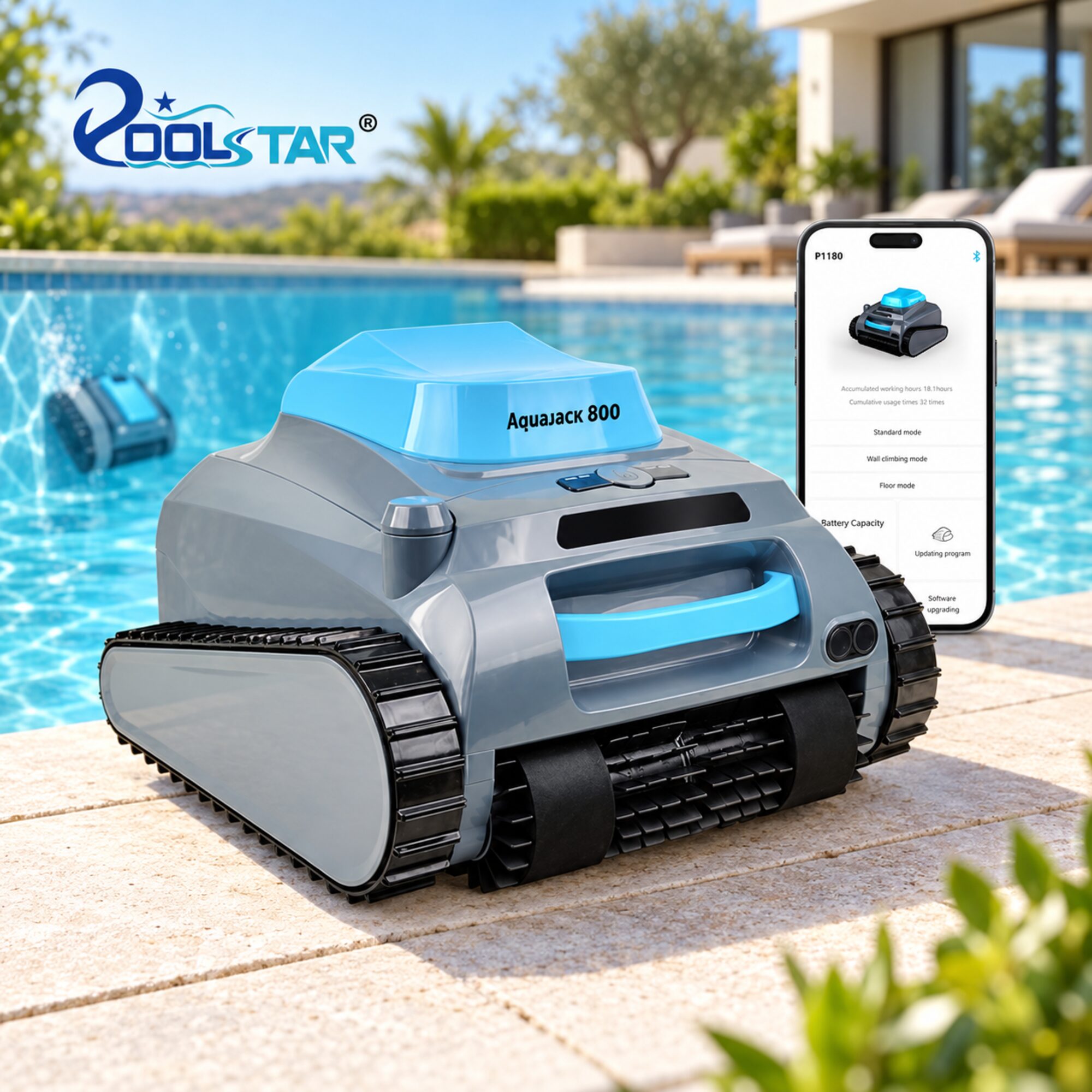
The Aquajack 800 is engineered specifically for the demands of commercial pool cleaning, with specifications that distinguish it from consumer-grade robotic cleaners designed for residential pools. The unit's 78.2 GPM (296 L/min) suction rate is achieved through a high-efficiency brushless DC motor operating at 50 watts — a power consumption level that keeps operating costs low while delivering the suction force needed to remove settled debris, algae, and biofilm from commercial pool surfaces.
The 4-liter filter basket provides the debris capacity needed for commercial cleaning cycles. Residential pool cleaners typically feature 1 to 2-liter filter baskets that are adequate for pools with low bather loads and minimal debris. In commercial environments where high bather loads, outdoor exposure to leaves and insects, and chemical-treated water create heavier debris loads, a larger filter basket reduces the frequency of mid-cycle interruptions for filter cleaning.
Battery performance is where the Aquajack 800 truly differentiates for commercial use. The dual-battery configuration — each battery rated at 22.2V/4400mAh — provides a combined runtime of 240 minutes, enough to clean a 200-square-meter pool surface on a single charge. The 2-hour charging time means that a depleted unit can be fully recharged during a shift change or lunch break, ready for afternoon or evening cleaning cycles. For facilities operating multiple pools, this rapid turnaround allows a fleet of Aquajack 800 units to provide continuous cleaning coverage throughout the operating day.
The IPX8 waterproof rating ensures reliable operation during extended submersion, a critical requirement for commercial cleaners that may spend 4 to 8 hours per day underwater. The modular design of all major components — brushes, filter basket, battery packs, and drive tracks — allows facility maintenance staff to perform routine replacements without specialized tools or manufacturer service calls.
3. Cordless Operation: Eliminating the Safety and Logistics Burden of Corded Cleaners
For commercial aquatic centers, the cordless design of the Aquajack 800 addresses safety and operational concerns that are often underestimated in purchasing decisions. Corded robotic pool cleaners require a power cable running from a GFCI-protected outlet to the pool edge and then into the water. In a commercial environment where public safety liability is a primary concern, this cable creates a tripping hazard at the pool deck — one of the most common sources of slip-and-fall injuries in aquatic facilities.
The cable itself is also an operational constraint. It limits the cleaner's range to the cable length (typically 15 to 20 meters for commercial units), can become tangled around pool features like ladders and lane dividers, and requires careful management to prevent damage from pool chemicals and UV exposure. In heated pools, the cable can interfere with pool covers and thermal blankets that are used to reduce heating costs during non-operating hours.
By eliminating the power cable entirely, the Aquajack 800 removes all of these concerns. The unit can be deployed in any pool body without consideration for outlet locations or cable routing. It navigates freely around obstacles using its sonar-based avoidance system, and can be moved between pools by a single staff member without the logistical complexity of managing cable lengths and connections. This operational simplicity is particularly valuable for facilities that clean multiple pools in sequence — a staff member can deploy the cleaner in the main pool, move to other duties, and relocate the unit to the leisure pool when the first cycle completes.
4. Sonar Navigation and Autonomous Operation in Complex Pool Geometries
Commercial pools present navigation challenges that residential pools do not. Competition pools have lane dividers, starting blocks, and touchpads at each end. Leisure pools feature water slides, fountains, geysers, and zero-depth entry areas with irregular contours. Therapy pools have built-in benches, handrails, and hydrotherapy jets. Each of these features represents an obstacle that a robotic cleaner must detect and navigate around to achieve complete surface coverage.
The Aquajack 800's sonar obstacle avoidance system provides reliable detection of underwater obstacles regardless of water clarity or lighting conditions. Unlike optical or infrared sensors that can be confused by turbid water or the reflections from tiled surfaces, sonar sensors emit sound pulses and measure the return signal to detect objects in the cleaner's path. This technology is the same principle used in marine navigation and fish-finding equipment, adapted for the confined environment of a swimming pool.
When the sonar system detects an obstacle, the Aquajack 800 adjusts its cleaning path to navigate around the obstruction without stopping, getting stuck, or requiring human intervention. This autonomous operation capability is essential for commercial deployment where cleaners may operate outside of staffed hours — overnight cleaning cycles, early morning pre-opening preparation, or mid-day sessions during low-occupancy periods.
The Poolstar Aquajack 800 Automatic Vacuum Robot path planning algorithm ensures systematic coverage of the pool floor and walls, rather than the random movement patterns used by simpler robotic cleaners. This systematic approach guarantees that the entire pool surface is cleaned in each cycle, eliminating the missed spots that random-path cleaners leave behind and that require manual follow-up cleaning.
5. P1180 App Integration: Fleet Management for Multi-Pool Facilities
Commercial aquatic centers managing fleets of robotic cleaners need centralized monitoring and control capabilities that go beyond the simple on/off operation of consumer-grade devices. The Aquajack 800 connects to Poolstar's P1180 mobile application via Bluetooth, providing facility managers with a comprehensive management interface for their cleaning operations.
The app provides five core capabilities that address commercial operational needs. One-touch mode switching allows managers to select cleaning programs optimized for different conditions — a deep-clean mode for post-event cleaning after high-attendance sessions, a quick-clean mode for routine daily maintenance, and a wall-only mode for targeted algae treatment on vertical surfaces. Remote firmware updates ensure that the cleaner's navigation algorithms and cleaning programs are always current without requiring physical access to the unit.
Real-time battery monitoring allows managers to track the charge status of each unit in their fleet, enabling efficient scheduling of cleaning rotations. Work data tracking records cumulative operating hours and cleaning counts, providing the documentation needed for equipment lifecycle management and regulatory compliance reporting. Fault alerts notify managers immediately if a cleaner encounters a mechanical issue or gets stuck, allowing rapid response before the problem affects cleaning schedules.
For multi-site aquatic facility operators — companies managing pools across multiple community centers, hotel complexes, or resort properties — the P1180 app provides a unified interface for monitoring cleaning operations across their entire portfolio. This centralized visibility supports standardized cleaning protocols, performance benchmarking across facilities, and data-driven decisions about fleet sizing and replacement scheduling.
6. Total Cost of Ownership: Robotic vs. Manual Commercial Pool Cleaning
| Cost Category | Manual Cleaning (1,000 m²) | Aquajack 800 Fleet (5 units) |
|---|---|---|
| Equipment Cost | 2,000–4,000 USD (vacuum equipment) | 6,000–10,000 USD (5 units) |
| Annual Labor Cost | 25,000–40,000 USD | 5,000–8,000 USD (monitoring only) |
| Annual Energy/Consumables | 1,500–2,500 USD | 800–1,200 USD |
| Annual Maintenance | 500–1,000 USD | 1,000–2,000 USD (batteries, brushes) |
| Total Annual Cost | 29,000–47,500 USD | 12,800–21,200 USD |
| Annual Savings | Baseline | 16,200–26,300 USD |
The labor cost reduction is the primary economic driver. By replacing 7 to 10 hours of daily manual vacuum labor with autonomous robotic cleaning, facilities can redirect staff time to higher-value activities including equipment maintenance, guest services, and safety supervision. The payback period for the robotic fleet investment is typically 3 to 6 months, after which the ongoing savings contribute directly to the facility's operating margin.
7. Deployment Best Practices for Commercial Aquatic Centers
Successfully deploying robotic cleaners in a commercial aquatic center requires planning that accounts for the facility's specific pool configurations, operating schedules, and maintenance workflows. The following best practices are drawn from Poolstar's experience working with commercial pool operators across Europe, North America, and Asia-Pacific markets.
Fleet sizing: Plan for one Aquajack 800 unit per 150 to 200 square meters of pool surface that requires daily cleaning. For facilities with multiple pool bodies, maintain a spare unit as a rotation backup to ensure continuous coverage during battery charging or maintenance downtime.
Scheduling: Align cleaning cycles with the facility's operating schedule. Early morning cleaning (before opening) removes overnight debris accumulation and provides a clean pool surface for the first swimmers of the day. Mid-day cleaning during a low-occupancy window addresses debris from morning swim sessions. Evening cleaning after closing removes the full day's debris load before overnight chemical treatment.
Chemical coordination: Schedule robotic cleaning before chemical shock treatments rather than after, as high chlorine concentrations can accelerate wear on the cleaner's seals and brushes. Allow at least 2 hours between chemical treatment and robotic cleaning to ensure chemical concentrations have stabilized.
Storage and charging: Designate a clean, dry storage area near the pool deck for cleaner storage and charging. Avoid storing units in chemical storage rooms where exposure to concentrated chlorine gas can corrode electronic components. Use the P1180 app's battery monitoring feature to ensure units are fully charged before each deployment.
Poolstar's OEM and ODM capabilities allow commercial buyers to customize Aquajack 800 units with facility branding, specific cleaning program configurations, and fleet management features tailored to their operational requirements.
8. Frequently Asked Questions
Q: How does the Aquajack 800 compare to corded robotic pool cleaners for commercial pools?
The Aquajack 800 eliminates the tripping hazards and outlet dependency of corded cleaners while matching or exceeding their cleaning performance. Its 78.2 GPM suction rate is competitive with premium corded commercial units, and the 240-minute dual-battery runtime covers pools up to 200 square meters on a single charge. The cordless design also eliminates cord tangling, which is a major maintenance headache with corded cleaners in large commercial pools.
Q: What pool surfaces is the Aquajack 800 compatible with?
The Aquajack 800 is designed for use on all common commercial pool surfaces including tile, vinyl liner, fiberglass, and painted concrete. Its adjustable brush system and controlled suction power allow it to clean effectively without damaging delicate surfaces like vinyl liners while still providing sufficient agitation to remove algae and biofilm from textured concrete surfaces.
Q: How does the sonar obstacle avoidance system work in a commercial pool environment?
The Aquajack 800 uses sonar sensors to detect obstacles including pool ladders, drain covers, main drains, underwater lights, and swim lane dividers. When an obstacle is detected, the cleaner adjusts its path to navigate around it without stopping or getting stuck. This autonomous navigation capability is particularly valuable in commercial pools with complex geometries, built-in features, and high bather loads that introduce debris throughout operating hours.
Q: Can the Aquajack 800 be managed remotely through the P1180 app?
Yes. The P1180 app connects to the Aquajack 800 via Bluetooth and provides one-touch mode switching, remote firmware updates, real-time battery monitoring, work data tracking, and fault alerts. Facility managers can monitor multiple units, schedule cleaning cycles, and receive diagnostic notifications without being physically present at the pool.
Q: What is the filter capacity and how often does it need to be cleaned in a commercial setting?
The Aquajack 800 has a 4-liter filter basket that captures debris down to fine particles. In a commercial aquatic center with typical bather loads, the filter basket should be inspected and cleaned after each cleaning cycle or at least once per day during peak season. The modular design allows the filter to be removed, rinsed, and reinstalled in under two minutes without tools.
Q: How many Aquajack 800 units does a commercial aquatic center typically need?
A standard 50-meter Olympic competition pool with a surface area of approximately 1,250 square meters would require 6 to 7 Aquajack 800 units operating in rotation to maintain daily cleaning coverage. A typical community aquatic center with a main pool, leisure pool, and children's pool totaling 500 to 800 square meters would need 3 to 4 units. Poolstar's OEM and ODM capabilities allow commercial buyers to customize units with facility branding and specific cleaning program configurations.
Ready to automate your commercial pool cleaning? View Aquajack 800 specifications or contact Poolstar for a fleet sizing consultation and OEM customization options.