
 +86-574-5680 8878

0102030405
Cordless Pool Robot: Why Runtime Is Only Part of the Story
2026-10-17
Cordless Pool Robot: Why Battery Runtime Is Only Part of the Story
How to Evaluate Cleaning Performance, Battery Flexibility, Reliability, and Long-Term Serviceability
When shopping for a cordless robotic pool cleaner, battery runtime is often one of the first specifications buyers notice.
One model offers 90 minutes of operation. Another offers two hours. Some models advertise even longer cleaning times.
Naturally, buyers may assume that a longer runtime means a better robotic pool cleaner.
But is that always true?
Not necessarily.
Battery runtime is important, but it is only one part of a robotic pool cleaner's overall performance and ownership experience.
A cleaner that operates for four hours is not automatically more effective than one that operates for two hours.
The real question is whether the machine can clean the intended pool effectively, operate reliably, and remain practical to maintain over time.
Here are the key factors worth considering before choosing a cordless robotic pool cleaner.
1. Battery Runtime: How Much Cleaning Time Do You Really Need?
Battery runtime describes how long a cordless robotic pool cleaner can operate using its available battery energy.
For many residential pools, a shorter cleaning session may be sufficient.
Other pools may require longer operation because of their dimensions, cleaning requirements, or debris conditions.
However, buyers should distinguish between three different concepts:
-
Battery runtime: How long the cleaner operates.
-
Cleaning coverage: How effectively it reaches the intended cleaning areas.
-
Cleaning results: How well it removes the debris present in the pool.
These three characteristics are related, but they are not interchangeable.
A robotic pool cleaner can operate for a long time without necessarily achieving complete or effective cleaning coverage.
Therefore, the ideal runtime is the amount of operating time needed to complete the intended cleaning task effectively.
2. Cleaning Performance Matters More Than Runtime Alone
A robotic pool cleaner is purchased to remove debris from a swimming pool.
Its primary function is cleaning.
Important performance considerations include:
Suction and Water Flow
The cleaner needs an effective water-flow system to collect debris.
However, advertised flow rate alone does not determine cleaning performance.
The intake design, hydraulic efficiency, filter condition, and overall cleaning system also matter.
Brush and Mechanical Cleaning
Brushes help loosen dirt and debris from pool surfaces.
Their effectiveness depends on brush design, surface contact, and the type of debris being cleaned.
Filtration
A cleaner should have filtration appropriate for the debris it is intended to collect.
Leaves, sand, fine dirt, and other particles may require different filtration characteristics.
Movement and Coverage
The cleaner needs to move effectively across its intended cleaning area.
Long runtime is less useful if the machine repeatedly misses important areas.
Effective cleaning is the result of a complete system, not simply a large battery.
3. Pool Size and Cleaning Area Must Match the Robot
Not all cordless robotic pool cleaners are designed for the same applications.
Some are intended primarily for above-ground pools or pool-floor cleaning.
Others support additional cleaning areas, depending on their design.
Before purchasing, buyers should check:
-
Recommended pool dimensions
-
Pool shape compatibility
-
Intended cleaning surfaces
-
Pool-floor characteristics
-
Maximum operating depth
-
Manufacturer-specified cleaning capabilities
A cleaner should be selected based on the pool's actual requirements.
A longer battery runtime cannot compensate for a mismatch between the robot's design and the pool's intended cleaning application.
For example, a floor-cleaning robot should not be assumed to clean pool walls simply because it has sufficient battery capacity.
The correct product specification matters more than the headline runtime figure.
4. Battery Flexibility Can Be More Useful Than a Fixed Runtime
Most buyers compare cordless robotic pool cleaners by asking:
"How long does the battery last?"
But another useful question is:
"Can the battery configuration adapt to different cleaning requirements?"
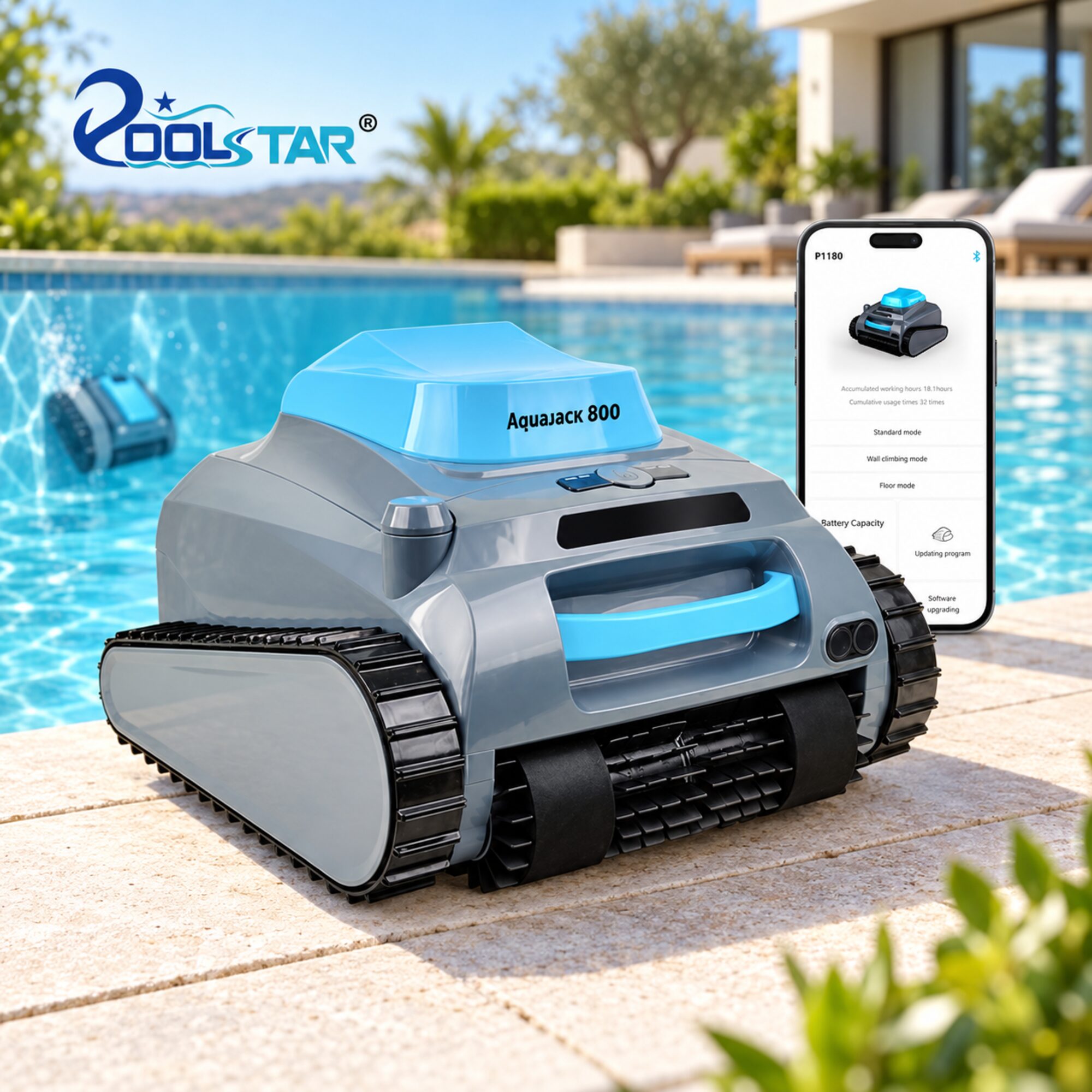
AquaJack 800 introduces a modular approach to battery capacity.
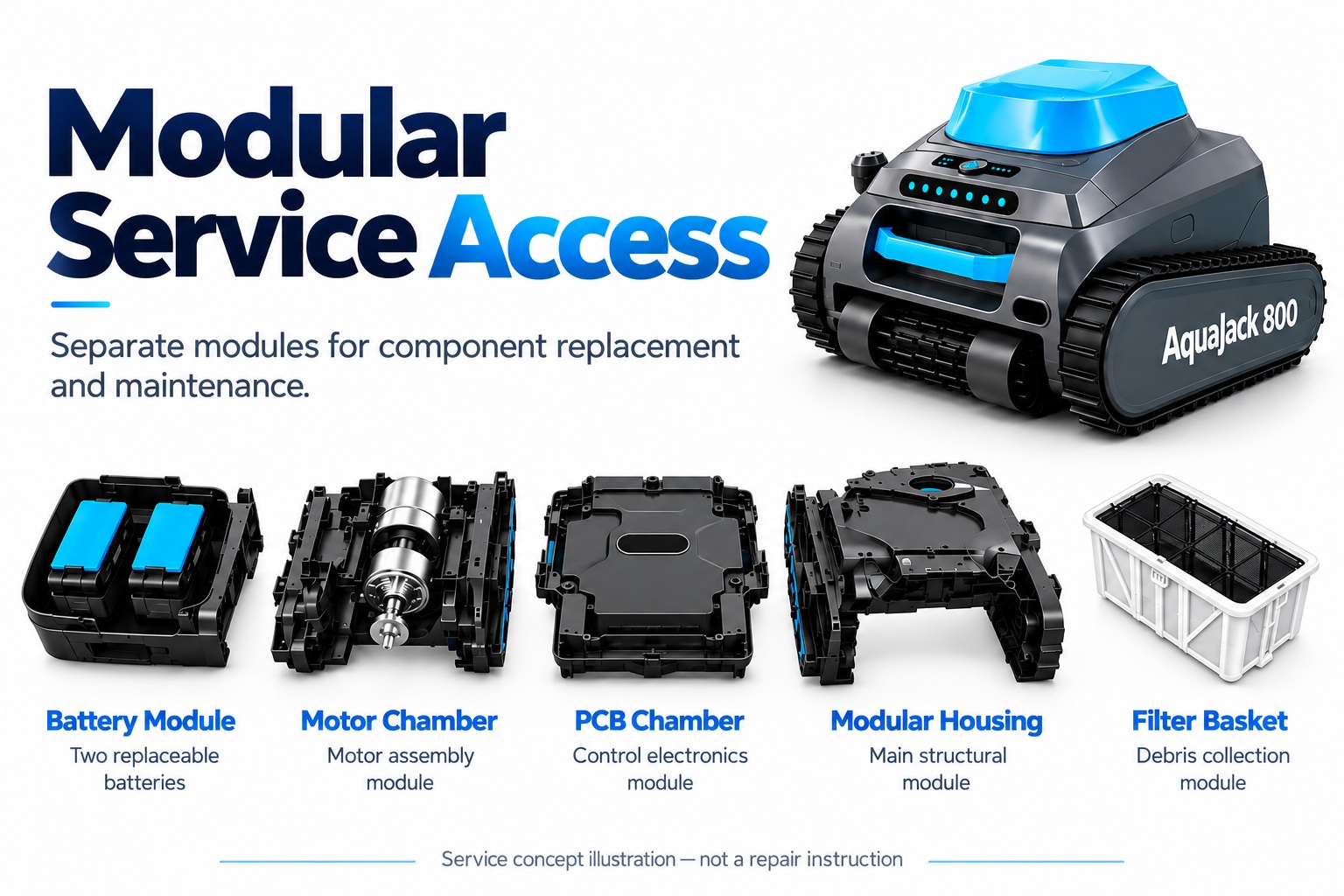
Its design supports two independent battery modules installed inside the machine.
It can also operate with a single battery module and a dedicated ballast weight in the second battery position.
This creates two configurations.
| AquaJack 800 configuration | Installed components | Maximum stated runtime |
|---|---|---|
| Single-battery mode | 1 battery + 1 ballast weight | Up to approximately 2 hours |
| Dual-battery mode | 2 independent batteries | Up to approximately 4 hours |
The two-battery configuration provides additional operating time when longer cleaning is required.
The single-battery configuration provides an alternative for shorter cleaning requirements.
Actual runtime depends on operating conditions and battery condition.
This flexibility is different from simply increasing the size of one permanently integrated battery.
It allows battery capacity to be configured within the same robotic cleaner platform.
5. Why Does AquaJack 800 Use a Ballast Weight?
A robotic pool cleaner operates underwater, where weight distribution and mechanical balance are important.
Removing one battery module changes the machine's mass distribution.
AquaJack 800 therefore uses a dedicated ballast weight in the unused battery position when operating in single-battery mode.
The ballast weight helps maintain the intended mechanical configuration.
It should not be treated as an optional decorative accessory.
The approved ballast component should be installed according to the manufacturer's instructions.
This design demonstrates that modular battery architecture requires consideration of the complete mechanical system, not just electrical capacity.
6. Reliability: What Happens After Hundreds of Cleaning Cycles?
A robotic pool cleaner may perform well during its first few cleaning sessions.
But long-term reliability is equally important.
Pool cleaning equipment operates in a demanding environment involving water, chemicals, debris, moving parts, and repeated charging.
Reliability depends on factors such as:
-
Waterproofing and sealing
-
Motor durability
-
Battery protection
-
Electrical connection reliability
-
Materials and mechanical construction
-
Manufacturing quality control
-
Proper use and maintenance
A longer runtime specification does not automatically indicate greater durability.
Buyers should consider whether the cleaner is designed and manufactured to perform reliably over repeated use.
For professional distributors, product reliability is especially important because failures can create warranty claims, returns, and customer dissatisfaction.
7. Replaceable Batteries: An Important Long-Term Advantage
Rechargeable batteries gradually lose capacity over time.
A battery may eventually require replacement even when the rest of the robotic cleaner remains functional.
This raises an important question:
Can the battery be replaced without replacing the entire machine?
Some cordless robotic pool cleaners use highly integrated battery assemblies.
Others are designed with removable battery modules.
AquaJack 800 uses a removable battery architecture.
This allows the battery to be treated as a separate service component.
If an individual battery module eventually needs replacement, the product architecture supports addressing that component separately, subject to the manufacturer's service procedures.
This can help extend the useful life of an otherwise functional cleaner.
Battery replacement should always follow the manufacturer's safety instructions, particularly when water intrusion or physical damage is suspected.
8. Motor Serviceability Is Just as Important
Battery replacement is only one part of long-term product ownership.
The motor and drive system are also critical components.
Over time, mechanical and electrical components may require inspection or service.
AquaJack 800 incorporates a serviceable motor module as part of its modular architecture.
This supports a component-level approach to maintenance.
Instead of treating every major component issue as an automatic reason for whole-unit replacement, the product is designed to provide service options for selected assemblies.
Of course, repair suitability depends on the actual failure, product condition, safety, spare-part availability, and service cost.
Nevertheless, designing for serviceability from the beginning creates more options for long-term ownership.
9. Total Cost of Ownership: Look Beyond the Purchase Price
The lowest purchase price does not always result in the lowest long-term ownership cost.
Likewise, the product with the longest runtime is not automatically the most economical.
A more complete evaluation considers:
Initial purchase price
The cost of acquiring the robotic pool cleaner.
Maintenance
Routine cleaning, filters, brushes, and other maintenance requirements.
Battery replacement
The availability and cost of replacement battery modules.
Repairability
Whether selected components can be serviced or replaced.
After-sales support
The availability of technical assistance, warranty support, and spare parts.
Product replacement
The potential cost of replacing the entire machine when repair is impractical.
A serviceable robotic cleaner may offer economic advantages in some repair scenarios, although actual savings depend on replacement-part prices, labor, and product condition.
For buyers planning to use a robotic cleaner over several seasons, these factors deserve attention.
10. What Should Pool Distributors Look for Beyond Battery Runtime?
For importers, wholesalers, and professional pool equipment dealers, product selection involves more than comparing consumer-facing specifications.
A distributor must also consider how the product fits its business model.
Important questions include:
Product Reliability
Does the manufacturer have appropriate quality-control and product-testing processes?
After-Sales Support
Are clear warranty and service procedures available?
Spare Parts
Can batteries, motor modules, filters, and other supported parts be supplied?
Product Differentiation
Does the cleaner offer meaningful benefits beyond price and runtime?
Service Economics
Can certain failures be handled through component replacement rather than complete product replacement?
Product Positioning
Does the cleaner match the needs of the distributor's target customers?
AquaJack 800's modular architecture is particularly relevant to these considerations.
Its removable battery modules, serviceable motor module, and configurable battery capacity provide product characteristics that can be explained in terms of both consumer convenience and professional after-sales service.
11. Seven Questions to Ask Before Buying a Cordless Pool Robot
A practical buying decision should answer the following questions.
1. Is the cleaner suitable for my pool?
Check the intended pool size, surfaces, and cleaning applications.
2. Does it collect the debris I normally encounter?
Consider the cleaning mechanism and filtration system.
3. Is the available runtime sufficient?
Evaluate the required cleaning duration rather than choosing the highest number automatically.
4. Is the battery replaceable?
Battery serviceability can become important over the product's useful life.
5. Can important components be serviced?
Check the manufacturer's approach to motor and component replacement.
6. Are replacement parts available?
A serviceable design is most valuable when supported by an appropriate spare-parts strategy.
7. What happens when something goes wrong?
Understand the warranty, technical support, and repair procedures.
These questions help buyers evaluate the complete product rather than a single specification.
12. AquaJack 800: More Than a Four-Hour Runtime Specification
AquaJack 800 combines several design concepts within one cordless robotic pool cleaner.
Flexible Battery Configuration
One battery with a ballast weight supports up to approximately two hours of operation.
Two independent batteries installed simultaneously support up to approximately four hours of total operation.
Removable Battery Modules
The battery architecture is designed to support battery replacement and servicing.
Serviceable Motor Module
The motor module is designed with maintenance and component-level service in mind.
Modular Product Architecture
The cleaner is developed around the principle that selected components should be accessible and replaceable when required.
These features represent a broader approach to product design.
AquaJack 800 is not intended to be evaluated only by how long it operates during one cleaning session.
Its design also considers how the cleaner can be configured, maintained, and serviced over time.
Built to Be Serviced. Designed for a Longer Life.
Frequently Asked Questions
Is longer battery runtime always better in a robotic pool cleaner?
No. Longer runtime provides more operating time, but cleaning effectiveness also depends on movement, filtration, cleaning mechanisms, and pool compatibility.
Is a four-hour robotic pool cleaner better than a two-hour model?
Not necessarily. A four-hour runtime can be useful for longer cleaning requirements, but the best choice depends on cleaning performance, reliability, and the pool's needs.
What matters most when choosing a cordless robotic pool cleaner?
Pool compatibility, cleaning effectiveness, appropriate runtime, reliability, maintenance requirements, and after-sales support are all important.
Does AquaJack 800 support two batteries?
Yes. AquaJack 800 can accommodate two independent battery modules installed simultaneously.
Can AquaJack 800 work with one battery?
Yes. It can operate with one battery and a dedicated ballast weight installed in the second battery position.
How long does AquaJack 800 run with one battery?
Up to approximately two hours, depending on operating conditions.
How long does AquaJack 800 run with two batteries?
Up to approximately four hours of total operation, depending on operating conditions.
Does a replaceable battery extend a pool robot's lifespan?
It can help extend useful product life when the battery is the primary issue and the remaining components are functional and safe.
Can the AquaJack 800 motor be serviced?
AquaJack 800 incorporates a serviceable motor module designed to support maintenance and component replacement according to the manufacturer's procedures.
Why is serviceability important for pool distributors?
Serviceability can support spare-parts management, component-level after-sales service, warranty handling, and long-term customer support.
Conclusion: The Best Cordless Pool Robot Is More Than Its Battery Runtime
Battery runtime is important.
But a good cordless robotic pool cleaner must do more than operate for a long time.
It should clean effectively, suit the intended pool, operate reliably, and provide practical maintenance options.
The AquaJack 800 approaches these requirements through a modular product architecture.
Its configurable one- or two-battery system provides flexible runtime, while removable battery modules and a serviceable motor module support long-term maintenance.
For pool owners, this means evaluating both cleaning convenience and future service options.
For distributors, it means considering the complete product lifecycle rather than competing on headline specifications alone.
AquaJack 800 — Flexible Runtime. Modular Architecture. Long-Term Serviceability.
Built to Be Serviced. Designed for a Longer Life.
Related Reading
-
Article 05: How Long Does a Cordless Robotic Pool Cleaner Last?
-
Article 06: Why a Replaceable Battery Can Extend the Life of a Robotic Pool Cleaner
-
Article 07: One Battery or Two? Understanding Long Runtime in Cordless Robotic Pool Cleaners
-
Article 08: How a Dual-Battery Robotic Pool Cleaner Can Deliver Up to 4 Hours of Cleaning
Explore: AquaJack 800 Modular Cordless Robotic Pool Cleaner