
 +86-574-5680 8878


If you manage a pool service fleet with twelve vans and three thousand contract pools across Germany, France, or the Benelux region, you already know that equipment downtime is the single largest variable cost your team faces. Every van that sits waiting for a replacement cleaner, a spare hose, or a compatible connector is a van that is not generating revenue. I have spent the last decade working with pool equipment procurement teams across Europe, and the pattern I see is consistent: fleet downtime is almost never caused by catastrophic failure of the cleaner itself. It is caused by incompatible parts across multiple SKU lines, delayed spare part fulfilment from distant suppliers, and the inefficiency of maintaining four different connector types across twelve different cleaners. This article walks through how standardizing on the AQUAJACK 600-800 cordless robotic pool cleaner series — with 38 mm standard fittings and a Rotterdam-based spare parts warehouse — can reduce fleet equipment downtime to under 72 hours and simplify your supply chain at the same time.
At Poolstar, I oversee global brand strategy and channel development across Europe, America, and Asia-Pacific. Over the past decade I have helped launch the Aquajack series and built partnerships with professional pool service fleets across multiple continents. What follows is not a generic product review — it is a sourcing framework drawn from what I have seen work for fleet operators who treat their equipment pool as an operational asset rather than a collection of independent tools.
What Fleet Downtime Actually Costs a European Pool Service Company
I often ask procurement managers whether they have calculated the fully loaded cost of a single van going off route because a cleaner malfunctioned mid-morning. The numbers are rarely small. Industry benchmarks from commercial fleet operations show downtime cost ranging from €400 to €700 per vehicle per day when you include lost billable hours, re-routing expenses, the technician wage, and the delayed service to the next three clients on the schedule. For a fleet of fifteen vans, each cleaner failure that takes a van off the road for one day effectively costs the company between €6,000 and €10,500 in lost productivity per event.
European service fleets operate in a regulatory environment where service contracts often include penalty clauses for missed maintenance windows. A typical commercial pool service agreement for an apartment complex in Germany or the Netherlands may specify that chemical balancing and cleaning must occur within a 48-hour window. If a van is down and the next available unit is already fully booked, that contract triggers a penalty. I have seen operations where penalty expenses from equipment downtime exceeded the annual spare parts budget by a factor of two.
The root cause is rarely a single catastrophic breakage. It is the accumulated friction of managing multiple cleaner models with incompatible hoses, different battery platforms, and spare parts that have to be air-freighted from Asia because no European stock exists. When a fleet manager has to carry three different hose diameters, two different charger types, and a mix of corded and cordless machines, the failure rate per unit of cleaning time actually trends upward, because the technician spends more mental energy on compatibility checks than on actual maintenance.
Why 38 mm Standard Fittings Matter When You Have Fifteen Vans
The hose connector is the most overlooked source of fleet inefficiency. In Europe, the professional pool cleaning market has gravitated toward a 38 mm (approximately 1.5-inch) hose diameter for above-ground and inground pool vacuuming. This diameter offers the best balance between water flow rate and maneuverability for the medium to large residential and light commercial pools that dominate the contract pool service sector across France, Germany, and the Low Countries.
When every cleaner in your fleet uses the same 38 mm quick-connect fitting, a technician can transfer a hose, a skimmer plate, or a telescopic pole from any van to any other van without stopping to search for an adapter. This sounds trivial, but I have watched a ten-van fleet in Bavaria lose an average of 45 minutes per day per van on connector-switching alone — nearly 40 hours per month across the entire fleet, all of it non-billable. The AQUAJACK 600 and AQUAJACK 800 series are designed around the European 38 mm fitting standard, meaning they integrate directly with the hose systems that your technicians already carry. No adapter. No guesswork.

The European swimming pool equipment standards framework (CEN/TC 287) covers a broad range of safety and compatibility requirements for pool equipment sold within the EU. The 38 mm hose interface aligns with the dominant European pool vacuum profile used by professional service fleets, and the AQUAJACK series is certified to CE and RoHS standards that apply across all EU markets. For a procurement manager managing equipment across multiple country operations, this single-connector approach reduces the number of SKU line items you need to stock by roughly two-thirds, compared to a fleet running three different connector sizes.
Cordless vs. Corded: The Fleet Manager's Real Trade-Off
I have had this conversation more times than I can count: a fleet manager wants the power of a corded robot but the logistics simplicity of a cordless unit. The honest answer is that cordless technology has crossed the threshold where it can cover the majority of European residential and light commercial pools on a single charge. The AQUAJACK 600 runs for 60 minutes on its integrated 4000 mAh lithium battery — enough to clean a standard 8 × 4 m inground pool at least twice. The AQUAJACK 800, with its 4400 mAh battery, delivers up to 120 minutes of continuous operation on a single battery, and up to 240 minutes with the optional dual-battery configuration.
For a fleet technician running a route of seven to nine pools per day, the routine is straightforward. Drop the AQUAJACK 800 into the first pool, let it run its full cleaning cycle while the technician performs chemical testing and skimming, then pull it out, swap the battery if needed, and move to the next pool. The technician never needs to untangle a 20-meter power cord, never needs to search for an outdoor power outlet that may or may not be working, and never risks the vehicle driving away with the cord still plugged in — a surprisingly common cause of equipment damage that I have seen cost fleets thousands in repairs annually.
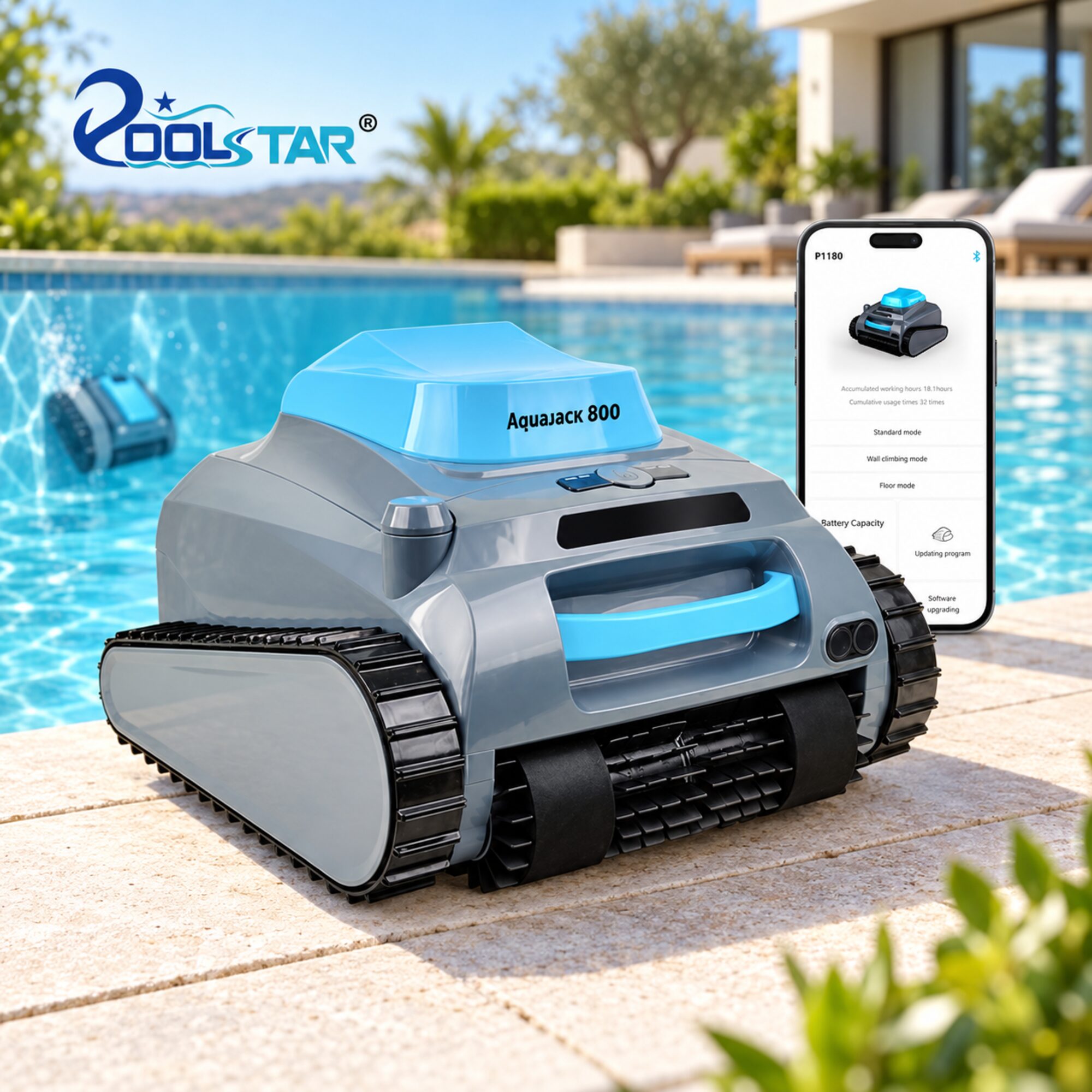
The suction performance of the AQUAJACK 800 — 78.2 gallons per minute (296 liters per minute) with a 4-liter filter capacity — means that even on its standard single battery, it handles leaf debris, sand, and biofilm more than adequately for the heavy-use pools that dominate a service fleet's portfolio. The AQUAJACK 800 product page includes the full technical specifications, including the three cleaning modes (surface, wall, and floor) that allow a single unit to cover every surface type a technician will encounter in a typical route.
AQUAJACK 600 vs. 800: Matching the Cleaner to the Pool Profile
Fleet procurement is not about choosing the best cleaner overall. It is about choosing the right cleaner for each pool profile across your contract portfolio, and then standardizing on a compatible platform so that spare parts and batteries work across the entire fleet. The AQUAJACK 600 and AQUAJACK 800 share the same 38 mm fitting, the same charger interface, and a common spare parts ecosystem. They differ in power, runtime, and coverage — which maps directly to different pool types.
| Specification | AQUAJACK 600 | AQUAJACK 800 |
|---|---|---|
| Motor power | 27 W | 50 W |
| Suction flow | 120 L/min (est.) | 296 L/min (78.2 GPM) |
| Single-battery run time | 60 minutes | 120 minutes |
| Dual-battery run time | N/A | 240 minutes |
| Battery capacity | 4000 mAh | 4400 mAh |
| Pool coverage per charge | Up to 50 m² | Up to 200 m² |
| Cleaning modes | Floor + wall + surface water | Floor + wall + surface water (APP control) |
| Filtration capacity | 2 L (est.) | 4 L |
| Waterproof rating | IPX8 | IPX8 |
| Fitting standard | 38 mm European | 38 mm European |
| APP connectivity | Bluetooth | Bluetooth |

In practice, a fleet operator serving a mix of small residential pools (20–35 m²) and larger hotel or apartment complex pools (up to 200 m²) can equip each van with two AQUAJACK 600 units for the standard residential route plus one AQUAJACK 800 for the larger commercial accounts. Because all units share the same fitting and the cleaning accessory ecosystem, the technician carries one hose type and one set of spare filters. The AQUAJACK 600 product page shows the full specifications for the smaller unit, while the 800 handles the heavier-duty applications within the same operational framework.
Rotterdam Warehouse: 72-Hour Parts Availability as a Contractual Commitment
This is the piece of the sourcing equation that I see fleet managers value most once they experience it. Even the most reliable pool cleaner will eventually need a replacement filter bag, a worn brush roller, or a new battery pack after 800 to 1,000 charge cycles. The difference between a fleet that recovers from a parts failure in three days and one that waits three weeks is not the quality of the cleaner — it is the warehouse network supporting it.
Poolstar maintains a spare parts and inventory warehouse in the Rotterdam port area. From this location, standard spare parts — filter cartridges, brush assemblies, battery packs, chargers, and connector adapters — reach destinations in Germany, France, Belgium, and the Netherlands within three to five working days via road freight. For expedited shipments to locations within the Benelux region and western Germany, the typical delivery window compresses to 48 hours. This is not a promotional claim; it is a logistics arrangement that I have worked to establish so that our fleet customers can include 72-hour parts availability in their service-level agreements with their own end clients.
The Port of Rotterdam is the largest seaport in Europe and serves as the primary gateway for Asian-manufactured goods entering the EU market. By positioning inventory at this hub, we reduce the typical Europe-bound spare parts lead time from 25–35 days (ship from China plus customs clearance plus last-mile) to a regional delivery cycle measured in days rather than weeks.
For a fleet operator managing, say, forty AQUAJACK units across fifteen vans, the common spare parts consumption pattern is predictable: approximately two filter sets per unit per season, one brush roller replacement per unit every eighteen months, and one battery pack replacement per unit every two to three years. With the Rotterdam warehouse, the fleet manager can place a single quarterly replenishment order instead of chasing emergency shipments every time a filter tears or a brush jams. This predictability transforms spare parts procurement from a reactive cost center into a manageable operational line item.
The OEM/ODM Advantage: Why Custom Branding Streamlines Fleet Procurement
One of the operational insights I have gained from working with European fleet operators is that standardized equipment becomes even more valuable when it carries the fleet's own branding. Poolstar offers OEM and ODM services that allow fleet operators to place the AQUAJACK 600 or 800 under their own brand name, with their own packaging, their own SKU numbers, and their own spare parts catalog. The internal components, fittings, and accessories remain identical — which means that a fleet operator running a private-label cleaner can still order replacement parts from the Rotterdam warehouse using their own catalog system.
This matters for two reasons. First, it eliminates the confusion that arises when a technician's van carries cleaners from three different manufacturers, each with a different control interface, different charger, and different connector. Second, it simplifies the procurement cycle: the fleet manager issues a single purchase order for branded units plus a quarterly replenishment of branded spare parts, rather than managing separate vendor relationships for each component. I have seen fleets reduce their equipment vendor count from six to two within a single procurement cycle by adopting this approach.
The total solutions approach at Poolstar covers the full equipment lifecycle — from initial specification and OEM branding through to spare parts logistics and after-sales support. For a fleet procurement manager who values predictability over piecemeal sourcing, this single-vendor model reduces administrative overhead by a measurable margin.
Battery Fleet Management: Swappable Packs Reduce Route Disruption
A cordless fleet introduces a new variable that corded operations never had to manage: battery charging. If every cleaner has its own battery type and charger, the charging station in the depot becomes a logistical bottleneck. The AQUAJACK 600 and 800 share a compatible charger interface, meaning a single charger rack can service both models simultaneously. The 4000 mAh pack from the 600 and the 4400 mAh pack from the 800 are interchangeable for charging purposes, so a technician arriving at the depot after a full day can swap depleted packs onto the charging rack without sorting units by model.
For fleets running the AQUAJACK 800 in dual-battery mode, I recommend a ratio of three battery packs per cleaner. One pack in the cleaner, one on the charger, and one in rotation as a hot spare. This triples the effective fleet capacity without tripling the number of cleaners. A fleet of twenty AQUAJACK 800 units needs approximately sixty battery packs, not eighty. The charging infrastructure scales proportionally, and the total capital tied up in battery inventory is lower than it would be with mixed-brand equipment.
The IPX8 waterproof rating on both models means that a technician can operate the cleaner in rain or splash conditions without worrying about electrical failure — a practical advantage for fleets operating in northern European climates where the pool season overlaps with unpredictable weather.
How the Fleet Sourcing Decision Maps to Your Procurement Cycle
I break the fleet sourcing evaluation into three stages for the procurement teams I advise. First, the compatibility audit: count every unique connector type, battery platform, and charger model currently in your fleet, and calculate the technician time lost to compatibility workarounds. Second, the logistics timeline review: for each spare part your fleet consumed over the last twelve months, measure the actual lead time from order placement to technician hand — not the quoted lead time. Third, the standardization assessment: estimate the percentage of your fleet's pool coverage that falls within the 20–200 m² range that the AQUAJACK 600 and 800 cover.
I have seen fleets complete this three-stage evaluation and reduce their equipment-related downtime by over 60 percent within a single procurement cycle. The robotic pool cleaner category page on the Poolstar site provides an overview of the full AQUAJACK lineup, and I recommend starting there when building the comparison spreadsheet for your procurement committee.
If your fleet is running mixed-brand equipment with incompatible hoses, multiple charger systems, and a spare parts supply chain that depends on air freight, the annual efficiency loss is almost certainly higher than the cost of a phased migration to a standardized platform. Based on the downtime cost benchmarks from commercial fleet data, even a twenty-percent reduction in lost van-hours recovers enough capacity to cover the transition investment within one peak season.
I encourage procurement managers to visit our contact page and request a fleet assessment. We will map your current equipment inventory to the AQUAJACK platform, calculate the spare parts logistics timeline from the Rotterdam warehouse to your operational region, and provide a phased migration plan that fits your service schedule.
Frequently Asked Questions
What is the minimum order quantity for fleet customers ordering the AQUAJACK 600 or 800 series?
For standard product orders, the MOQ is 50 units per model. For OEM/private-label orders including custom packaging and branding, the MOQ is 500 units per model. We can structure phased delivery schedules to align with fleet deployment timelines. The FAQ page provides additional ordering details.
Are spare parts for the AQUAJACK 600 and 800 interchangeable between the two models?
Filter cartridges, hose connectors, brush roller assemblies, and charger units are shared across both models. Battery packs differ in capacity (4000 mAh vs. 4400 mAh) but share the same physical interface and charging cradle. This interchangeability is intentional — it allows a fleet to stock one set of spare parts for both cleaner models.
What warranty applies to AQUAJACK units used in commercial fleet applications?
The standard warranty covers the main unit for 12 months against manufacturing defects, with the motor and battery covered for 6 months under normal operating conditions. For fleet-scale contracts, extended warranty terms are negotiable as part of the OEM supply agreement. All units carry CE and RoHS certification applicable to EU markets.
How does the Rotterdam warehouse spare parts fulfillment work for a fleet operator based outside the Benelux region?
Orders placed before 12:00 CET on a working day are dispatched the same day. Standard road freight reaches Germany, France, Belgium, Netherlands, and Luxembourg within 3–5 working days. Expedited (48-hour) service is available for Benelux and western Germany. For other European regions, we coordinate with regional freight partners and can quote specific timelines based on the destination.
Can the AQUAJACK 600 or 800 handle commercial pool volumes, such as hotel or apartment complex pools?
The AQUAJACK 800 with its 50 W motor, 296 L/min suction, and 4 L filter capacity is suitable for light commercial pools up to 200 m². For a hotel or apartment complex pool in the 80–200 m² range, the dual-battery configuration provides sufficient runtime for a full cleaning cycle without interruption. The AQUAJACK 600 is optimized for residential pools up to 50 m². We recommend the 800 for any pool above 50 m² or with high debris load.
Do you provide training materials for fleet technicians when switching to the AQUAJACK platform?
Yes. For fleet-scale orders, we provide a digital operations manual, an illustrated quick-start guide, and a video tutorial covering battery management, cleaning mode selection, and routine maintenance. For OEM customers, we can co-brand these materials. On-site training at the fleet depot can be arranged for orders exceeding 200 units.