
 +86-574-5680 8878



0102030405
How a Two-Battery System Can Provide Up to 4 Hours of Pool Cleaning
2026-10-16
How a Dual-Battery Robotic Pool Cleaner Can Deliver Up to 4 Hours of Cleaning
One Battery or Two? How the AquaJack 800 Modular Battery System Adapts to Different Pool Cleaning Needs
When choosing a cordless robotic pool cleaner, battery runtime is often one of the first specifications buyers consider.
But not every swimming pool requires the same cleaning time.
A small residential pool may need a relatively short cleaning session, while a larger pool or one with heavier debris may benefit from extended operation.
This raises an important question:
What if a robotic pool cleaner could be configured for either two hours or four hours of cleaning, depending on your needs?
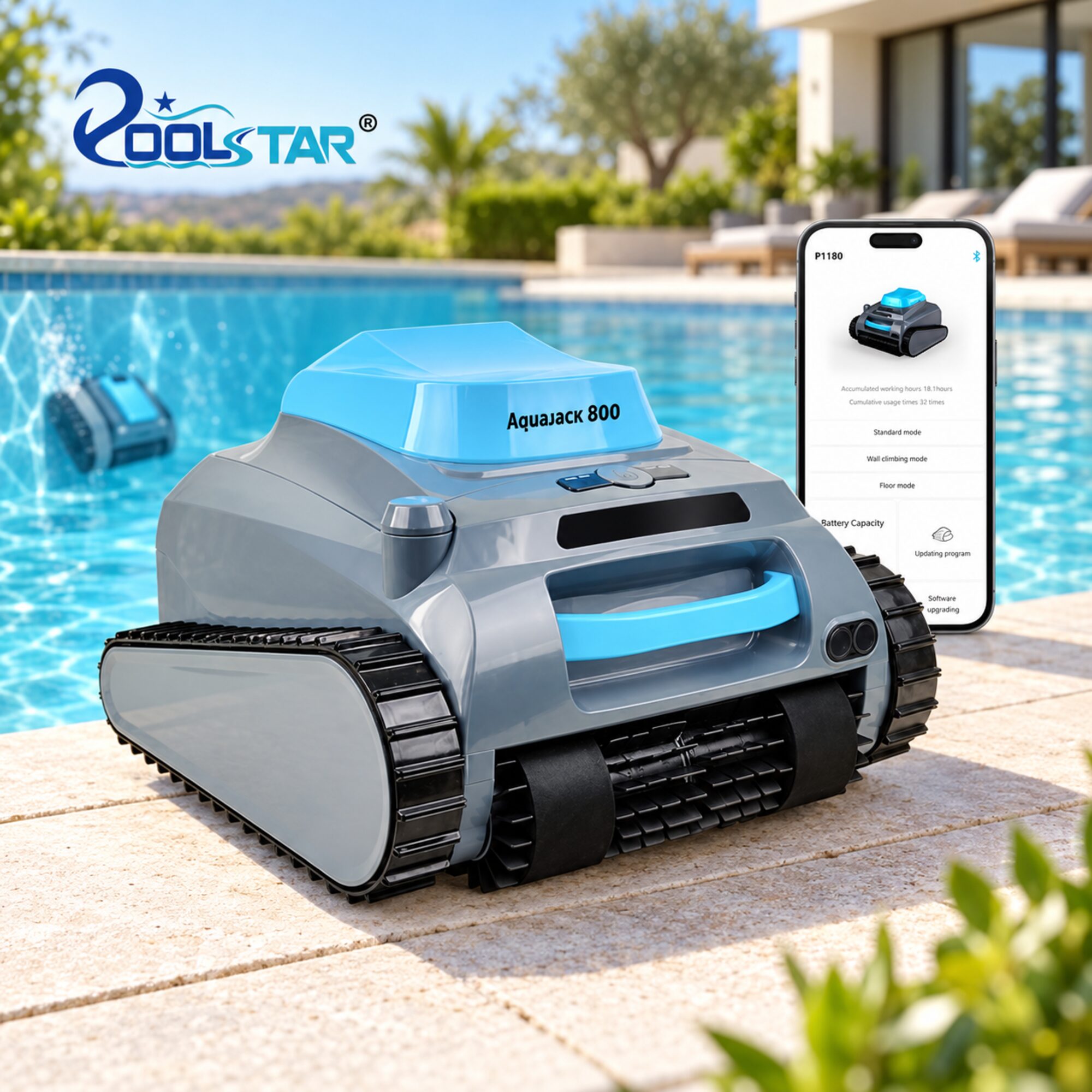
The AquaJack 800 cordless robotic pool cleaner introduces a flexible approach through its modular dual-battery architecture.
It can operate with one battery module or accommodate two independent battery modules installed inside the machine.
This allows pool owners to choose a battery configuration based on their cleaning requirements.
1. Why Fixed Battery Runtime Is Not Always Ideal
Traditional cordless robotic pool cleaners generally have a fixed battery configuration.
Their runtime is determined by the installed battery capacity, power consumption, and operating conditions.
For some pool owners, that configuration is sufficient.
However, swimming pools vary considerably.
Cleaning requirements may depend on:
-
Pool dimensions and shape
-
Amount of accumulated debris
-
Frequency of cleaning
-
Seasonal conditions
-
Cleaning mode and operating conditions
-
Number of cleaning cycles required
A cleaner designed around only one fixed battery configuration may offer more runtime than some owners need and less than others would prefer.
A modular battery system provides an alternative.
Instead of offering only one battery arrangement, the cleaner can support different configurations within the same product architecture.
2. AquaJack 800: One Robot, Two Battery Configurations
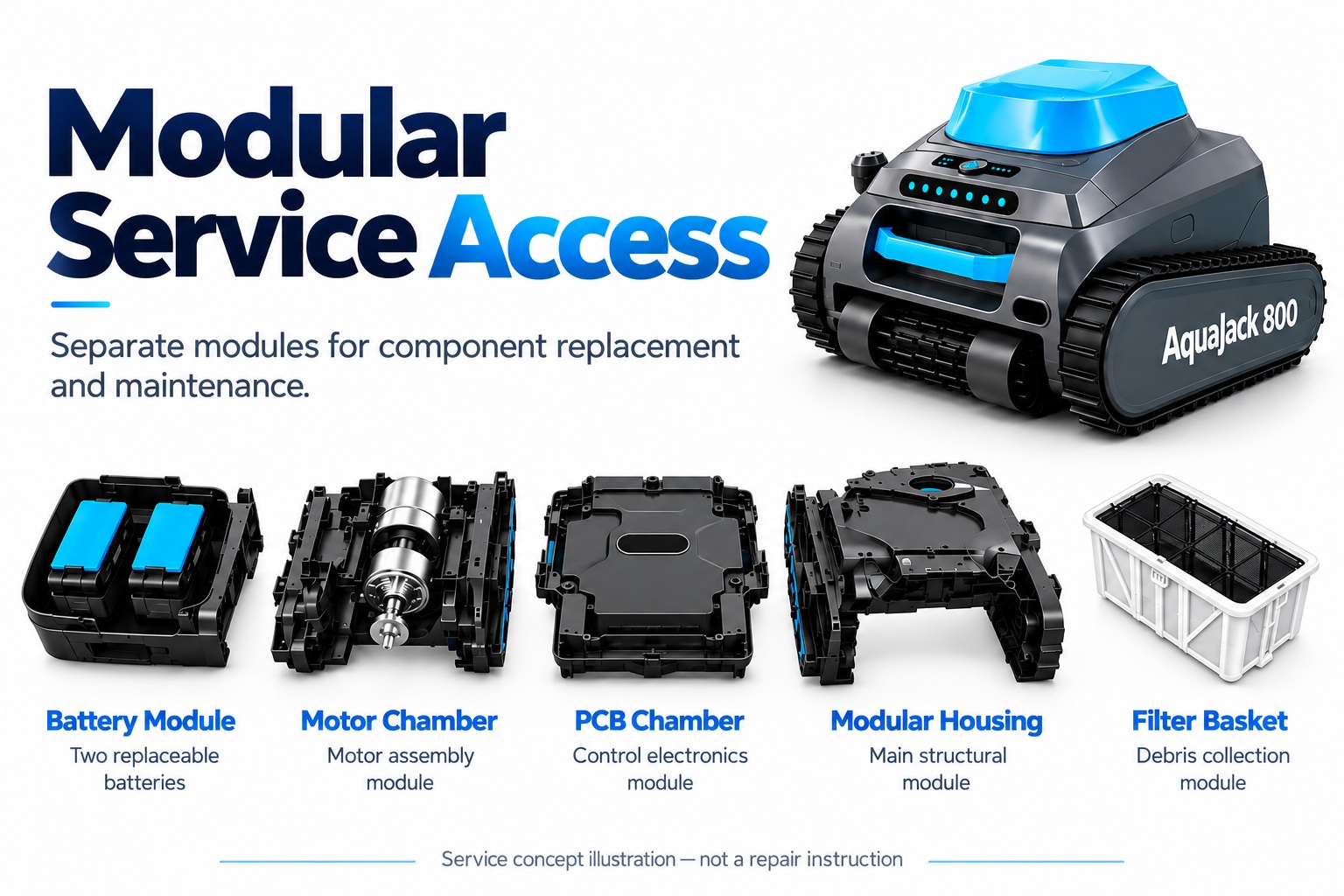
The AquaJack 800 is designed to accommodate two independent battery modules inside the machine.
However, both battery positions do not necessarily need to contain batteries.
The cleaner can also operate with one battery module installed.
In that configuration, a dedicated ballast weight is placed in the second battery position.
This creates two operating options.
Option A: Single-Battery Configuration
One battery module + one ballast weight
-
One battery module installed
-
Ballast weight installed in the second battery position
-
Up to approximately two hours of cleaning operation
-
Suitable when extended runtime is unnecessary
Option B: Dual-Battery Configuration
Two independent battery modules installed
-
Two battery modules installed simultaneously
-
Up to approximately four hours of total cleaning operation
-
Greater runtime flexibility for longer cleaning requirements
-
No need to allocate the second battery position to a ballast weight
Both configurations use the same AquaJack 800 product architecture.
This is an important advantage of modular design.
One robotic pool cleaner. Two battery configurations. Flexible cleaning runtime.
3. How Does the Dual-Battery System Work?
The AquaJack 800 has two dedicated battery positions within its modular construction.
Each battery module is designed to provide up to approximately two hours of operation.
With both battery modules installed, the system supports up to approximately four hours of total cleaning operation, depending on operating conditions.
The two batteries are independent modules rather than one permanently integrated battery pack.
This provides flexibility in battery configuration and future replacement.
The exact power-management sequence is controlled by the product's electrical design and operating system.
For buyers, the key benefit is straightforward:
The machine can accommodate the battery capacity required for a shorter or longer cleaning session.
Runtime figures represent maximum expected operating durations under specified conditions. Actual runtime may vary with operating conditions and battery condition.
4. Why Is a Ballast Weight Used in Single-Battery Mode?
AquaJack 800 can operate with one battery module, but the second battery position should not simply be left empty.
Instead, a dedicated ballast weight is installed.
This is an important design consideration for equipment operating underwater.
A robotic pool cleaner must maintain appropriate weight distribution, balance, and contact with the pool surface.
Removing a battery module changes the machine's mass distribution.
A properly designed ballast component helps compensate for that difference and maintain the intended mechanical configuration.
The ballast weight is therefore a functional part of the single-battery arrangement, not merely a placeholder.
Pool owners should use the specified ballast component and follow the manufacturer's installation instructions.
5. Two Hours or Four Hours: Which Configuration Should You Choose?
The best configuration depends on the actual cleaning task.
| Cleaning consideration | Single-battery configuration | Dual-battery configuration |
|---|---|---|
| Installed modules | 1 battery + ballast weight | 2 batteries |
| Maximum stated runtime | Up to approximately 2 hours | Up to approximately 4 hours |
| Intended use | Shorter cleaning requirements | Longer cleaning requirements |
| Battery capacity installed | One battery module | Two battery modules |
| Product platform | AquaJack 800 | AquaJack 800 |
| Battery serviceability | Removable battery | Two removable battery modules |
The single-battery configuration may be sufficient for routine cleaning when the required cleaning duration is relatively short.
The dual-battery configuration can be useful when additional operating time is desired.
However, battery runtime should not be used as the only indicator of pool compatibility.
Pool size, cleaning coverage, debris conditions, and the manufacturer's recommended application range must also be considered.
6. Scenario One: Routine Residential Pool Cleaning
Consider a residential swimming pool that receives regular maintenance.
The owner runs the robotic cleaner frequently, so debris accumulation remains relatively manageable.
In this situation, a two-hour cleaning session may be sufficient for the intended cleaning task.
The AquaJack 800 can be configured with:
One battery module + one ballast weight
This provides a practical single-battery operating arrangement without requiring both battery positions to contain batteries.
The owner can select the configuration appropriate for routine cleaning.
7. Scenario Two: A Pool with Heavier Debris Accumulation
Now consider a pool surrounded by trees.
During certain periods, leaves and other debris may accumulate more quickly.
Additional cleaning time may be useful, depending on the cleaner's debris-handling capability and the pool's conditions.
With the AquaJack 800, the owner can select the dual-battery configuration:
Two battery modules installed simultaneously
This supports up to approximately four hours of total operation.
The additional battery capacity gives the cleaner more available operating time for longer cleaning requirements.
Actual cleaning results still depend on filtration, debris characteristics, cleaning performance, and operating conditions.
8. Scenario Three: Changing Cleaning Requirements During the Season
Swimming pool maintenance requirements are rarely identical throughout the year.
During quieter periods, shorter cleaning sessions may be sufficient.
During periods of heavy use or increased debris accumulation, owners may prefer longer cleaning sessions.
A modular battery arrangement allows the same robotic cleaner to support both operating configurations.
This means pool owners do not necessarily need to choose between two completely different machines solely because their desired runtime changes.
Instead, they can select the appropriate battery configuration within the AquaJack 800 platform.
This flexibility is one of the most practical benefits of modular battery architecture.
9. Does Four Hours of Runtime Mean Better Cleaning?
Longer runtime provides more available operating time.
However, it does not automatically guarantee better cleaning results.
A robotic pool cleaner must also deliver effective debris collection and cleaning coverage.
Important factors include:
Cleaning Efficiency
How effectively does the cleaner collect debris during operation?
Movement and Coverage
Does the cleaner move effectively through the intended cleaning area?
Filtration
Can the filtration system retain the types of debris present in the pool?
Mechanical Performance
Are the brushes, motors, and other cleaning components operating correctly?
Battery Management
Does the power system provide reliable energy throughout the intended operating period?
A longer runtime is most valuable when it supports effective cleaning.
For this reason, buyers should consider the AquaJack 800's flexible battery configuration alongside its cleaning specifications and intended pool applications.
10. Modular Batteries Also Support Long-Term Maintenance
The AquaJack 800 battery system is not designed solely around runtime.
Its independent battery modules also support a more practical approach to battery replacement.
Rechargeable batteries gradually lose capacity as they age.
Eventually, an individual battery module may need to be replaced.
In a modular architecture, the affected battery can be addressed separately from the rest of the cleaner.
This creates an important distinction between two product benefits:
Flexible runtime: Choose the number of installed batteries based on cleaning requirements.
Long-term serviceability: Replace an individual battery module when necessary, according to the manufacturer's procedures.
AquaJack 800 also incorporates a serviceable motor module, extending the same product philosophy beyond the battery system.
The overall design emphasizes maintenance and component replacement as part of long-term ownership.
11. What Does Dual-Battery Design Mean for Pool Distributors?
For professional pool equipment distributors, the modular battery architecture creates several potential opportunities.
Flexible Product Positioning
The same product platform can support different battery configurations.
This may help distributors address customers with different runtime requirements.
Battery Replacement Support
Independent battery modules can support a defined replacement-part strategy.
After-Sales Service
Battery-related service can potentially be handled at the module level.
Product Differentiation
Rather than competing only on headline runtime, distributors can explain the benefits of configurable battery capacity and long-term serviceability.
Private-Label Opportunities
For pool equipment brands and OEM/ODM customers, a configurable battery architecture may offer additional flexibility in product positioning, subject to the manufacturer's approved configurations and commercial arrangements.
The commercial benefits depend on actual product specifications, approved configurations, spare-parts support, and pricing.
Nevertheless, a modular dual-battery design provides a distinctive product story for professional distribution channels.
12. What Should Buyers Check Before Using One or Two Batteries?
Before selecting a battery configuration, pool owners should consider several points.
Battery installation
Use only the specified compatible battery modules.
Ballast installation
When operating with one battery, install the approved ballast weight in the second battery position.
Water protection
Ensure battery modules and relevant interfaces are correctly installed according to the manufacturer's instructions.
Charging
Follow the manufacturer's charging procedures for each battery module.
Operating time
Understand that actual runtime depends on cleaning conditions and battery performance.
Servicing
Do not attempt unauthorized repairs to electrical or battery components.
A modular battery system provides flexibility, but correct installation and maintenance remain essential for safe and reliable operation.
Frequently Asked Questions
Does AquaJack 800 have two battery compartments?
AquaJack 800 is designed with two positions for independent battery modules.
Can AquaJack 800 operate with only one battery?
Yes. AquaJack 800 supports a single-battery configuration with a dedicated ballast weight installed in the second battery position.
Why does AquaJack 800 need a ballast weight?
The ballast weight helps compensate for the missing battery's mass and maintain the intended mechanical configuration in single-battery operation.
How long does AquaJack 800 operate with one battery?
One battery provides up to approximately two hours of cleaning operation, depending on operating conditions.
Can two batteries be installed simultaneously?
Yes. AquaJack 800 can accommodate two independent battery modules installed inside the machine at the same time.
How long does AquaJack 800 operate with two batteries?
With two batteries installed, AquaJack 800 supports up to approximately four hours of total cleaning operation, depending on operating conditions.
Does AquaJack 800 require two batteries to work?
No. It can operate with one battery and the approved ballast weight installed in the second battery position.
Are the two batteries removable?
Yes. The battery modules are designed to be removable as part of AquaJack 800's modular architecture.
Does longer runtime mean the robot can clean any pool size?
No. Pool compatibility also depends on the cleaner's intended cleaning area, coverage, movement, filtration, and other specifications.
Can the batteries be replaced when they age?
AquaJack 800's removable battery architecture is designed to support battery replacement and servicing according to the manufacturer's procedures.
Conclusion: Flexible Runtime Starts with Flexible Product Design
Not every swimming pool needs the same cleaning time.
Some owners may find that two hours is sufficient for their regular maintenance routine.
Others may benefit from additional operating time.
The AquaJack 800 addresses these different needs through a modular battery architecture.
With one battery and a ballast weight, it supports up to approximately two hours of operation.
With two independent batteries installed simultaneously, it supports up to approximately four hours of total operation.
Combined with removable battery modules and a serviceable motor design, this approach offers more than extended runtime.
It provides flexibility in how the cleaner is configured, operated, and maintained over time.
AquaJack 800 — One Robot. Two Battery Configurations. Up to 4 Hours of Cleaning.
Built to Be Serviced. Designed for a Longer Life.
Related Reading
-
Article 02: Can You Replace the Battery in a Robotic Pool Cleaner?
-
Article 05: How Long Does a Cordless Robotic Pool Cleaner Last?
-
Article 06: Why a Replaceable Battery Can Extend the Life of a Robotic Pool Cleaner
-
Article 07: One Battery or Two? Understanding Long Runtime in Cordless Robotic Pool Cleaners
Explore: AquaJack 800 Modular Cordless Robotic Pool Cleaner