
 +86-574-5680 8878

0102030405
How Long Does a Cordless Robotic Pool Cleaner Last?
2026-10-15
How Long Does a Cordless Robotic Pool Cleaner Last?
Understanding Battery Lifespan, Motor Durability, Maintenance, and the Benefits of Modular Design
When buying a cordless robotic pool cleaner, most pool owners focus on cleaning performance, battery runtime, and price.
But there is another important question that deserves attention:
How long will a cordless robotic pool cleaner actually last?
The answer depends on several factors, including product design, battery condition, motor reliability, maintenance habits, storage conditions, and the availability of replacement parts.
A robotic pool cleaner's useful life is not determined by battery runtime alone.
In fact, one of the most important differences between robotic pool cleaners is what happens when a key component eventually needs replacement.
1. What Is the Average Lifespan of a Cordless Robotic Pool Cleaner?
There is no single lifespan that applies to every cordless robotic pool cleaner.
Under suitable operating and maintenance conditions, a quality robotic pool cleaner may remain usable for several years. However, actual service life varies significantly between models.
Important factors include:
-
Battery quality and charging practices
-
Motor and drive system durability
-
Waterproofing and sealing reliability
-
Frequency of cleaning cycles
-
Pool water chemistry
-
Cleaning and maintenance habits
-
Storage conditions
-
Availability of replacement components
A cleaner used frequently in a demanding pool environment may experience more wear than one used occasionally in a small residential pool.
Product architecture also matters.
A robotic cleaner designed with replaceable components may offer more options for extending its useful life than one whose major assemblies are difficult to service.
2. Battery Runtime Is Not the Same as Battery Lifespan
These two terms are often confused.
Battery runtime describes how long a robotic pool cleaner can operate on one charge.
Battery lifespan describes how long the rechargeable battery remains usable before its capacity or performance declines enough to require replacement.
For example, a cordless pool robot may offer two hours of cleaning per charge when new.
After extended use, its battery may gradually lose capacity.
The machine itself may still be mechanically functional even if the battery no longer delivers its original runtime.
This creates an important question:
Should an aging battery mean replacing the entire robotic pool cleaner?
Not necessarily.
The answer depends on whether the battery is designed to be replaced and whether suitable replacement parts and service support are available.
3. Why Do Cordless Pool Cleaner Batteries Lose Capacity?
Most modern cordless robotic pool cleaners use rechargeable lithium-based batteries.
Like other rechargeable batteries, they experience gradual aging.
Several factors can influence battery lifespan.
Charging Cycles
Each charging and discharging cycle contributes to battery aging.
Actual battery life depends on battery chemistry, charging management, operating conditions, and other factors.
Temperature
Exposure to excessive heat can accelerate battery degradation.
A robotic pool cleaner should be charged and stored according to the manufacturer's temperature recommendations.
Storage Conditions
Leaving a battery unused for extended periods under unsuitable conditions may affect its performance.
Following the manufacturer's recommended storage charge level and maintenance procedures can help preserve battery condition.
Water Intrusion or Physical Damage
Although cordless pool cleaners are designed for aquatic environments, electrical components still require appropriate protection.
If water enters a protected battery compartment or the battery is physically damaged, the product may require professional inspection and service.
A suspected damaged battery should not be charged or reused until it has been assessed according to the manufacturer's safety procedures.
4. Can Replacing the Battery Extend the Life of a Pool Robot?
In many cases, yes.
If the battery is the only component that has reached the end of its useful life, replacing it may allow an otherwise functional robotic pool cleaner to continue operating.
However, battery replacement depends on the product's internal architecture.
Some robotic pool cleaners have highly integrated battery assemblies that may require extensive disassembly.
Others are designed with removable or replaceable battery modules.
This is one reason modular design is becoming an important consideration in cordless pool cleaning equipment.
A replaceable battery does not guarantee that every problem can be repaired.
But it provides an additional service option when battery aging becomes the main issue.
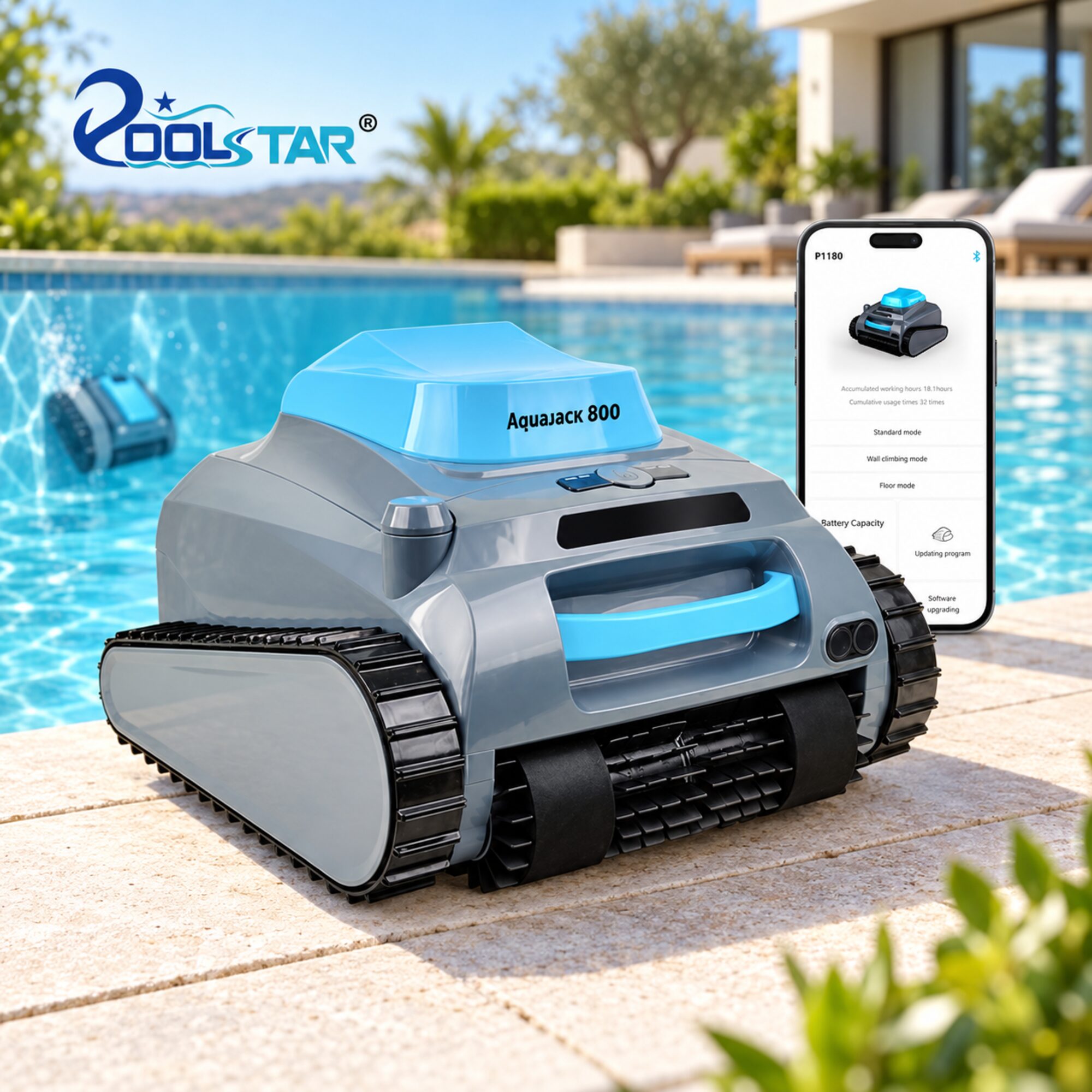
5. AquaJack 800: Designed with a Removable Battery Module
The AquaJack 800 cordless robotic pool cleaner takes a modular approach to product design.
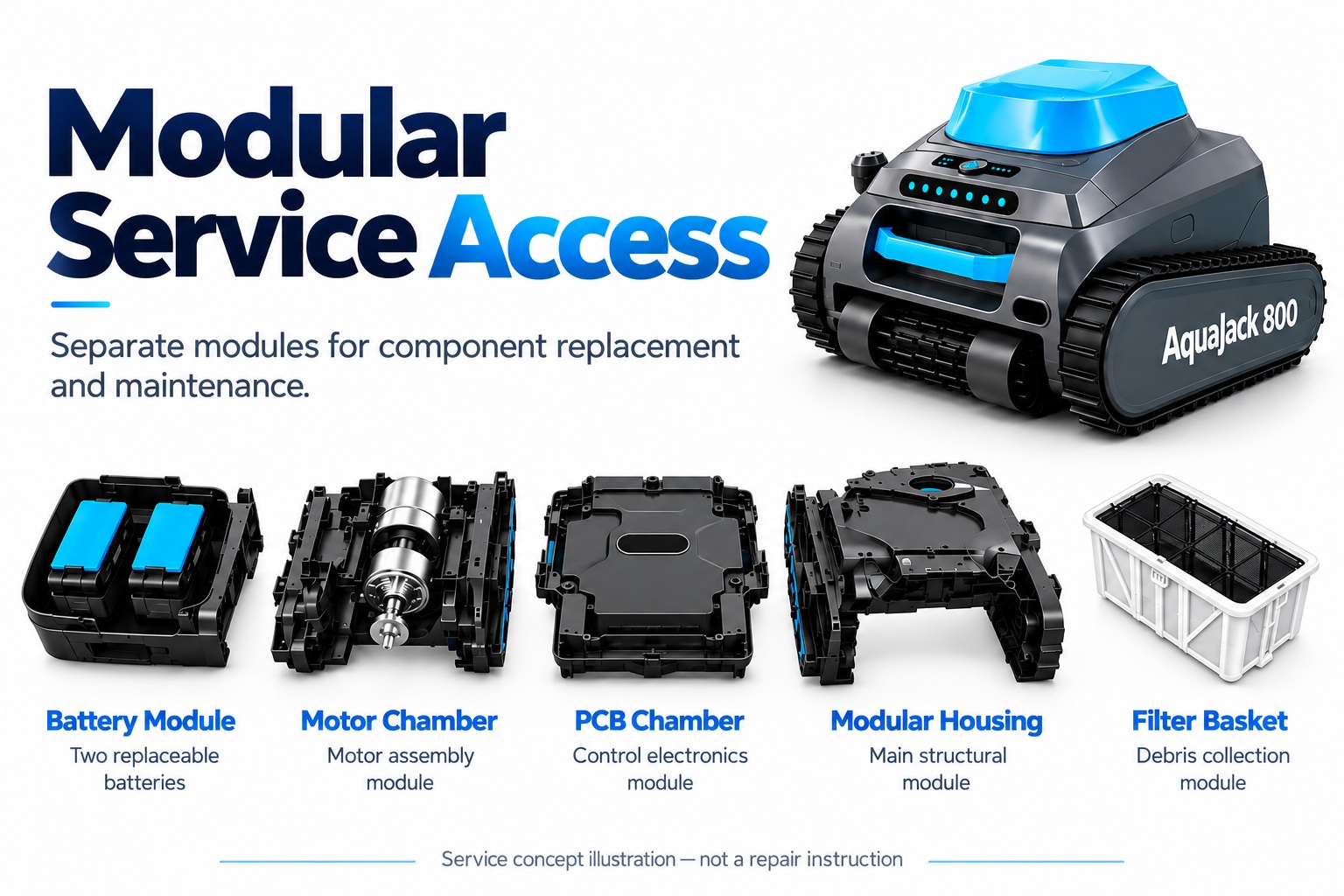
Rather than treating the battery as an inseparable part of the complete machine, AquaJack 800 incorporates a removable battery module.
This architecture is intended to support easier battery replacement and servicing.
For pool owners, it means the battery can be considered separately from the rest of the robotic cleaner when service is required.
For distributors, it creates an opportunity to organize battery-related after-sales service around a defined replacement module.
The concept is straightforward:
A battery has its own lifecycle. The entire robotic pool cleaner should not automatically be treated as having the same lifecycle.
6. How Long Does the AquaJack 800 Run?
AquaJack 800 combines modular battery design with extended cleaning flexibility.
Its battery system supports two battery modules.
Each battery provides up to approximately two hours of operation, depending on cleaning conditions.
When two batteries are used sequentially, the cleaner can provide up to approximately four hours of total cleaning operation.
This offers two distinct advantages.
Operational flexibility: A second battery can support additional cleaning time when needed.
Long-term serviceability: The removable battery architecture also supports replacement when the battery eventually requires attention.
It is important to distinguish the two:
Four hours refers to the potential combined cleaning operation using two batteries sequentially, not the runtime of a single battery.
7. How Long Does a Robotic Pool Cleaner Motor Last?
The motor is another critical component affecting a pool robot's service life.
Its durability depends on factors such as:
-
Motor design and component quality
-
Operating hours
-
Water protection
-
Mechanical loading
-
Debris accumulation
-
Maintenance and cleaning conditions
A motor can experience wear or develop faults over time.
However, a motor-related problem does not always mean the entire robotic cleaner has reached the end of its useful life.
The important consideration is whether the motor can be accessed, serviced, or replaced.
AquaJack 800: Serviceable Motor Module
In addition to its removable battery, AquaJack 800 is designed with a serviceable motor module.
This supports a component-level approach to maintenance.
When a motor-related issue occurs, qualified service personnel can evaluate the affected module according to the manufacturer's procedures.
This design philosophy helps separate the useful life of the complete product from the service life of individual components.
8. Modular Design vs. Highly Integrated Design: Which Can Last Longer?
It is not possible to conclude that every modular robotic pool cleaner will last longer than every highly integrated model.
Reliability depends on engineering quality, materials, waterproofing, manufacturing controls, and operating conditions.
However, modular construction can create an important advantage when a replaceable component reaches the end of its useful life.
| Consideration | Modular design | Highly integrated design |
|---|---|---|
| Battery replacement | Can support module-level replacement | May require more extensive disassembly |
| Motor servicing | Can provide a dedicated serviceable assembly | Accessibility depends on construction |
| Spare parts | Can be organized around modules | May involve larger integrated assemblies |
| Maintenance | Designed with selected service operations in mind | Service procedures vary by model |
| Product service life | May be extended through component replacement | Depends on repairability and parts support |
| Waterproof protection | Requires reliable sealing | Requires reliable sealing |
Both architectures can be reliable when properly engineered.
The difference is not simply how the product performs when new.
It is also how the product can be maintained as it ages.
9. Seven Ways to Help Your Cordless Robotic Pool Cleaner Last Longer
Proper maintenance can help reduce avoidable wear and protect the cleaner's performance.
1. Clean the Filter Regularly
A clogged filter can restrict water flow and affect cleaning performance.
Clean the filter according to the manufacturer's recommendations.
2. Remove Debris from Brushes and Moving Parts
Leaves, hair, and other debris may become trapped around moving components.
Regular inspection helps prevent unnecessary mechanical loading.
3. Follow Proper Charging Instructions
Use the specified charging equipment and follow the manufacturer's charging procedures.
Avoid charging a battery that appears damaged or has been exposed to abnormal water intrusion.
4. Store the Cleaner Properly
Store the cleaner in a suitable location away from excessive heat, direct sunlight during prolonged storage, and other damaging conditions.
5. Maintain Proper Pool Water Chemistry
Water chemistry outside the manufacturer's recommended range can affect materials and components.
6. Inspect the Cleaner Periodically
Check accessible parts for unusual wear, damage, or debris accumulation.
Do not open sealed electrical compartments unless authorized by the manufacturer's service instructions.
7. Choose a Product with a Practical Service Strategy
Before purchasing, investigate whether replacement batteries, motor modules, filters, and other essential parts are available.
A good maintenance routine is valuable.
A serviceable product architecture provides additional options when routine maintenance is no longer sufficient.
10. Repair or Replace: When Is a New Pool Robot Necessary?
When a robotic pool cleaner stops functioning correctly, replacing the entire machine should not always be the first conclusion.
The appropriate decision depends on the cause of the failure, repair cost, product condition, safety, and availability of replacement parts.
For example:
Situation A: Reduced battery runtime
If the battery has aged but the cleaner remains otherwise functional, battery replacement may be a practical option.
Situation B: Motor-related failure
If the motor module can be serviced or replaced, the cleaner may be returned to operation without replacing every component.
Situation C: Extensive electrical or structural damage
If damage affects multiple major components, or safe repair is not practical, complete replacement may be more appropriate.
This is why repairability should be evaluated together with product reliability.
A modular design creates service options, but repair decisions must still be technically and economically justified.
11. Why Product Lifespan Matters to Pool Distributors
For importers, wholesalers, and professional pool equipment distributors, product lifespan affects more than customer satisfaction.
It also influences after-sales operations.
A distributor may need to manage:
-
Warranty claims
-
Replacement batteries
-
Technical support
-
Motor-related service
-
Spare-part inventory
-
Customer returns
-
Product replacement decisions
A robotic pool cleaner designed with serviceable modules can help support a more structured after-sales process.
Instead of replacing an entire product for every major component issue, distributors may have the option to identify and replace an affected module.
This can potentially reduce unnecessary whole-unit replacements and support better customer service, depending on the nature of the failure and the cost of servicing.
For brands building a long-term pool equipment business, serviceability is therefore a product strategy consideration, not merely a technical feature.
12. Why Long-Term Value Is More Important Than Runtime Alone
A robotic pool cleaner with impressive runtime can be attractive at the point of purchase.
But runtime is only one measure of value.
Consider two questions:
How many hours can the cleaner operate today?
And:
What options will the owner have when a major component needs replacement in the future?
Both questions matter.
AquaJack 800 addresses these considerations through its modular design, removable battery module, serviceable motor module, and two-battery operating capability.
Its product philosophy is built around long-term ownership rather than focusing exclusively on initial specifications.
Built to Be Serviced. Designed for a Longer Life.
Frequently Asked Questions
How many years does a cordless robotic pool cleaner last?
A cordless robotic pool cleaner may remain usable for several years, but there is no universal lifespan. Actual service life depends on product quality, usage, maintenance, storage conditions, and the availability of replacement components.
Does the battery wear out before the pool robot?
It can. Batteries are aging components, and their capacity may decline while other parts of the cleaner remain functional.
Can you replace the battery in a cordless pool robot?
Some cordless robotic pool cleaners support battery replacement, while others have more integrated constructions. AquaJack 800 uses a removable battery module designed for replacement and servicing.
Does a replaceable battery make a pool robot last longer?
A replaceable battery can help extend the useful life of a robotic cleaner when battery aging is the main issue and the rest of the product remains in suitable condition.
How long does the AquaJack 800 battery run?
Each battery provides up to approximately two hours of operation, depending on cleaning conditions.
Can AquaJack 800 clean for four hours?
With two battery modules used sequentially, AquaJack 800 can provide up to approximately four hours of total cleaning operation.
Can the motor in a robotic pool cleaner be replaced?
Motor serviceability varies by model. AquaJack 800 is designed with a serviceable motor module.
Is it worth repairing a cordless robotic pool cleaner?
It depends on the failure, repair cost, availability of parts, and overall product condition. Component replacement can be worthwhile when the rest of the machine remains functional and safe.
What is the best way to extend the life of a robotic pool cleaner?
Regular filter cleaning, proper charging, suitable storage, appropriate pool water chemistry, and following manufacturer maintenance instructions can help. Choosing a product with replaceable components may also provide more long-term service options.
What should distributors consider when selecting a robotic pool cleaner?
Beyond price and cleaning performance, distributors should evaluate product reliability, battery replacement, spare parts availability, motor serviceability, warranty procedures, and technical support.
Conclusion: A Pool Robot's Life Should Not Depend on One Component
A cordless robotic pool cleaner is made up of components with different functions and different lifecycles.
The battery may eventually lose capacity.
A motor may require servicing.
Other components may continue operating normally.
A well-considered product design recognizes these differences.
With a removable battery module, serviceable motor module, and modular construction, AquaJack 800 is designed to provide more options for maintenance and component replacement throughout its useful life.
When choosing a robotic pool cleaner, look beyond how long it runs on a single charge.
Consider how the product is designed to remain useful over time.
AquaJack 800 — Built to Be Serviced. Designed for a Longer Life.
Related Reading
-
Article 01: Why Modular Design Matters in a Cordless Robotic Pool Cleaner
-
Article 02: Can You Replace the Battery in a Robotic Pool Cleaner?
-
Article 03: What Happens When Water Gets Into a Cordless Pool Robot?
-
Article 04: Modular vs. Highly Integrated Robotic Pool Cleaners: What Is the Difference?
-
Product: AquaJack 800 Cordless Robotic Pool Cleaner