
 +86-574-5680 8878

0102030405
One Battery or Two? Understanding Long Runtime in Cordless Robotic Pool Cleaners
2026-10-16
One Battery or Two? Understanding Long Runtime in Cordless Robotic Pool Cleaners
How Battery Runtime, Cleaning Flexibility, and Replaceable Battery Design Affect Your Pool Cleaning Experience
Battery runtime is one of the most frequently compared features when choosing a cordless robotic pool cleaner.
Some models offer approximately 60 to 90 minutes of operation, while others are designed for longer cleaning sessions.
But a longer runtime specification does not always tell the whole story.
For pool owners, a more practical question is:
Is one battery enough for your pool, or would a two-battery system offer greater flexibility?
The answer depends on pool size, cleaning requirements, debris conditions, battery capacity, and how frequently the cleaner is used.
Understanding these factors can help buyers choose a cordless robotic pool cleaner that fits their actual cleaning routine.
1. Why Battery Runtime Matters in a Cordless Pool Robot
Unlike corded robotic pool cleaners, cordless models operate using rechargeable batteries.
This eliminates the need for a power cable during cleaning, but it also means that each cleaning session is limited by the available battery energy.
Runtime can affect:
-
How much of the pool can be cleaned during one session
-
Whether additional cleaning cycles are possible
-
How often the battery needs charging
-
How convenient the cleaner is during busy swimming seasons
-
Whether cleaning can continue after the first battery is depleted
However, longer runtime does not automatically guarantee better cleaning.
A cleaner's actual performance also depends on its cleaning mechanism, water flow, navigation, movement speed, and ability to collect debris.
A well-designed robotic cleaner should balance battery runtime with effective cleaning performance.
2. Is a Single Battery Enough for Most Swimming Pools?
For some pools, a single battery may be sufficient.
Smaller above-ground pools and compact residential pools may require relatively short cleaning sessions.
In these situations, a cordless robotic cleaner with an appropriate single-battery runtime may complete the required cleaning without interruption.
However, other pools may have more demanding cleaning requirements.
Examples include:
-
Larger residential swimming pools
-
Pools surrounded by trees
-
Pools with frequent leaf accumulation
-
Pools requiring multiple cleaning cycles
-
Pools used heavily during the swimming season
-
Pools that require additional spot cleaning
In these situations, access to a second battery can provide more operating flexibility.
The key consideration is not simply pool size.
It is whether the available runtime is sufficient for the cleaner to complete the intended cleaning task.
3. What Happens When a Cordless Pool Cleaner Runs Out of Battery?
When a cordless robotic pool cleaner reaches its low-battery threshold, its behavior depends on the model and its control system.
Some cleaners stop operating when their battery is depleted.
Others may use programmed low-battery behavior to help with retrieval.
After the cleaning cycle, the battery must be recharged before another full session can begin.
For a cleaner with only one battery, this creates a waiting period.
If additional cleaning is needed, the owner may need to wait until sufficient charge is available.
A system that supports a second battery offers another possibility.
The owner can use a charged replacement battery for an additional cleaning session, following the manufacturer's operating instructions.
This can be especially useful when the pool needs more cleaning than one battery can provide.
4. Single-Battery vs. Two-Battery Robotic Pool Cleaners
A single-battery design and a two-battery arrangement can both be suitable solutions.
Their advantages depend on the owner's needs.
| Feature | Single-battery system | Two-battery system |
|---|---|---|
| Initial setup | One battery required | Two batteries available |
| Cleaning flexibility | Limited to available charge | Additional operating period possible |
| Extended cleaning | Requires recharging when depleted | Can continue with another charged battery |
| Spare battery | Not necessarily supported | Supported by the battery system |
| Battery management | Simpler | Requires managing two batteries |
| Upfront battery cost | Generally lower | May be higher |
| Long-term flexibility | Depends on battery design | Can provide additional operating and replacement options |
A two-battery system is not automatically necessary for every pool.
However, it can be valuable for owners who need longer total cleaning time or prefer to keep a spare battery available.
5. AquaJack 800: Up to Four Hours of Total Cleaning with Two Batteries
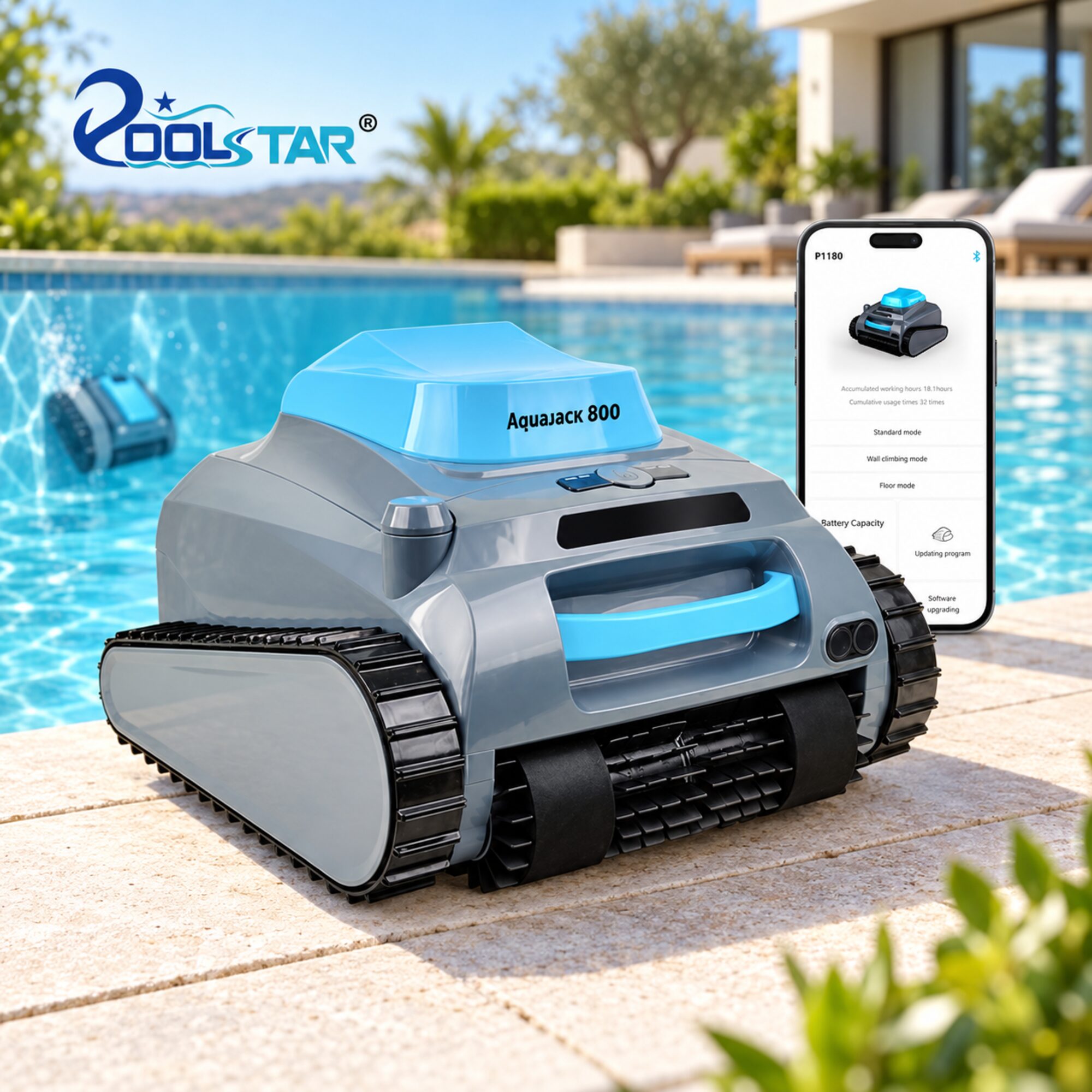
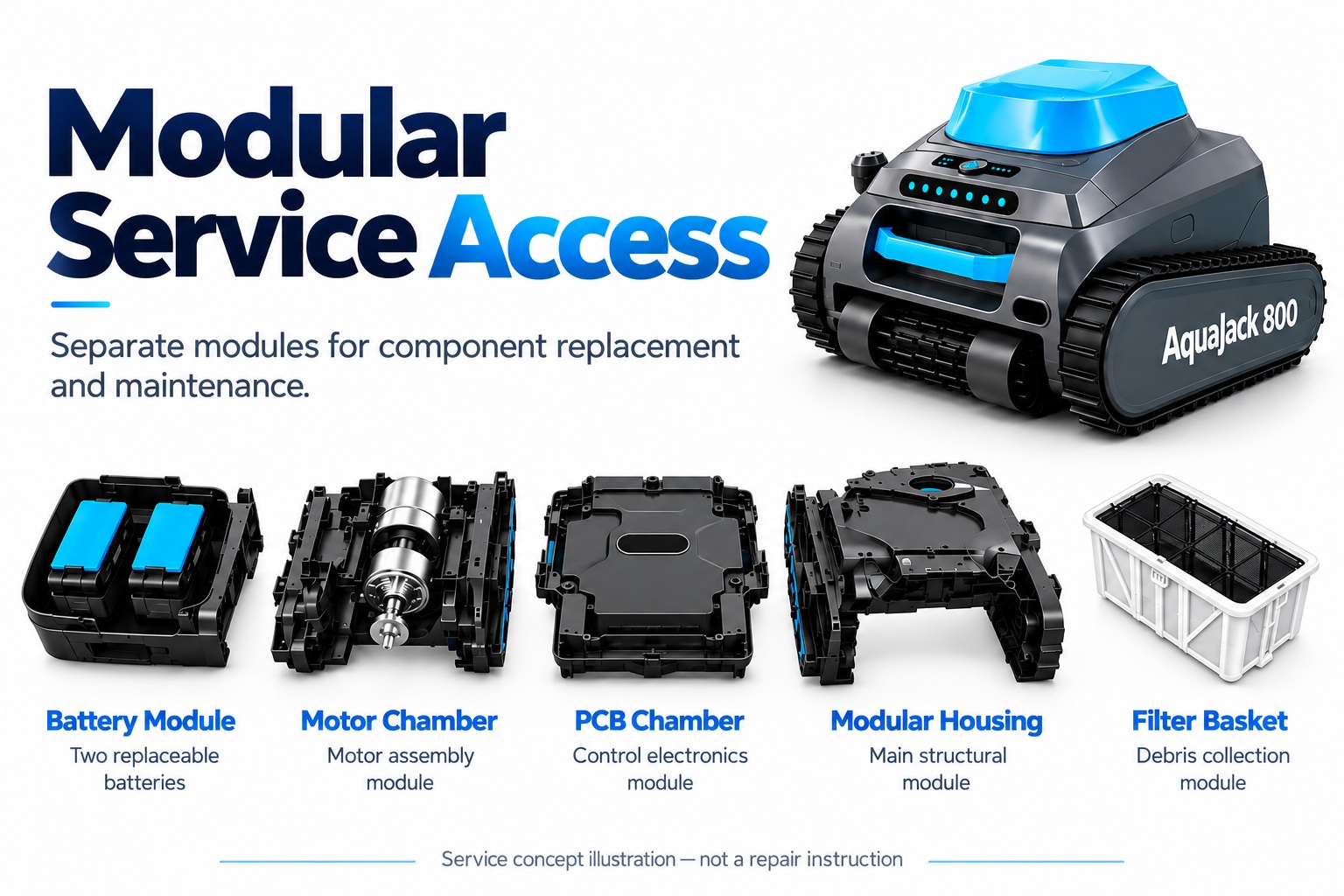
The AquaJack 800 cordless robotic pool cleaner is designed around a modular battery architecture.
It supports two battery modules.
Each battery provides up to approximately two hours of cleaning operation, depending on operating conditions.
When two batteries are used sequentially, the system can provide up to approximately four hours of total cleaning operation.
This offers a practical alternative to relying on a single battery for every cleaning session.
How the Two-Battery System Works
First cleaning session
Battery 1 provides up to approximately two hours of operation.
Additional cleaning session
Battery 2 can provide up to approximately two additional hours of operation.
Combined potential operation
Up to approximately four hours of total cleaning time with two batteries used sequentially.
This does not mean that a single battery operates for four hours.
It also does not imply that the cleaner automatically changes batteries during operation.
The second battery is used as an additional power source according to the product's operating and battery replacement procedures.
6. Does Longer Runtime Mean Better Pool Cleaning?
Not necessarily.
Runtime is important, but cleaning efficiency is equally important.
Consider two cordless robotic pool cleaners.
One cleaner operates for three hours but moves inefficiently or repeatedly covers the same areas.
Another operates for two hours but uses an effective cleaning mechanism and movement pattern.
The second cleaner may achieve comparable or better results in certain pools despite having a shorter runtime.
Actual cleaning performance depends on several factors:
Cleaning Mechanism
The design of the brushes, suction system, and filtration components affects debris collection.
Pool Conditions
A pool containing heavy leaf accumulation may require different cleaning effort from a pool with mostly fine sediment.
Movement and Coverage
The cleaner's movement behavior influences how effectively it covers the intended cleaning area.
Battery Performance
The battery must provide sufficient energy for the cleaner's motors and other operating systems.
Maintenance
A clean filter and properly maintained moving components help the cleaner operate as intended.
Therefore, buyers should evaluate runtime together with cleaning performance rather than treating runtime as the only measure of product quality.
7. Why a Second Battery Can Be Useful During Swimming Season
During the swimming season, pool cleaning requirements may change from week to week.
A pool may need only routine cleaning under normal conditions.
But after windy weather, heavy swimming activity, or increased debris accumulation, additional cleaning may be necessary.
A second battery can offer more flexibility in these situations.
For example:
Routine maintenance
One battery may provide sufficient operating time.
Heavier debris conditions
A second battery can support an additional cleaning session.
Frequent cleaning
Having two batteries available may reduce dependence on waiting for the same battery to recharge before every session.
This is particularly relevant for pool owners who want more control over when cleaning takes place.
8. Replaceable Batteries Offer More Than Extra Runtime
A second battery provides additional operating time.
But a replaceable battery architecture offers another potential benefit: long-term serviceability.
Rechargeable batteries gradually lose capacity as they age.
After extended use, a battery may no longer provide its original runtime.
If the cleaner uses a replaceable battery module, the affected battery can potentially be replaced while the rest of the cleaner remains in service.
This is an important part of AquaJack 800's product philosophy.
Its modular architecture combines:
-
Removable battery module
-
Serviceable motor module
-
Two-battery operating capability
-
Product design focused on long-term maintenance
The objective is not simply to increase runtime.
It is also to provide a more practical approach to maintaining the cleaner throughout its useful life.
Runtime matters today. Serviceability matters over time.
9. What Should Buyers Check Before Choosing a Long-Runtime Pool Robot?
Before purchasing a cordless robotic pool cleaner, consider the following questions.
How Large Is Your Pool?
The cleaner should be suitable for the pool's dimensions, shape, and intended cleaning area.
How Much Debris Accumulates?
Pools with frequent debris accumulation may need additional cleaning time or more frequent cleaning cycles.
Is the Battery Replaceable?
A replaceable battery can provide both operating flexibility and long-term service options.
Is a Second Battery Supported?
Not all cordless robotic pool cleaners support removable or additional battery modules.
How Long Does Charging Take?
Runtime should be considered together with charging time.
A long runtime may be less convenient if the owner needs frequent additional cleaning sessions and the battery requires a long recharge period.
Are Replacement Batteries Available?
The availability of compatible replacement batteries is important for long-term ownership.
What Is the Actual Cleaning Performance?
Runtime should always be considered alongside cleaning effectiveness, filtration, and pool compatibility.
10. Why Two-Battery Flexibility Matters for Pool Distributors
For importers, wholesalers, and professional pool equipment distributors, battery architecture can influence both product positioning and after-sales service.
A two-battery system creates opportunities to explain different customer benefits.
For consumers: Additional cleaning flexibility and access to a spare battery.
For distributors: A potential replacement-battery offering and a defined battery service pathway.
For private-label brands: A way to differentiate products beyond headline runtime specifications.
However, the commercial value depends on reliable battery performance, appropriate pricing, parts availability, and clear service instructions.
A two-battery system should therefore be supported by a practical product and after-sales strategy.
11. Long Runtime and Long Product Life Are Different Benefits
A cordless robotic pool cleaner can have a long runtime without necessarily being easy to repair.
Likewise, a serviceable cleaner may not have the longest runtime in its category.
These are two different product characteristics.
Long runtime describes how long the cleaner can operate before it needs additional battery energy.
Long product life describes how long the cleaner remains usable with appropriate maintenance and service.
AquaJack 800 is designed to address both considerations through its modular battery system and serviceable architecture.
The combination offers a broader ownership proposition than runtime alone.
Frequently Asked Questions
Is one battery enough for a cordless robotic pool cleaner?
It depends on the pool size, cleaning requirements, and the cleaner's efficiency. A single battery may be sufficient for smaller pools or routine cleaning.
Is a two-battery pool robot better?
A two-battery system can provide additional cleaning flexibility, especially when one battery does not offer enough operating time. However, it is not necessary for every pool.
How long does AquaJack 800 run on one battery?
Each AquaJack 800 battery provides up to approximately two hours of operation, depending on cleaning conditions.
Can AquaJack 800 run for four hours?
With two batteries used sequentially, AquaJack 800 can provide up to approximately four hours of total cleaning operation.
Does AquaJack 800 automatically switch between batteries?
The stated four-hour total is based on sequential use of two battery modules. It should not be interpreted as automatic battery switching.
Can a second battery help clean a larger pool?
A second battery can provide additional cleaning time. However, whether a robotic cleaner is suitable for a particular pool also depends on its cleaning coverage, movement, filtration, and manufacturer-specified pool compatibility.
Does longer battery runtime mean stronger suction?
No. Runtime and suction performance are different characteristics. Suction depends on the cleaner's pump, water-flow system, and overall design.
Can I replace the AquaJack 800 battery?
AquaJack 800 features a removable battery module designed for replacement and servicing. Follow the manufacturer's battery replacement procedures.
Does using two batteries extend the lifespan of the robot?
Having two batteries does not automatically extend the cleaner's service life. However, replaceable battery architecture can support continued use when an individual battery eventually needs replacement.
What is more important: runtime or battery replaceability?
Both matter. Runtime affects daily cleaning convenience, while battery replaceability can provide more flexibility for maintenance and long-term ownership.
Conclusion: Choose Runtime That Fits Your Pool and Your Lifestyle
A cordless robotic pool cleaner should provide enough operating time to meet the pool owner's actual cleaning requirements.
For some pools, one battery is sufficient.
For others, a second battery can provide valuable additional flexibility.
The AquaJack 800 supports two battery modules, each offering up to approximately two hours of operation, for up to approximately four hours of total cleaning when used sequentially.
Combined with its removable battery module and serviceable motor architecture, AquaJack 800 offers an approach that considers both daily cleaning convenience and long-term ownership.
AquaJack 800 — Flexible Battery Runtime. Modular Design. Long-Term Serviceability.
Built to Be Serviced. Designed for a Longer Life.
Related Reading
-
Article 01: Why Modular Design Matters in a Cordless Robotic Pool Cleaner
-
Article 02: Can You Replace the Battery in a Robotic Pool Cleaner?
-
Article 05: How Long Does a Cordless Robotic Pool Cleaner Last?
-
Article 06: Why a Replaceable Battery Can Extend the Life of a Robotic Pool Cleaner
Explore: AquaJack 800 Cordless Robotic Pool Cleaner