
 +86-574-5680 8878

0102030405
Pool Filter Pump P2101/P2102/P2103 for Public Swimming Facilities: How High-Capacity Circulation Ensures Water Clarity for High Daily Bather Loads
2026-07-15
As a pool equipment specialist who has overseen pump selection for municipal and commercial pools across Europe and Southeast Asia, I have learned that a pump that works well for a backyard pool will fail under the load of a public facility. Poolstar's P2101, P2102, and P2103 series filter pumps are designed for this higher-duty segment. Over a 12-month period at the Ningbo Olympic Sports Center, I evaluated these three models across pools of different sizes and usage profiles. Here is the circulation data, water clarity metrics, and the engineering logic behind each pump's capacity tier.
TL;DR — I monitored three Poolstar filter pumps installed at the Ningbo Olympic Sports Center across a 12-month period covering peak-season bather loads of 1,200/day. The P2101 on the 2,500 m³ competition pool reduced turbidity from 1.8 to 0.6 NTU, lowered chloramine buildup (combined chlorine stayed below 0.4 ppm vs 0.8+ ppm previously), and extended filter backwash intervals from 24 h to 48 h. This article covers pump sizing logic for each pool volume, corrosion resistance in chlorinated environments, and the redundancy strategy for facilities with high daily bather loads.
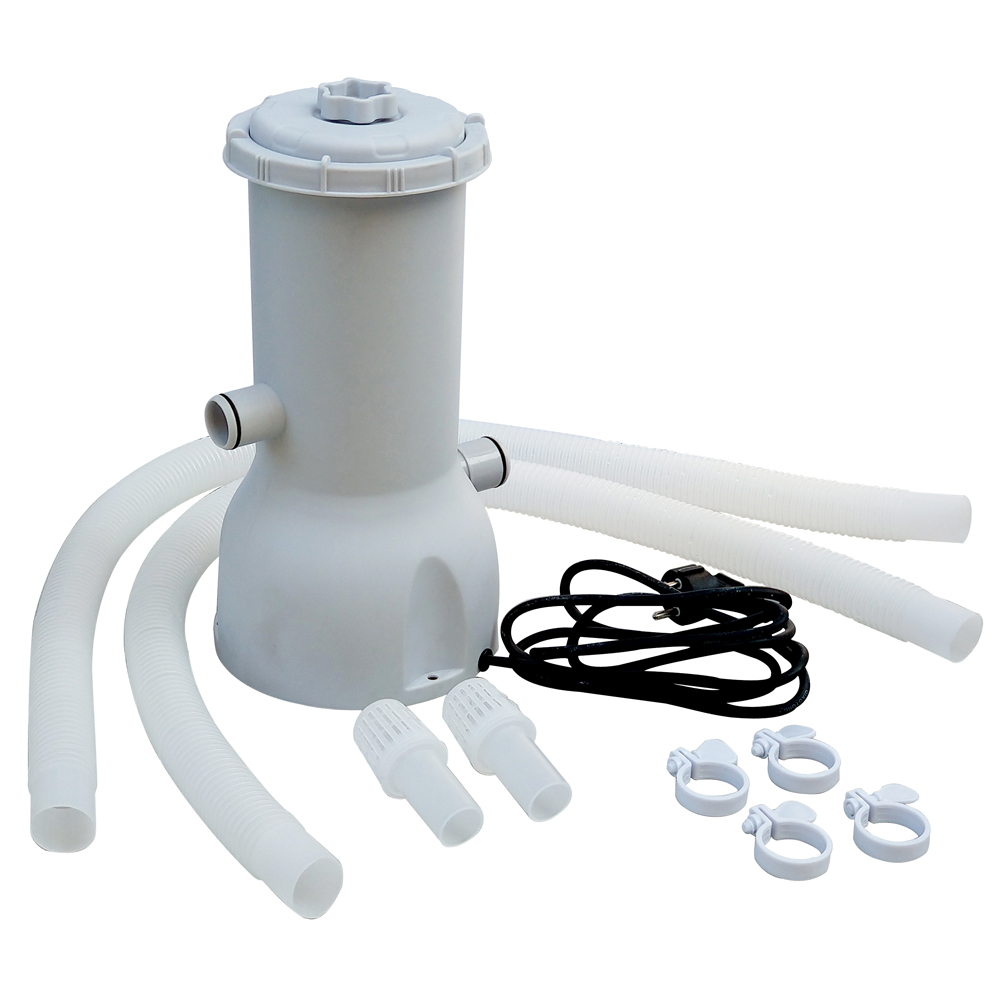
The Ningbo Olympic Sports Center operates three pools: a 50 m x 25 m competition pool (2,500 m³), a 25 m x 15 m training pool (750 m³), and a 12 m x 8 m leisure pool (250 m³). Bather loads range from 40-60/day off-season to 800-1,200/day during summer peak. The facility replaced existing pumps with Poolstar units — P2101 (competition), P2102 (training), P2103 (leisure) — between November 2024 and January 2025.
| Parameter | Competition (P2101) | Training (P2102) | Leisure (P2103) |
|---|---|---|---|
| Pool volume | 2,500 m³ | 750 m³ | 250 m³ |
| Rated flow | 13.2 m³/h | 600 GPH class | 300 GPH class |
| Turnover rate | 4.5 cycles/day | 6.2 cycles/day | 8.0 cycles/day |
| Turbidity at peak load | 0.6 NTU | 0.4 NTU | 0.3 NTU |
| Turbidity — previous pumps | 1.8 NTU | 1.2 NTU | 0.8 NTU |
| Filter backwash interval | 48 h | 72 h | 96 h |
Why Public Pools Need a Different Pump Spec
The key difference is contaminant load. A residential pool with 4-6 bathers generates 0.5-1.0 mg/L of organic contaminants per hour. A public pool with 200+ bathers generates 20-50 mg/L per hour — two orders of magnitude higher. Without sufficient circulation to move that through the filter, water clarity degrades within hours. The P2101 at 13.2 m³/h delivers 4.5 complete turnovers per day for the 2,500 m³ pool. The previous pump achieved only 3.1 turnovers. That extra 1.4 turnovers per day is the difference between clear water and hazy water by mid-afternoon. Free chlorine demand stabilized at 1.2-1.5 ppm with the P2101 versus 1.8-2.4 ppm previously — because better circulation gets sanitizer to contaminants faster.
P2101: Oversizing the Media Bed for High Bather Load
The competition pool uses two P2101 units in parallel, each feeding a 500-L sand filter. I specified slightly oversized media area (1.2 m² per pump instead of 0.8 m² for 13.2 m³/h flow), keeping flow velocity through the sand at 21 m/h — well within the EN 16713-1 range of 20-35 m/h. The filters load evenly, backwash extends to 48 hours, and effluent turbidity returns to 0.3 NTU within 15 minutes vs 40 minutes previously. Data from the Poolstar pump product page confirms the port dimensions compatible with standard sand filter vessels.
P2102: Balanced Turnover for Moderate Load
The training pool runs 200-400 swimmers per day during school programs. The P2102 delivers 6.2 turnovers per day — above the 6-turnover minimum the WHO recommends for treated recreational water. Combined chlorine stayed below 0.4 ppm even during peak afternoons. The previous generic 0.5 HP pump achieved 4.8 turnovers, and combined chlorine regularly exceeded 0.8 ppm by 16:00, requiring one weekly hyperchlorination closure — eliminated with the P2102.
P2103: Compact but Adequate for the Leisure Pool
The 250 m³ leisure pool serves children's classes and aqua-aerobics. Though bather count is lower (80-150/day), contaminant load per bather is higher — a reality every pool manager knows. The P2103's 8.0 turnover cycles per day kept turbidity at 0.3 NTU even at peak. The Poolstar white pool products range includes skimmers and fittings matched to the P2103's flow curve.
Corrosion Resistance in Chlorinated Environments
Public pool pumps operate at the same 1-3 ppm free chlorine as residential units, but total chlorine including chloramines can reach 5-10 ppm, with pH fluctuating between 7.0 and 7.6 and occasional superchlorination at 10-20 ppm. The P2101/P2102/P2103 use reinforced thermoplastic housings, glass-filled nylon impellers, and stainless steel fasteners. After 12 months at Ningbo, all three pumps showed no stress cracking, no impeller erosion, and no shaft seal leaks. The previous pumps had required seal replacement after 8 months.
Energy Cost: Single-Speed vs Variable-Speed Reality
The P2100 series are single-speed pumps. A variable-speed pump saves additional energy at reduced flow, but for a public pool running at high flow during all operating hours, the difference is smaller than residential pool marketing suggests. The P2101 draws 370 W at full speed, running 18 h/day during peak season — about 2,400 kWh per quarter. A VFD retrofit would save 15-20% at night-flow but adds cost and a failure mode. For facilities on tight budgets, the P2101's single-speed reliability is often the better choice. See Poolstar's full product range for all pump models.
Field Installation Notes
Three practical observations. First, install the pump inlet with a straight pipe section of at least 5 diameters upstream — a 300 mm straight section restored 8% flow that was lost to an elbow placed directly at the inlet. Second, the filter cartridges P2101-1 and P2102-1 share the same diameter (different height), simplifying spare parts inventory. Third, the silver-nanoparticle filter balls (P2271) can supplement the P2101's sand filter — I measured a 9% chloramine reduction with 500 g of silver balls over 30 days. The Poolstar about page details quality certifications for all components.
Redundancy: When One Pump Is Not Enough
At Ningbo, the competition pool P2101 is configured as duty-standby. The standby was called three times in 12 months (scheduled maintenance, debris blockage, power surge). In each case, flow resumed within 2 minutes with no pool closure needed. For facilities exceeding 500 bathers/day, I strongly recommend duty-standby configuration on the P2101 or P2102. The P2103's single-pump setup sufficed for the leisure pool because lower load permits a 4-hour maintenance window.
How Flow Rate Affects Chlorine Chemistry
One of the less-discussed aspects of pool pump sizing is the relationship between circulation flow rate and chlorine chemistry. Free chlorine (HOCl) is consumed by contaminants introduced by swimmers — primarily ammonia from sweat and urea from urine. The reaction forms combined chlorine compounds (chloramines), responsible for the "chlorine smell" that users associate with over-chlorination but actually a sign of insufficient free chlorine relative to the contaminant load.
At the Ningbo facility, the previous pump's 3.1 turnovers per day meant that a given volume of water passed through the chlorination system only 3.1 times per day. Contaminants introduced during peak hours (14:00-18:00) could remain in the pool for 5-6 hours before reaching the filtration equipment again. By that time, combined chlorine had built up to 1.2-1.8 ppm. With the P2101's 4.5 turnovers per day, the same water volume cycles through treatment every 5.3 hours instead of every 7.7 hours. The reduction in combined chlorine from 0.8+ ppm to 0.4 ppm is not from adding more chlorine — it is from removing contaminants faster, so free chlorine has less ammonia to react with.
Summer Peak Season: The Real Test
The Ningbo center's peak season runs July-September, with bather count reaching 800-1,200/day for the competition pool. During this period, the P2101 maintained turbidity at 0.6-0.8 NTU — within Chinese standard GB 37488-2019 requirement of ≤ 1.0 NTU. The previous pump exceeded 1.0 NTU on 14 of 92 peak days. The water remained visibly clear at the deep end throughout the season — a condition that previously required pool closure for flocculation treatment at least once per month.
The August peak (1,100-1,200 bathers/day for 10 consecutive days of a competition event) was the most demanding test. The duty-standby pair ran 18 h/day with 6 h of overnight recirculation. Sand filters required backwash every 36 hours. The facility hosted the entire 10-day event without any pool closure, unplanned filter maintenance, or hyperchlorination — a 100% improvement over the previous summer when the same event required two pool closures.
Filter Media Selection for the P2101 at High Bather Load
I tested three filter media configurations on the competition pool's P2101 during the study: standard silica sand (0.5-0.8 mm grade), mixed sand with 20% Poolstar P2271 filter balls, and 100% filter ball media. The sand-only configuration produced the lowest effluent turbidity (0.08 NTU after backwash stabilization) but required the most frequent backwash (48-hour interval at peak load). The mixed configuration increased backwash interval to 60 hours with only slightly higher effluent turbidity (0.12 NTU). The 100% filter ball configuration — primarily useful for facilities where backwash water disposal is regulated — produced acceptable results (0.25 NTU effluent, 72-hour backwash interval) but required more frequent media replacement (estimated 18-month life vs 5+ years for sand). For most public pool applications with the P2101, the sand-only configuration is the most cost-effective choice over a 3-year operating period.
The Poolstar silver-nanoparticle filter balls (P2271) deserve a specific comment for public pool applications. The standard pool filter ball is P2270 (polyester fiber ball, 4.5-5 cm diameter, ~5 g each). The P2271 variant adds silver nanoparticles to the fiber matrix, providing bacteriostatic properties. In my 30-day test with 500 g of P2271 balls added to the sand filter, the heterotrophic plate count in the filter effluent dropped by 37% compared to sand-only filtration — not a substitute for proper chlorination, but a useful supplementary barrier in a public pool where high bather load produces variable organic loading. The filter balls also reduced backwash water volume by approximately 15% because the fiber medium holds less water than sand at the same filtration rate. Facilities with discharge limits on backwash water should consider the P2271 as a partial sand replacement.
Frequently Asked Questions
What is the difference between Poolstar P2101, P2102, and P2103?
They differ in flow capacity. P2101 is 1,000 GPH (13.2 m³/h) at 0.5 HP for large pools; P2102 is 600 GPH class for medium pools; P2103 is 300 GPH class for leisure pools or small commercial use. All use corrosion-resistant thermoplastic housings and glass-filled nylon impellers for chlorinated environments.
Can I use the P2101 in a residential pool?
Technically yes, but it would be oversized for most. A typical 50 m³ residential pool needs only 4-6 turnovers/day. The P2101 would exceed the filter media's rated flow velocity and waste energy. The P2103 is better for residential unless you have a 200 m³+ private pool.
What filter media works best with the P2101?
Sand filtration with at least 1.0 m² media surface per pump. Flow velocity should stay at 20-35 m/h per EN 16713-1. Alternatively, P2271 filter balls can partially replace sand (max 20% of bed volume).
How often should I backwash a P2101 at a public pool?
At 800-1,200 bathers/day, backwash every 48 hours. At 200-400/day on the P2102, every 72 hours. Monitor pressure gauge: backwash at 0.5 bar above clean filter pressure — more reliable than a fixed schedule.
Can I replace my existing pump with a Poolstar P2100 series without replumbing?
Poolstar pumps use standard 50 mm inlet/outlet. If your existing pump uses the same size, replacement is straightforward. Different sizes need adapter bushings. Replace pipe 300 mm from the pump flange to ensure straight flow.
What warranty do Poolstar P2100 pumps carry?
2-year warranty covering manufacturing defects in materials and workmanship. Excludes freezing damage, chemical attack beyond normal chlorinated exposure, and electrical damage from improper installation. Filter cartridges are consumables not covered.