
 +86-574-5680 8878


0102030405
Pool Leaf Vacuum vs Pool Skimmer: What’s the Difference and When Do You Need Both?
2026-09-28
Pool Leaf Vacuum vs Pool Skimmer: What's the Difference and When Do You Need Both?
Leaves are one of the most common types of debris found in swimming pools.
But not all leaves are in the same place.
Some remain floating on the water surface. Others become trapped along the pool walls. Many eventually become waterlogged and sink to the bottom.
This is why pool owners often need more than one tool to keep a pool clean.
A pool skimmer is designed primarily for floating debris.
A pool leaf vacuum is designed to collect debris that has already sunk into the pool.
Understanding the difference can help you choose the right cleaning tool for the job.
What Is a Pool Skimmer?
A pool skimmer is a tool or system designed to remove debris from the surface of the water.
There are several types of pool skimmers, including:
-
Manual leaf skimmers
-
Telescopic pool nets
-
Automatic surface skimmers
-
Floating robotic skimmers
-
Built-in pool skimmer systems
Their common purpose is to collect floating material before it sinks.
Typical debris includes:
-
Floating leaves
-
Flowers
-
Insects
-
Small twigs
-
Grass
-
Other lightweight debris
A skimmer works best when the debris is still on the water surface.
What Is a Pool Leaf Vacuum?
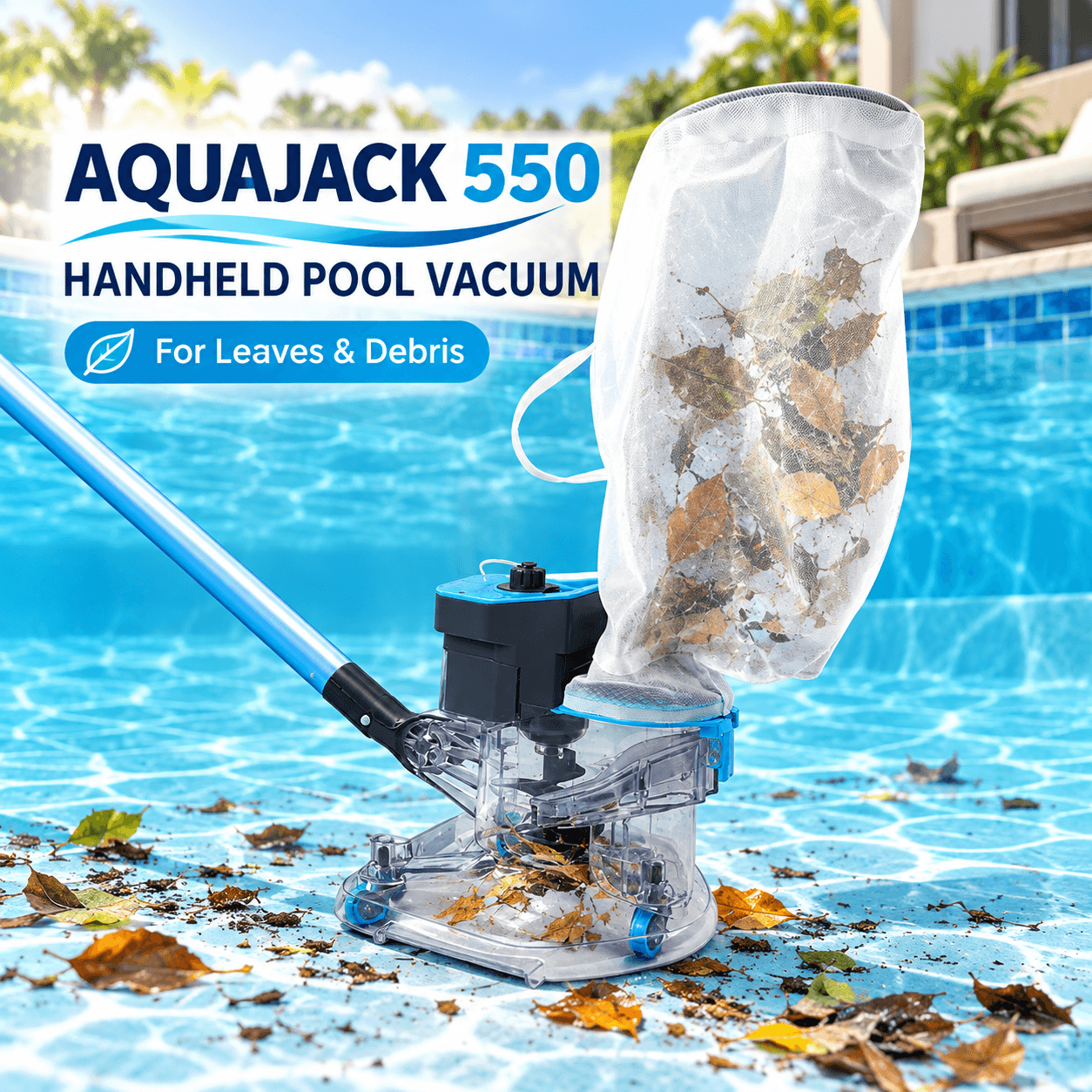
A pool leaf vacuum is designed to collect debris from inside the pool, particularly from the pool floor.
A handheld rechargeable model has its own motor and battery, allowing the user to guide the vacuum directly over the debris.
Instead of trying to lift wet leaves with a net, the vacuum pulls them into a collection bag.
This makes it particularly useful for:
-
Leaves
-
Acorns
-
Fruit
-
Seed pods
-
Small organic debris
-
Other large debris that has sunk
AquaJack 550 is designed for this type of cleaning.
Pool Skimmer vs Pool Leaf Vacuum
The easiest way to understand the difference is to look at where the debris is located.
| Cleaning Tool | Primary Cleaning Area | Typical Debris |
|---|---|---|
| Pool skimmer | Water surface | Floating leaves, insects, flowers |
| Leaf net | Surface and shallow areas | Leaves and larger floating debris |
| Handheld pool leaf vacuum | Pool floor | Leaves, fruit, acorns, seed pods |
| Robotic pool cleaner | Depending on model | General pool-floor debris |
| Surface robotic skimmer | Water surface | Floating leaves and debris |
The tools are not necessarily competitors.
They can perform different jobs.
Why Can't a Surface Skimmer Remove Sunk Leaves?
A surface skimmer works at the water surface.
Once a leaf becomes waterlogged and sinks, it is no longer within the effective cleaning area of a surface skimmer.
This creates a common maintenance cycle:
Leaf falls into pool → Leaf floats → Leaf sinks → Surface skimmer can no longer reach it.
If the pool is surrounded by trees, this can happen repeatedly.
A pool owner may therefore use a surface skimmer regularly and still find a layer of leaves accumulating on the bottom.
This is where a pool leaf vacuum becomes useful.
Why Are Wet Leaves More Difficult to Remove?
A dry leaf floating on water is lightweight.
A wet leaf at the bottom of a pool is different.
After absorbing water, it becomes heavier and can stick to the pool floor.
Multiple wet leaves can also form a pile.
Trying to lift a large pile with a manual leaf net may disturb the debris and cause some of it to scatter.
A handheld pool leaf vacuum approaches the problem differently.
Instead of lifting the leaves through the water with a net, it draws the debris into a collection bag.
When Should You Use a Pool Skimmer?
A surface skimmer is useful for routine daily maintenance.
For example, if leaves are floating on the pool after a windy day, removing them before they sink can reduce the amount of debris that eventually reaches the bottom.
A manual skimmer is also useful before swimming.
The general principle is:
Remove floating debris before it sinks whenever practical.
However, even with regular skimming, some debris will eventually reach the bottom.
That is when a pool-floor cleaning tool becomes necessary.
When Should You Use a Pool Leaf Vacuum?
A pool leaf vacuum is particularly useful when debris has already reached the bottom.
Typical situations include:
After Heavy Wind
Wind can blow leaves directly into the pool.
Some may float while others sink quickly.
During Autumn
Seasonal leaf fall can produce a much larger volume of debris than normal.
After a Storm
Rain and wind can bring leaves, fruit, seed pods, and small organic debris into the pool.
When Trees Overhang the Pool
Pools located underneath or close to trees often receive continuous organic debris.
Before Using the Pool
A quick handheld cleaning session can remove visible debris from the bottom before swimming.
Why AquaJack 550 Is Designed for Large Debris
AquaJack 550 is not designed simply as a general-purpose small particle vacuum.
Its standard filtration system focuses on large debris.
It comes with an extra-large 10-liter filter bag designed to collect:
-
Leaves
-
Fruit
-
Seed pods
-
Larger organic debris
This large capacity is important because leaves take up significantly more space than fine dust.
A small filter bag can fill quickly when collecting wet leaves.
A 10-liter bag allows the user to collect a larger volume of debris before stopping to empty it.
What If the Pool Also Has Sand and Dust?
Large debris and fine particles require different filtration characteristics.
AquaJack 550 therefore offers an optional 10-liter fine-mesh filter bag.
This can be used for finer debris such as:
-
Sand
-
Dust
-
Fine dirt
-
Small particles
This gives AquaJack 550 two practical filtration configurations.
Large-Debris Configuration
10L large-mesh bag
Best suited for:
Leaves + fruit + seed pods + large debris
Fine-Debris Configuration
10L fine-mesh bag
Best suited for:
Sand + dust + finer particles
Users can select the filter according to the cleaning task.
Why 90 L/min Water Flow Matters for Leaf Cleaning
When the primary job is collecting leaves, the ability to move a substantial amount of water is important.
AquaJack 550 provides up to 90 L/min water flow.
This helps move water and debris through the vacuum and into the collection bag.
The goal is not simply to create a high specification on a product sheet.
The practical purpose is to provide sufficient water movement for collecting larger debris such as wet leaves and fruit.
75 Minutes of Cordless Operation
AquaJack 550 uses a 2600 mAh rechargeable lithium battery and provides up to 75 minutes of operating time.
This makes the vacuum suitable for routine cleaning sessions without requiring a power cable.
There is no need to run an extension cord around the pool.
The user can simply charge the unit, place it in the pool, and guide it over the debris.
For targeted cleaning, this can be more convenient than preparing a full pool vacuum system.
See the Debris Through the Transparent Body
Another practical feature of AquaJack 550 is its transparent body.
When collecting leaves, users can see the debris entering the collection area.
This provides immediate visual feedback.
You can check:
-
Whether debris is being collected
-
How much debris has entered the system
-
Whether the filter bag needs attention
For a handheld cleaning tool, being able to see the cleaning process can make operation easier and more intuitive.
Do You Need Both a Pool Skimmer and a Leaf Vacuum?
For many pools, using both makes sense because they solve different problems.
Think of them as two stages of pool maintenance.
Stage 1: Surface Cleaning
Use a skimmer to remove floating debris.
Goal: prevent debris from sinking.
Stage 2: Bottom Cleaning
Use a handheld pool leaf vacuum to remove debris that has already sunk.
Goal: remove what the surface skimmer cannot reach.
This combination creates a simple division of work:
Skimmer = surface
Leaf vacuum = bottom
Neither tool needs to perform the job of the other.
What About a Robotic Pool Cleaner?
A robotic pool cleaner can also remove debris from the pool floor, depending on its design.
However, a robotic cleaner and a handheld leaf vacuum offer different user experiences.
A robotic cleaner is designed to operate automatically.
A handheld vacuum is manually controlled.
This means a handheld vacuum can be particularly useful when you want to clean one specific area immediately.
For example:
A large pile of leaves has accumulated in one corner.
You may not want to run an entire robotic cleaning cycle.
You can simply take the handheld vacuum to the affected area and remove the debris.
This makes a handheld leaf vacuum a useful complement to automatic cleaning equipment.
A Simple Pool Cleaning Strategy
For pools that regularly receive leaves, a practical routine can be:
1. Skim the Surface
Remove floating leaves and debris.
2. Check the Bottom
Look for leaves, fruit, acorns, and other large debris.
3. Use a Handheld Leaf Vacuum
Collect the large debris with the 10-liter filter bag.
4. Switch to Fine Filtration if Needed
Use the optional fine-mesh bag when sand, dust, or finer particles need to be collected.
5. Empty and Rinse
Remove the collected debris and rinse the filter bag after use.
This approach prevents one cleaning tool from being expected to handle every type of debris.
The Right Tool Depends on Where the Debris Is
The simplest way to choose between a pool skimmer and a leaf vacuum is to ask one question:
Where is the debris?
If it is floating:
Use a pool skimmer.
If it has sunk:
Use a pool leaf vacuum.
If you have both:
Use them together.
This simple distinction can make pool maintenance more efficient.
AquaJack 550 at a Glance
AquaJack 550 is a rechargeable handheld pool leaf vacuum designed primarily for removing large debris from the pool floor.
Key features include:
-
Up to 90 L/min water flow
-
Up to 75 minutes runtime
-
2600 mAh rechargeable lithium battery
-
10-liter extra-large filter bag
-
Optional 10-liter fine-mesh filter bag
-
Transparent body
-
Cordless handheld operation
-
Designed for leaves and large pool-floor debris
Its standard configuration focuses on large debris.
The optional fine-mesh filter expands its application to finer material such as sand and dust.
Final Takeaway
A pool skimmer and a pool leaf vacuum are designed for different stages of pool cleaning.
A skimmer handles debris that is still floating on the surface.
A leaf vacuum handles debris that has already sunk to the pool floor.
For pool owners dealing with frequent leaves, fruit, acorns, or other large organic debris, using the two tools together can create a straightforward maintenance routine.
Skim the surface.
Vacuum the bottom.
Use the right filter for the debris.
With its 90 L/min water flow, up to 75-minute cordless runtime, 10-liter large-capacity filter bag, optional fine-mesh filter, and transparent body, AquaJack 550 is built specifically for the part of pool cleaning that begins when the leaves sink.