
 +86-574-5680 8878


0102030405
Robotic Pool Cleaner Suction Power vs Filtration: Which Matters More? | Aquajack 800
2026-09-05
Robotic Pool Cleaner Suction Power vs Filtration: Which Matters More?
When comparing robotic pool cleaners, many buyers begin with one number: suction power.
A high water-flow figure can indicate that a robot moves a large amount of water. However, suction power alone does not guarantee that the pool will be cleaned effectively.
Filtration is equally important—but filtration alone is not enough either.
The real cleaning result depends on how several systems work together:
-
Water flow
-
Suction opening design
-
Brush contact
-
Filter fineness
-
Filter capacity
-
Cleaning route
-
Surface traction
-
Robot movement speed
-
Pool conditions
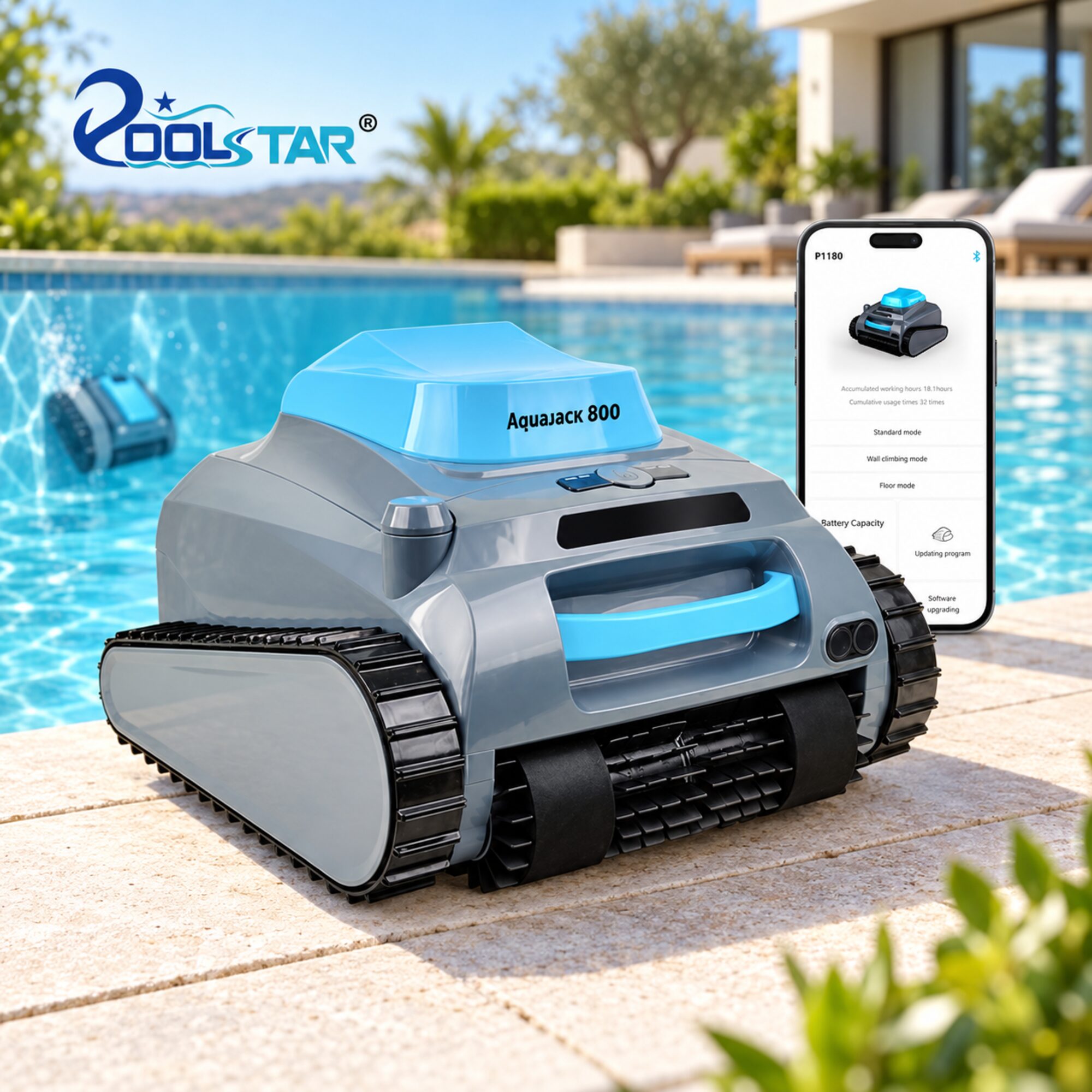
Aquajack 800 combines water flow of up to 296 L/min with a 4 L filter capacity and floor, wall and waterline cleaning functions.
These specifications are useful, but understanding how they work together is more important than comparing one headline number.
What Does Suction Power Mean in a Robotic Pool Cleaner?
Robotic pool cleaner manufacturers may describe suction performance using different measurements, including:
-
Litres per minute
-
Gallons per minute
-
Cubic metres per hour
-
Gallons per hour
-
Motor power
-
Flow rate
These figures are not always directly comparable.
For example, litres per minute measure the volume of water moving through the cleaner. Motor wattage describes electrical power consumption or output, but it does not directly show how much debris the robot will collect.
A robot with a larger motor does not automatically provide better cleaning if the suction opening, filter, water channel or movement system is poorly designed.
When evaluating suction performance, buyers should ask:
-
How much water moves through the cleaner?
-
How wide is the suction opening?
-
Can the robot maintain stable contact with the pool surface?
-
Does the brush loosen dirt before it reaches the suction opening?
-
Can the filter maintain water flow as it fills with debris?
-
Does the robot cover the entire cleaning area?
These questions provide a more complete picture than motor power alone.
Why High Suction Does Not Always Mean Better Cleaning
High water flow can help lift debris, but it cannot compensate for every weakness in a robotic cleaner.
A robot may still leave dirt behind if:
-
The suction opening passes beside the debris
-
The robot moves too quickly
-
The brushes do not maintain contact with the surface
-
The cleaning route misses parts of the pool
-
The filter becomes blocked
-
Water escapes through poorly designed internal channels
-
The robot loses traction on walls
-
Large leaves block the suction inlet
For this reason, laboratory water-flow figures should be considered together with practical debris tests.
A meaningful test should include more than one type of debris, such as:
-
Large leaves
-
Small leaves
-
Sand
-
Fine dust
-
Insects
-
Seeds
-
Small plant material
A robotic pool cleaner may perform well with sand but struggle with leaves. Another model may collect large debris effectively but allow fine particles to pass through its filter.
There is no single performance number that describes every pool-cleaning situation.
What Does Filtration Mean in a Pool Robot?
The filtration system captures debris after it enters the robotic cleaner.
A typical robotic pool cleaner filter must perform several tasks:
-
Allow sufficient water flow
-
Retain the required debris
-
Resist blockage
-
Hold enough dirt for one cleaning cycle
-
Be easy to remove
-
Be easy to wash
-
Remain durable after repeated use
Two measurements are particularly important:
-
Filter capacity
-
Filter fineness
These measurements describe different characteristics and should not be confused.
Filter Capacity vs Filter Fineness
What Is Filter Capacity?
Filter capacity describes how much space is available to hold debris.
Aquajack 800 has a filter capacity of approximately 4 L, allowing it to collect a useful amount of leaves and settled dirt during a cleaning cycle.
A larger filter can be especially helpful for:
-
Pools surrounded by trees
-
Pools exposed to wind
-
Large residential pools
-
Pools that are not cleaned every day
-
Areas with insects and seasonal plant debris
However, a large filter is only useful when it can be removed and cleaned easily.
If emptying the filter is complicated, pool owners may delay maintenance. A dirty filter then reduces water flow and cleaning performance.
What Is Filter Fineness?
Filter fineness describes the approximate size of the particles the filter is designed to retain.
A finer filter can capture smaller particles, including:
-
Fine sand
-
Dust
-
Pollen
-
Small sediment
-
Loose material after algae treatment
However, a finer filter normally creates more resistance to water flow and may become blocked more quickly.
This means that the finest possible filter is not automatically the best choice for every pool.
A pool with heavy leaves may benefit from a different filtration setup than a pool affected mainly by fine desert dust.
Which Is More Important: Suction Power or Filtration?
Neither one is more important in every situation.
Suction moves debris into the cleaner. Filtration keeps that debris inside the cleaner.
If suction is strong but filtration is unsuitable, fine debris may return to the pool.
If filtration is very fine but water flow is insufficient, the robot may struggle to lift debris or maintain wall contact.
The best cleaning result comes from a balanced system:
-
Brushes loosen dirt from the surface.
-
Water flow carries debris toward the suction opening.
-
The suction channel guides debris into the filter.
-
The filter captures the required particle sizes.
-
The robot continues moving through an effective cleaning route.
-
The filter maintains adequate flow as debris accumulates.
This balance is more important than the highest individual specification.
How Does Aquajack 800 Balance Water Flow and Filtration?
Aquajack 800 is specified with water flow of up to 296 L/min and a 4 L filter capacity.
The purpose of this combination is to support the collection of different types of residential pool debris while maintaining sufficient water circulation during operation.
Aquajack 800 is also designed for:
-
Pool floor cleaning
-
Wall climbing
-
Waterline cleaning
-
Selectable cleaning modes
-
Cordless operation
-
App-assisted settings
-
Accessible filter maintenance
When Aquajack 800 moves across the floor, water flow helps draw loose debris into the filter.
During wall cleaning, water movement also contributes to stability and surface contact. This is one reason why a blocked filter can affect more than debris collection: reduced water flow may also influence movement and climbing performance.
For this reason, users should clean the filter regularly rather than waiting until it is completely full.
Which Filtration System Is Best for Leaves?
Pools surrounded by trees require a filtration system that can handle larger debris without becoming blocked too quickly.
For leaf-heavy pools, buyers should look for:
-
A sufficiently wide suction opening
-
Adequate filter capacity
-
Easy access to the filter
-
A filter structure that allows water to continue flowing
-
Simple removal of leaves after cleaning
-
A clear path between the suction opening and filter
Large leaves can sometimes fold or overlap inside a narrow inlet. Twigs and oversized plant material may also block the suction opening.
Before using any robotic pool cleaner, users should manually remove:
-
Long branches
-
Large stones
-
Pool toys
-
Long pieces of plant material
-
Objects that may damage or block the cleaner
A robotic cleaner is designed for routine debris collection, not for removing every object that enters a pool.
Which Filtration System Is Best for Sand and Fine Dust?
Sand and fine dust present a different challenge.
Instead of filling the filter quickly, small particles may pass through a filter that is too coarse.
This issue is particularly relevant in:
-
Dry regions
-
Coastal areas
-
Pools near construction sites
-
Windy environments
-
Pools surrounded by exposed soil
-
Areas affected by pollen
For these conditions, buyers should check the filtration specification rather than relying only on suction power.
A robot can appear to collect fine debris but release part of it back into the water through the filter.
The correct filter must balance particle retention with adequate water flow. If the filter is too restrictive, it may block rapidly and reduce overall performance.
Why Brushes Matter as Much as Suction
Some dirt does not remain loose on the pool surface.
Fine deposits, light algae film and dirt near the waterline may require physical contact before the water flow can remove them.
Brushes help loosen this material so that it can enter the suction system.
Effective brushing depends on:
-
Brush material
-
Brush position
-
Contact pressure
-
Robot movement speed
-
Surface compatibility
-
Cleaning route
This is particularly important when cleaning:
-
Pool walls
-
The waterline
-
Textured surfaces
-
Areas with light surface deposits
A strong pump cannot remove dirt effectively if the robot passes above it without sufficient brush contact.
Why Navigation and Coverage Affect Cleaning Results
A robotic pool cleaner cannot collect debris from an area it never reaches.
Navigation and route coverage therefore play a major role in real cleaning performance.
A robot may have strong suction and an effective filter but still leave dirty areas if it:
-
Repeats the same route too frequently
-
Misses corners
-
Becomes trapped near steps
-
Cannot transition onto the walls
-
Stops before completing the pool
-
Spends too much time in one area
When comparing robotic cleaners, distributors should evaluate cleaning coverage as well as individual specifications.
A practical pool test should observe:
-
How quickly the robot covers the floor
-
Whether it reaches different walls
-
How it behaves around drains
-
Whether it becomes trapped near steps
-
How often it repeats the same route
-
Whether it reaches the waterline
-
Whether it completes the required area before the battery is depleted
Cleaning efficiency is the relationship between performance and time—not simply the amount of water flowing through the robot.
How Does Pool Surface Affect Suction and Filtration Performance?
Pool surface material influences traction, brush contact and the robot’s ability to maintain a stable cleaning path.
Common surfaces include:
-
Concrete
-
Plaster
-
Tile
-
Mosaic
-
Fiberglass
-
Vinyl liner
-
Painted finishes
A rough surface may provide more traction but can also create more resistance.
A very smooth surface may make wall climbing more difficult if the robot cannot maintain sufficient contact.
Surface material may also determine the type of brush required. A brush suitable for concrete may not provide the same result on smooth tile or a flexible vinyl liner.
Before purchasing, users should confirm that the robotic cleaner is suitable for their pool finish.
Distributors should test the product on locally common pool surfaces before making broad compatibility claims.
How Does Filter Maintenance Affect Suction Power?
Even a well-designed robotic pool cleaner will lose performance if its filter is not maintained.
As debris accumulates, water must pass through a smaller open filter area. This increases resistance and may reduce water flow.
Possible results include:
-
Reduced debris collection
-
Lower cleaning efficiency
-
Weaker wall contact
-
Shorter effective cleaning coverage
-
Debris remaining near the suction opening
Pool owners should inspect the filter after each cleaning cycle.
The filter should be cleaned more frequently when the pool contains:
-
Large amounts of leaves
-
Fine sand
-
Pollen
-
Dust
-
Material loosened after algae treatment
A clean filter helps Aquajack 800 maintain more consistent water flow and cleaning performance.
How Should Buyers Compare Robotic Pool Cleaner Specifications?
When comparing two robotic pool cleaners, use a complete checklist instead of selecting the model with the largest number.
Water Movement
-
What is the stated water-flow rate?
-
Which unit of measurement is used?
-
Was the figure measured under comparable conditions?
Debris Collection
-
Can the cleaner collect leaves?
-
Can it retain fine sand?
-
How does it perform as the filter fills?
Filtration
-
What is the filter capacity?
-
What particle sizes is it designed to retain?
-
Is the filter easy to remove and wash?
Surface Cleaning
-
Does the robot use active brushes?
-
Can it clean the floor, walls and waterline?
-
Is it compatible with the intended pool surface?
Navigation
-
Does the robot cover the pool efficiently?
-
Can it manage slopes and wall transitions?
-
How does it behave around drains, steps and corners?
Maintenance
-
How long does filter cleaning take?
-
Are wear components replaceable?
-
Are spare parts available?
-
Can the product be serviced locally?
Battery and Runtime
-
Is the published runtime based on floor cleaning or full-pool cleaning?
-
Does wall climbing increase battery consumption?
-
Are different battery configurations available?
-
Is the runtime sufficient for the total cleaning area?
This method gives buyers a more realistic view of product performance.
What Should Pool Distributors Test?
Importers, wholesalers and retailers should conduct repeatable tests before adding a robotic pool cleaner to their product range.
A useful test program can include:
Large-Debris Test
Use a controlled quantity of dry and wet leaves to evaluate:
-
Pickup rate
-
Inlet blockage
-
Filter capacity
-
Water-flow stability
Fine-Debris Test
Use a measured amount of sand or fine test material to evaluate:
-
Particle pickup
-
Filter retention
-
Visible debris returning to the pool
-
Performance after the filter begins to fill
Coverage Test
Record:
-
Floor coverage
-
Wall-climbing frequency
-
Waterline movement
-
Missed areas
-
Repeated routes
-
Total operating time
Maintenance Test
Measure:
-
Filter removal time
-
Filter-cleaning time
-
Ease of reassembly
-
User contact with collected dirt
-
Risk of incorrect installation
Repeated-Cycle Test
One successful cleaning cycle does not prove long-term reliability.
The product should be tested through repeated:
-
Cleaning cycles
-
Charging cycles
-
Filter removal cycles
-
Wall-climbing cycles
-
Storage and handling conditions
These tests help distributors evaluate the product from both a performance and after-sales perspective.
Frequently Asked Questions
Does higher suction mean a better robotic pool cleaner?
Not automatically. Higher water flow can support debris pickup, but cleaning results also depend on brushes, filtration, navigation, suction opening design and surface contact.
Is filter capacity the same as filter fineness?
No. Filter capacity describes how much debris the filter can hold. Filter fineness describes the approximate size of particles the filter can retain.
Is a fine filter always better?
No. A finer filter captures smaller particles but may block more quickly and reduce water flow. The correct filter depends on the type of debris in the pool.
Can Aquajack 800 collect leaves and sand?
Aquajack 800 is designed to collect common pool debris, including leaves, sand, insects and settled dirt. Performance depends on debris size, filter condition and pool environment.
How large is the Aquajack 800 filter?
Aquajack 800 is specified with approximately 4 L of filter capacity. The final specification should be confirmed for the version supplied in each market.
What is the water-flow rate of Aquajack 800?
Aquajack 800 is specified with water flow of up to 296 L/min. Water flow should be evaluated together with filtration, brush performance and cleaning coverage.
Can a dirty filter reduce wall-climbing performance?
Yes. A blocked filter can reduce water flow. Because water movement may contribute to debris collection and stability, filter condition can affect overall performance.
How often should the filter be cleaned?
The filter should be inspected after every cycle and cleaned whenever debris has accumulated. Heavy leaves, fine dust or sand may require more frequent cleaning.
Does a robotic pool cleaner replace the main pool filter?
No. A robotic cleaner collects debris from the pool surfaces. The main filtration system circulates and treats the pool water.
The Best Robotic Pool Cleaner Is a Balanced System
Suction power attracts attention because it is easy to express as a number.
Real pool-cleaning performance is more complicated.
A capable robotic pool cleaner must combine:
-
Adequate water flow
-
Effective brush contact
-
Suitable filtration
-
Sufficient filter capacity
-
Complete route coverage
-
Stable surface traction
-
Easy maintenance
-
Appropriate battery runtime
-
Reliable after-sales support
Aquajack 800 combines up to 296 L/min of water flow with a 4 L filter capacity and floor, wall and waterline cleaning functions.
However, its value should not be judged by these numbers alone.
For pool owners, the important result is whether the cleaner can collect the debris found in their pool and remain easy to maintain.
For distributors and private-label buyers, the product should be evaluated through repeatable debris tests, local pool testing, component serviceability and long-term support.
The best robotic pool cleaner is not simply the model with the highest suction figure or the finest filter.
It is the cleaner in which water flow, filtration, brushing, navigation and maintenance work together as one balanced system.
For Aquajack 800 specifications, market configurations, OEM/ODM opportunities or distributor testing support, contact Poolstar for information suitable for your local market.