
 +86-574-5680 8878


0102030405
What Is the Best Pool Vacuum for Leaves and Large Debris?
2026-09-28
What Is the Best Pool Vacuum for Leaves and Large Debris?
Leaves are among the most common types of debris that pool owners have to deal with.
But when a pool is surrounded by trees, the problem is not limited to a few leaves floating on the surface.
Large amounts of leaves can sink to the bottom, along with acorns, fruit, seed pods, flowers, and other organic debris.
Removing this type of debris requires a different approach from cleaning fine dust or sand.
So what should you look for in a pool vacuum for leaves and large debris?
The answer comes down to several practical factors:
Water flow, collection capacity, runtime, filtration, and ease of handling.
Why Large Debris Requires a Different Pool Vacuum
A pool vacuum designed primarily for fine dirt does not necessarily make the best leaf vacuum.
Leaves are:
-
Large
-
Lightweight
-
Often wet
-
Irregularly shaped
-
Sometimes stuck together
-
Capable of taking up considerable filter volume
A vacuum that works well for a small amount of dust may quickly become inconvenient when faced with a large pile of wet leaves.
The problem is not necessarily just suction.
The vacuum also needs somewhere to put all that debris.
This is why collection capacity is an important consideration when choosing a pool leaf vacuum.
What Should a Good Pool Leaf Vacuum Have?
There is no single specification that determines whether a pool vacuum is suitable for leaves.
Instead, look at the complete system.
1. Strong Water Flow
Large leaves need to be moved through the cleaning system.
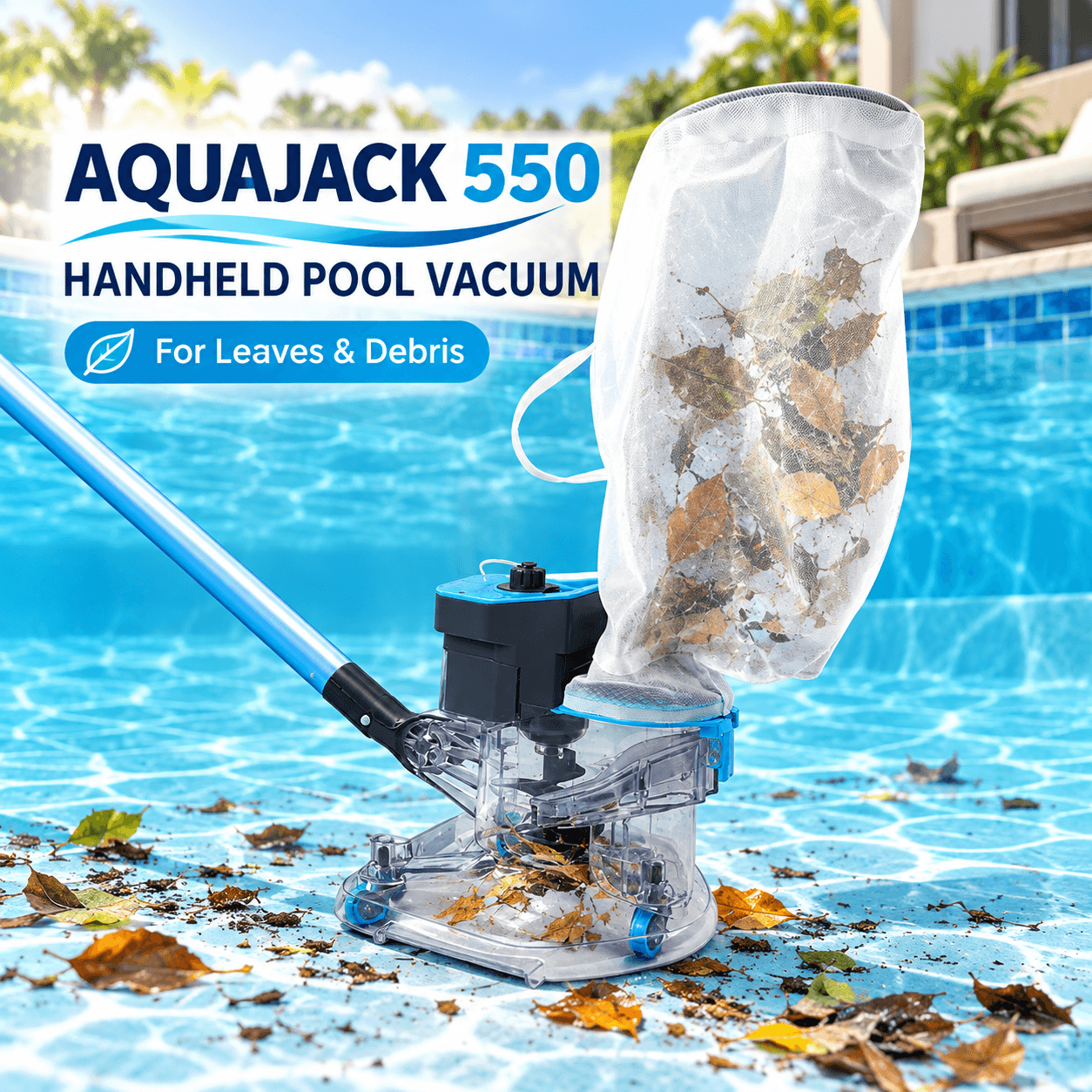
AquaJack 550 provides up to 90 L/min water flow, helping move water and large debris into the collection bag.
For a leaf vacuum, water flow is an important part of the overall cleaning performance.
2. Large Collection Capacity
This is one of the most important differences between a leaf vacuum and a small general-purpose handheld vacuum.
Leaves take up space.
AquaJack 550 comes with an extra-large 10-liter filter bag designed for large debris.
It is intended to collect:
-
Leaves
-
Fruit
-
Acorns
-
Seed pods
-
Flowers
-
Other larger organic debris
A larger bag means the user can collect more debris before stopping to empty it.
This is especially useful after storms or during seasonal leaf fall.
3. Sufficient Runtime
A leaf-covered pool may require more than a few minutes of cleaning.
AquaJack 550 provides up to 75 minutes of operating time from its rechargeable 2600 mAh lithium battery.
This allows the user to work through a larger cleaning area without being limited by a short operating cycle.
Because the vacuum is cordless, there is also no power cable to manage around the pool.
4. The Right Filter
A leaf vacuum should be matched to the debris it is expected to collect.
For large debris, AquaJack 550 uses a 10-liter large-debris filter bag.
But what happens when the pool also contains sand or dust?
AquaJack 550 can also use an optional 10-liter fine-mesh filter bag.
This gives users two different filtration options:
Large-mesh bag → leaves and large debris
Fine-mesh bag → sand, dust and finer particles
Using the appropriate filter for the job helps make the cleaning process more practical.
Why a Large Filter Is Particularly Important for Leaves
Imagine trying to clean a pool after a week of heavy leaf fall.
The bottom may contain a large amount of wet organic material.
A small filter bag can fill quickly.
Once it is full, the user has to:
-
Stop the vacuum.
-
Remove the filter.
-
Empty the debris.
-
Rinse the filter if necessary.
-
Reinstall it.
-
Return to cleaning.
If this happens several times during one cleaning session, the process becomes inefficient.
A larger collection bag does not eliminate emptying.
It simply allows more debris to be collected before emptying becomes necessary.
That is the practical value of AquaJack 550's 10-liter filter bag.
What About a Pool Leaf Net?
A traditional leaf net remains useful.
It is simple, inexpensive, and requires no battery.
For floating leaves, it can be one of the easiest cleaning tools available.
The situation changes when the leaves have sunk.
Wet leaves at the bottom of the pool can be awkward to lift with a net.
They may scatter as the net moves through the water.
A handheld leaf vacuum offers another approach:
Instead of lifting the leaves, collect them directly into a filter bag.
For larger amounts of bottom debris, this can be more convenient.
What About a Traditional Pool Vacuum?
Traditional pool vacuums can be effective for cleaning the pool floor.
However, many systems require a vacuum hose and connection to the pool's circulation system.
That can involve additional preparation.
A rechargeable handheld vacuum has a different operating concept.
The vacuum has its own:
-
Battery
-
Motor
-
Water-flow system
-
Filter
-
Collection bag
The user does not need to connect the cleaning head to the pool pump during operation.
This makes a cordless handheld vacuum particularly useful for quick, targeted cleaning.
What About a Robotic Pool Cleaner?
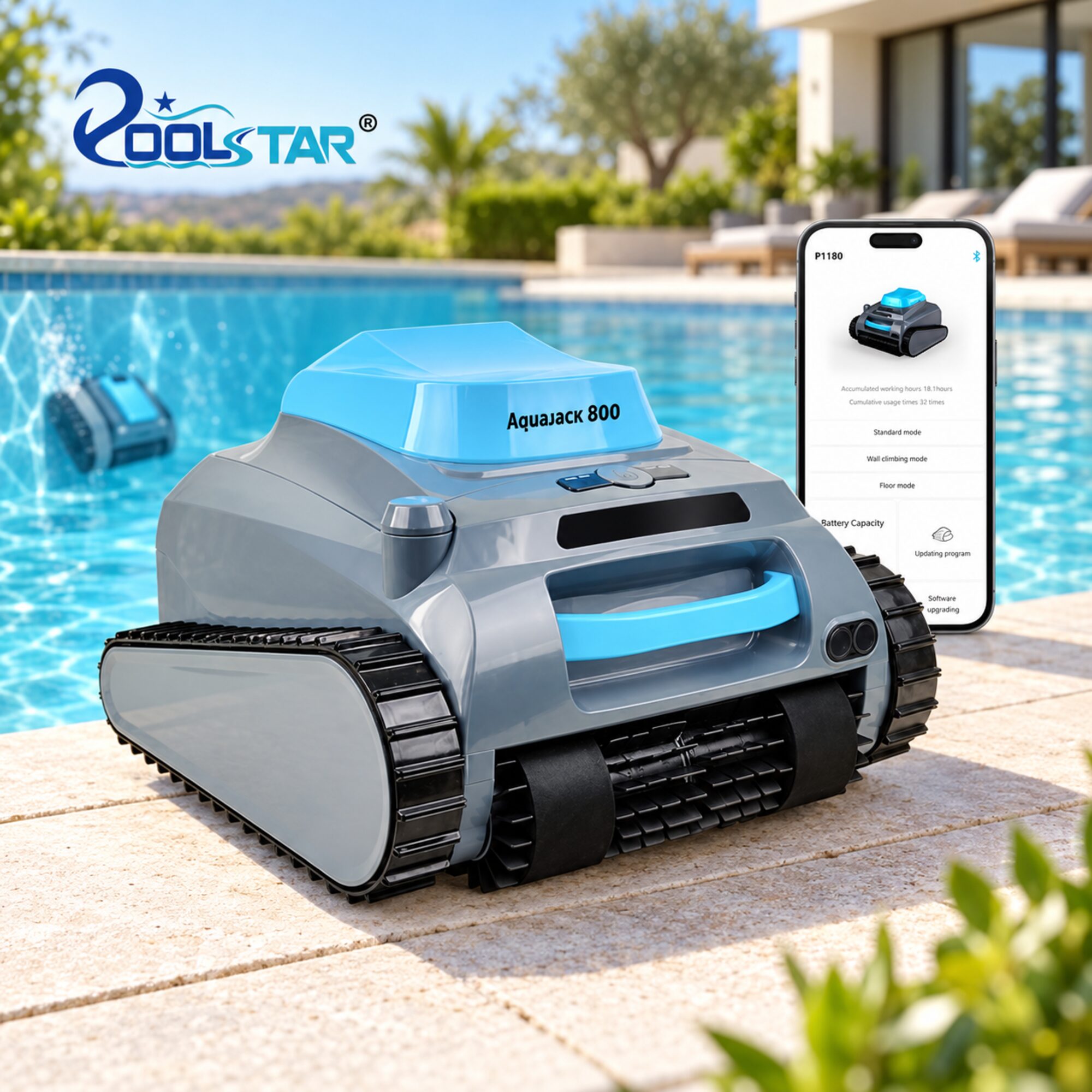
A robotic pool cleaner is designed to automate pool cleaning.
Depending on the model, it may clean the pool floor, walls, or waterline.
However, robotic cleaners and handheld leaf vacuums are designed around different cleaning experiences.
A robot:
Moves automatically through the pool.
A handheld vacuum:
Goes exactly where the user wants it to go.
This distinction becomes useful when there is a specific pile of leaves that needs immediate attention.
You may not need to run a complete robotic cleaning cycle just to remove several piles of large debris.
A handheld leaf vacuum can complement an automatic pool cleaner rather than replace it.
Why the Transparent Body Matters
AquaJack 550 features a transparent body, allowing users to see debris being collected.
This is particularly useful when working with leaves.
The user can visually confirm:
-
That debris is entering the vacuum
-
What type of debris is being collected
-
How much debris has accumulated
-
When the collection system needs attention
This creates direct visual feedback during cleaning.
For a handheld product, that can make the operation easier to understand.
Is Stronger Suction Always Better?
Not necessarily.
When comparing pool vacuums, it is tempting to focus on one number.
But real-world cleaning performance depends on the complete system.
For a leaf vacuum, consider:
Water flow
How effectively can the system move water and debris?
Filter design
Can the filter handle the type of debris you are collecting?
Collection capacity
How much debris can it hold before emptying?
Runtime
How long can the vacuum operate?
Handling
Can the user easily guide it around the pool?
A vacuum with a strong motor but a very small filter may not be convenient for heavy leaf cleaning.
Likewise, a large filter is not enough if the vacuum cannot move the debris effectively.
Large Debris vs Fine Debris
One of the most important things to understand is that different debris types require different filtration approaches.
Large Debris
Examples include:
-
Leaves
-
Acorns
-
Fruit
-
Seed pods
-
Flowers
-
Larger organic material
A larger mesh filter is generally more appropriate.
Fine Debris
Examples include:
-
Sand
-
Dust
-
Fine dirt
-
Small particles
A finer mesh filter is more appropriate.
AquaJack 550 is designed around this distinction.
Its standard 10-liter filter bag focuses on large debris.
The optional 10-liter fine-mesh filter bag provides an additional option for finer material.
When Is a Handheld Leaf Vacuum the Right Choice?
A rechargeable handheld pool leaf vacuum can be particularly useful in several situations.
You Have Trees Near the Pool
Leaves and organic debris may enter the pool frequently.
Your Pool Has Heavy Seasonal Leaf Fall
Autumn can create a much larger cleaning workload.
Your Pool Has Recently Experienced a Storm
Wind and rain can introduce large quantities of organic debris.
You Only Need to Clean a Specific Area
A handheld vacuum allows you to target the affected area directly.
You Want to Avoid Setting Up a Full Vacuum System
For a quick cleaning job, a cordless handheld unit can be ready to use without connecting a vacuum hose to the pool system.
AquaJack 550: Built Around Large-Debris Cleaning
AquaJack 550 is designed specifically as a rechargeable handheld pool leaf vacuum.
Its core specifications work together:
Up to 90 L/min Water Flow
Designed to move water and large debris through the cleaning system.
10L Extra-Large Filter Bag
Designed for leaves and other bulky debris.
Up to 75 Minutes Runtime
Provides extended cordless cleaning time.
2600 mAh Lithium Battery
Provides the rechargeable power source.
Optional 10L Fine-Mesh Filter
Provides an additional option for sand, dust, and finer debris.
Transparent Body
Allows the user to see debris entering the collection area.
The focus is not on making the vacuum do everything.
It is on making it particularly practical for one common pool-maintenance problem:
Large debris on the pool floor.
A Practical Way to Choose Your Pool Vacuum
Before buying a pool vacuum, ask yourself five questions.
Question 1: What type of debris do I have?
Mostly leaves?
Mostly dust?
A mixture?
Question 2: Where is the debris?
Floating on the surface?
Along the walls?
On the pool floor?
Question 3: How much debris do I normally collect?
A few leaves?
Or several liters of wet organic debris?
Question 4: How much cleaning time do I need?
A five-minute spot clean?
Or a longer cleaning session?
Question 5: Do I want automatic or manual cleaning?
If you want the pool cleaned automatically, a robotic cleaner may be appropriate.
If you want direct control over exactly where you clean, a handheld vacuum may be more suitable.
These questions can help you choose based on the actual cleaning problem rather than simply comparing product specifications.
Final Takeaway
The best pool vacuum for leaves is not necessarily the one with the biggest motor or the highest advertised suction number.
For large debris, the complete system matters.
You need enough water flow to move the debris, enough filter capacity to collect it, enough runtime to finish the cleaning task, and a filtration system suited to the type of debris.
AquaJack 550 combines up to 90 L/min water flow, up to 75 minutes of cordless runtime, a 2600 mAh lithium battery, and a 10-liter extra-large filter bag for large-debris pool-floor cleaning.
The optional 10-liter fine-mesh filter bag adds another configuration for sand, dust, and finer particles.
For pools surrounded by trees, gardens, or other sources of organic debris, the cleaning problem is often simple:
The leaves are not on the surface anymore. They are on the bottom.
And when the leaves sink, a dedicated handheld pool leaf vacuum can make the job considerably more straightforward.