
 +86-574-5680 8878

0102030405
What Should You Look for in a Serviceable Robotic Pool Cleaner?
2026-10-18
What Should You Look for in a Serviceable Robotic Pool Cleaner?
An Essential Buying Guide to Replaceable Batteries, Motor Maintenance, Modular Design, and Long-Term Ownership
When buying a robotic pool cleaner, most people compare suction performance, cleaning coverage, battery runtime, and price.
These are important specifications.
However, there is another question that is often overlooked:
What happens when the robotic pool cleaner eventually needs maintenance or a replacement component?
A robotic pool cleaner operates in a demanding environment. Water, pool chemicals, debris, moving parts, and repeated cleaning cycles can all influence its long-term condition.
Even a well-designed product may eventually require servicing.
This is why serviceability deserves attention before purchasing.
A serviceable robotic pool cleaner is designed to make certain maintenance, inspection, and component replacement procedures more practical.
But not every product advertised as "modular" provides the same level of serviceability.
Understanding what to look for can help pool owners and professional buyers make better long-term decisions.
1. What Does "Serviceable Robotic Pool Cleaner" Mean?
A serviceable robotic pool cleaner is designed so that selected components can be accessed, maintained, repaired, or replaced according to the manufacturer's procedures.
Depending on the product, these components may include:
-
Battery modules
-
Motor or drive assemblies
-
Filters
-
Brushes
-
Tracks or wheels
-
Other mechanical components
-
Selected electrical assemblies
Serviceability does not mean that every component can be repaired by the consumer.
Some procedures may require qualified service personnel, specialized tools, or manufacturer-approved replacement parts.
The important distinction is that the product architecture considers maintenance and component replacement during the design process.
Serviceability should be an engineering feature, not simply a marketing claim.
2. Check Whether the Battery Is Truly Replaceable
For a cordless robotic pool cleaner, battery replacement is one of the most important considerations.
Rechargeable batteries gradually lose capacity over time.
Eventually, a battery may no longer provide the same cleaning runtime as when it was new.
Before purchasing, ask:
-
Is the battery removable?
-
Is it designed to be replaced?
-
Is a compatible replacement battery available?
-
Does replacement require extensive disassembly?
-
Is there a documented service procedure?
-
Does battery replacement affect the product's waterproof protection?
These questions help distinguish a genuinely serviceable battery architecture from a product whose battery is technically removable only through complicated repair work.
AquaJack 800: Removable Battery Modules
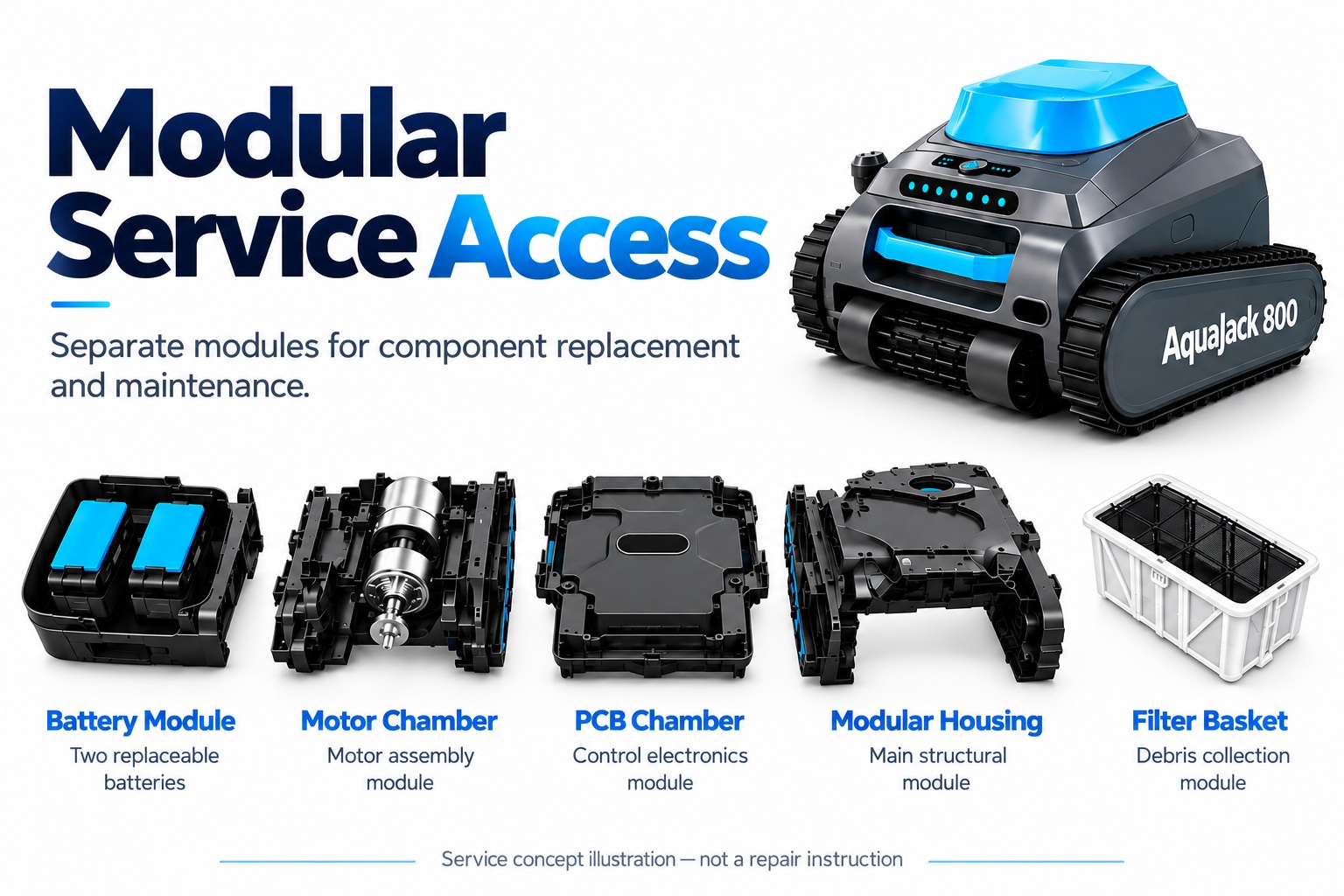
The AquaJack 800 cordless robotic pool cleaner is designed with removable battery modules.
Its modular architecture supports battery replacement and maintenance as part of the product's long-term service strategy.
The battery is treated as a separate functional module rather than an inseparable part of the entire cleaner.
This provides a practical pathway for battery-related servicing when required.
3. Look Beyond the Battery: Can the Motor Be Serviced?
Battery replacement is important, but it is not the only factor affecting a robotic cleaner's useful life.
The motor and drive system are also critical components.
Over time, a motor assembly may require inspection, maintenance, or replacement.
Before selecting a robotic pool cleaner, consider:
-
Can the motor assembly be accessed?
-
Is the motor designed as a replaceable module?
-
Are compatible replacement assemblies available?
-
Does the manufacturer provide service instructions?
-
Can the affected component be serviced without automatically replacing the complete cleaner?
A highly integrated design may make certain repairs more complicated.
A modular design can provide additional component-level service options.
AquaJack 800: Serviceable Motor Module
AquaJack 800 incorporates a serviceable motor module.
This supports a maintenance strategy in which selected components can be addressed separately.
For professional distributors, this can be particularly valuable when organizing technical support and after-sales procedures.
4. Modular Design: What Does It Actually Mean?
The word "modular" can describe different types of product construction.
A cleaner may have removable filters or brushes without necessarily offering replaceable major electrical components.
Therefore, buyers should investigate which components are genuinely modular.
A meaningful modular design may include:
Battery modularity
The battery is designed as a separate replaceable assembly.
Motor modularity
The motor or drive system can be serviced at the module level.
Mechanical modularity
Selected wear components can be accessed and replaced.
Service architecture
The product is designed with appropriate procedures for disassembly, inspection, reassembly, and testing.
A modular product does not need every component to be interchangeable.
What matters is whether the architecture provides practical service options for the components most likely to require attention.
5. Waterproofing and Serviceability Must Work Together
A robotic pool cleaner must operate safely and reliably in water.
Therefore, waterproofing remains essential regardless of the product's internal architecture.
A modular design does not eliminate the need for:
-
Reliable sealing
-
Protected electrical connections
-
Appropriate battery protection
-
Water-resistant interfaces
-
Suitable housing construction
-
Proper assembly and inspection procedures
In fact, modular construction introduces additional engineering considerations around removable interfaces and sealing.
A well-designed serviceable cleaner must address both requirements:
Protect components during normal operation.
Provide appropriate access when servicing is necessary.
Buyers should not assume that a removable battery automatically means the product is waterproof under every condition.
Correct installation and manufacturer-approved service procedures remain essential.
6. Are Replacement Parts Actually Available?
A product may be designed with replaceable components, but serviceability becomes less useful if compatible replacement parts cannot be obtained.
This is especially important for products intended to remain in use for several swimming seasons.
Before purchasing, ask whether the manufacturer supports replacement parts such as:
-
Battery modules
-
Motor modules
-
Filters
-
Brushes
-
Drive components
-
Approved sealing components
Also consider whether replacement parts are available through authorized distributors or service channels.
For professional buyers, spare-parts availability should be part of the supplier evaluation process.
A modular product architecture is the foundation.
A practical spare-parts strategy helps make that architecture useful over time.
7. Can the Cleaner Be Serviced Without Replacing the Entire Machine?
One of the clearest indicators of serviceability is how the manufacturer handles a component failure.
Consider a robotic pool cleaner whose battery no longer provides sufficient runtime.
If the rest of the machine remains functional, a replaceable battery architecture may allow the battery to be replaced independently.
Similarly, if a motor module requires attention, a serviceable motor architecture may offer a component-level repair option.
However, not every fault can or should be repaired.
Extensive water damage, structural failure, or multiple component faults may make complete replacement more appropriate.
The goal of serviceable design is not to guarantee that every failure can be repaired.
It is to provide practical options when component-level service is technically safe and economically reasonable.
8. Evaluate the Total Cost of Ownership
The initial purchase price is only one part of the cost of owning a robotic pool cleaner.
Long-term costs may include:
-
Replacement filters
-
Brushes and wear components
-
Battery replacement
-
Motor servicing
-
Repair labor
-
Shipping
-
Whole-unit replacement
A cleaner with a replaceable battery may offer lower costs in certain battery-related repair scenarios.
However, actual savings depend on the price of replacement parts, service labor, shipping, and the condition of the remaining product.
A higher initial price does not automatically mean better long-term value.
Likewise, a lower initial price does not necessarily mean lower ownership cost.
The most useful comparison considers both purchase price and the product's maintenance options.
9. Does the Product Offer Flexible Battery Configurations?
For cordless robotic pool cleaners, serviceability and operating flexibility can sometimes be combined.
AquaJack 800 provides an example.
Its modular architecture supports two independent battery modules installed inside the machine.
It can also operate with a single battery module when a dedicated ballast weight is installed in the second battery position.
| Configuration | Installed components | Maximum stated runtime |
|---|---|---|
| Single-battery configuration | 1 battery + 1 ballast weight | Up to approximately 2 hours |
| Dual-battery configuration | 2 independent batteries | Up to approximately 4 hours |
This provides flexibility for different cleaning requirements.
The single-battery configuration may be suitable for shorter cleaning sessions.
The dual-battery configuration offers additional operating time when needed.
Actual runtime depends on operating conditions and battery condition.
Importantly, the battery modules are also designed to be removable for servicing.
This demonstrates how modular architecture can support both daily operation and long-term maintenance.
10. Seven Signs of a Truly Serviceable Pool Robot
When comparing robotic pool cleaners, look for evidence of the following features.
1. Replaceable Battery
The battery is designed for replacement, with a defined service procedure.
2. Serviceable Motor
The motor or drive assembly can be addressed separately when appropriate.
3. Accessible Wear Components
Filters, brushes, and other relevant wear components can be maintained or replaced.
4. Reliable Waterproof Design
The cleaner includes appropriate protection for electrical components and removable interfaces.
5. Replacement-Part Support
Compatible service parts can be obtained through the manufacturer's supported channels.
6. Clear After-Sales Procedures
The manufacturer provides appropriate troubleshooting, repair, and warranty guidance.
7. Practical Repair Economics
Component replacement can be technically and economically reasonable compared with whole-unit replacement in relevant situations.
A product that meets these considerations offers a more complete serviceability proposition than one that simply uses the word "modular" in its marketing materials.
11. Why Serviceability Matters to Professional Pool Distributors
For importers, wholesalers, and professional pool equipment dealers, serviceability can affect the entire product ownership experience.
A distributor may need to manage:
-
Warranty claims
-
Technical troubleshooting
-
Customer complaints
-
Replacement parts
-
Product returns
-
Repair arrangements
-
Long-term customer relationships
A serviceable product architecture can support more structured after-sales operations.
For example, a distributor may be able to identify an affected battery module and arrange its replacement rather than immediately replacing the complete machine.
The same principle can apply to selected motor-related issues.
Actual outcomes depend on the product's engineering, spare-parts support, service procedures, and warranty terms.
Nevertheless, component-level serviceability is an important consideration when choosing products for professional distribution.
12. What Should OEM and Private-Label Buyers Ask Manufacturers?
For brands sourcing robotic pool cleaners from an OEM/ODM manufacturer, the evaluation should go beyond the product specification sheet.
Consider asking the supplier:
Product Architecture
Which components are designed as replaceable modules?
Battery System
Can the battery be replaced independently? What are the supported configurations?
Motor Service
Is the motor assembly serviceable or replaceable?
Quality Control
What tests are performed to verify sealing, electrical protection, and product reliability?
Spare Parts
Which replacement components are available, and what is the supply arrangement?
Warranty Handling
How are battery-related and motor-related claims diagnosed and resolved?
Technical Documentation
Are service instructions and relevant technical materials available to authorized partners?
Long-Term Support
What arrangements are available for replacement parts and after-sales service?
These questions help professional buyers evaluate the manufacturer's ability to support the product after shipment.
For private-label brands, this can be just as important as the initial purchase price.
13. AquaJack 800: Serviceability by Design
The AquaJack 800 was developed around a modular product philosophy.
Its key service-oriented features include:
Removable Battery Modules
Designed to support battery replacement and servicing.
Serviceable Motor Module
Designed to provide component-level maintenance options.
Flexible Battery Configuration
One battery with a ballast weight supports up to approximately two hours of operation.
Two independent batteries installed simultaneously support up to approximately four hours of total operation.
Modular Architecture
The product design considers how selected components can be accessed, maintained, and replaced over time.
Together, these features provide a product concept that goes beyond cleaning runtime and initial purchase specifications.
AquaJack 800 is designed to support a more practical long-term ownership experience.
Frequently Asked Questions
What is a serviceable robotic pool cleaner?
A serviceable robotic pool cleaner is designed so that selected components can be accessed, maintained, repaired, or replaced according to the manufacturer's procedures.
What is the difference between a modular and a non-modular pool robot?
A modular design separates selected functional components into serviceable assemblies. A highly integrated design may combine more components into larger assemblies, potentially affecting repair accessibility.
Does modular design make a robotic pool cleaner more reliable?
Not automatically. Reliability depends on engineering, sealing, component quality, manufacturing, and operating conditions. Modularity primarily provides additional service options.
Can you replace the battery in AquaJack 800?
Yes. AquaJack 800 uses removable battery modules designed for replacement and servicing.
Can the AquaJack 800 motor be serviced?
Yes. AquaJack 800 incorporates a serviceable motor module.
Can AquaJack 800 operate with one battery?
Yes. It can operate with one battery module and a dedicated ballast weight installed in the second battery position.
Can AquaJack 800 use two batteries simultaneously?
Yes. Two independent battery modules can be installed inside the machine at the same time.
How long does AquaJack 800 run?
Up to approximately two hours with one battery, or up to approximately four hours with two batteries installed, depending on operating conditions.
Does a serviceable pool robot last longer?
Serviceable construction may help extend useful product life when an affected component can be replaced and the rest of the cleaner remains functional. It does not guarantee a specific lifespan.
Why should distributors consider modular robotic pool cleaners?
Modular architecture can support spare-parts management, warranty handling, component-level servicing, and more practical long-term customer support.
Conclusion: Serviceability Should Be Part of the Buying Decision
A robotic pool cleaner should be evaluated on more than cleaning performance, runtime, and price.
Long-term maintenance deserves attention too.
A replaceable battery can provide options when battery capacity declines.
A serviceable motor module can support component-level maintenance.
Appropriate waterproofing, replacement-part availability, and clear service procedures help turn modular architecture into a practical ownership benefit.
The AquaJack 800 combines these considerations through its removable battery modules, serviceable motor design, and flexible one- or two-battery configuration.
For pool owners, this creates more options for maintenance and long-term use.
For distributors and professional buyers, it provides a product architecture designed with after-sales service in mind.
AquaJack 800 — Modular Design. Replaceable Battery. Serviceable Motor. Flexible Runtime.
Built to Be Serviced. Designed for a Longer Life.
Related Reading
-
Article 01: Why Modular Design Matters in a Cordless Robotic Pool Cleaner
-
Article 02: Can You Replace the Battery in a Robotic Pool Cleaner?
-
Article 04: Modular vs. Highly Integrated Robotic Pool Cleaners: What Is the Difference?
-
Article 05: How Long Does a Cordless Robotic Pool Cleaner Last?
-
Article 09: Cordless Pool Robot: Why Battery Runtime Is Only Part of the Story?
Explore: AquaJack 800 Modular Cordless Robotic Pool Cleaner